

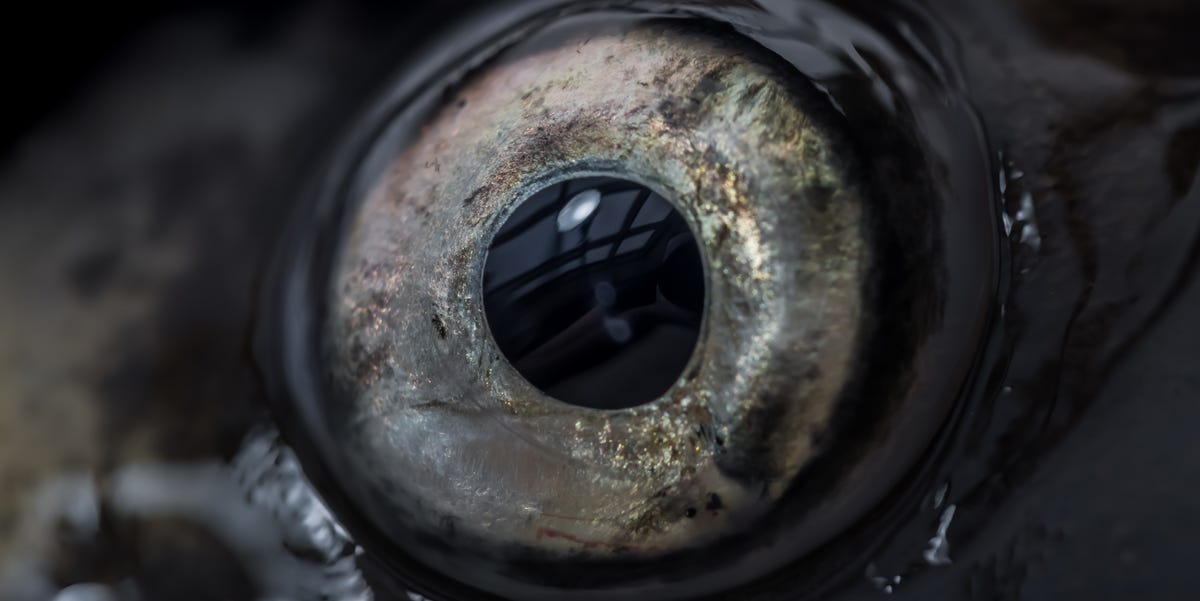
Some animals seem designed by nature. Others look as if nature spilled coffee on the blueprint, shrugged, and said, “Actually, this is better.” The newly described box jellyfish Tripedalia maipoensis belongs firmly in the second category. It is tiny, transparent, cube-shaped, equipped with 12 tentacles, andbecause one pair of eyes was apparently too mainstreambuilt with 24 eyes arranged around its body.
This strange little animal was identified from brackish shrimp ponds in Hong Kong’s Mai Po Nature Reserve, a wetland famous for birds, mangroves, and now a jellyfish that looks like a floating glass thimble with surveillance-camera ambitions. The discovery was published in Zoological Studies in 2023 by a Hong Kong Baptist University-led team, and it quickly captured public attention for one very understandable reason: 24 eyes is not a casual number of eyes.
But the story is more than “weird creature found in pond.” Tripedalia maipoensis gives scientists a fresh look at marine biodiversity, evolution, vision, and how animals without a central brain can still behave with surprising skill. It is also a reminder that some of Earth’s strangest life forms are not hiding on distant planets. They are drifting around in shallow coastal water, minding their own business, while wearing enough eyes to make a potato feel underprepared.
What Is This 24-Eyed Creature?
The creature is a new species of box jellyfish named Tripedalia maipoensis. Its name comes from Mai Po, the Hong Kong nature reserve where researchers collected specimens. It belongs to the family Tripedaliidae and the class Cubozoa, the group commonly known as box jellyfish.
Box jellyfish get their name from their squared-off, cube-like bell. Unlike the slow, drifting jellyfish most people imagine, many box jellyfish are active swimmers. They can pulse their bodies with purpose, steer through obstacles, and hunt prey rather than simply letting the ocean play taxi driver.
Tripedalia maipoensis is small. Its transparent, colorless bell is roughly 1.5 centimeters long on average, which makes it easy to miss unless you are specifically looking for tiny aquatic oddities. At each of its four corners are three tentacles, giving it 12 tentacles total. Those tentacles can reach several inches in length, which is impressive for an animal whose body is about the size of a fingernail.
Where Was Tripedalia maipoensis Found?
Researchers found the jellyfish in brackish shrimp ponds, locally known as gei wais, in the Mai Po Nature Reserve. “Brackish” means the water is a mix of fresh and salt water, the kind of in-between environment where estuaries, tidal channels, wetlands, and mangroves often create rich ecological neighborhoods.
Mai Po is connected to the Pearl River Estuary, which means the jellyfish may not be limited to the exact ponds where it was first collected. Scientists suspect it could also live in nearby coastal waters. That matters because new species are often discovered not because they suddenly appeared, but because humans finally noticed them. The ocean has been keeping receipts for a long time.
The discovery also marks the first record of the Tripedaliidae family in Chinese coastal waters. That makes the find important for taxonomy, biodiversity mapping, and conservation. In plain English: scientists have added a new pin to the map of life, and the pin has 24 eyes.
Why Does It Have 24 Eyes?
The 24 eyes of Tripedalia maipoensis are arranged in four groups of six. Each group sits inside a sensory structure called a rhopalium, located on one side of the jellyfish’s bell. So instead of having a face with eyes pointed in one direction, this jellyfish has visual clusters spaced around its body.
Two Kinds of Vision in One Tiny Animal
Not all 24 eyes do the same job. In each group of six, two eyes are believed to have lenses capable of forming images. The other four are simpler eyes that detect light and darkness. Think of it as a tiny security system: some cameras capture shapes, while other sensors say, “Something changed in the lightingmaybe pay attention.”
This setup gives box jellyfish a broad visual field. The phrase “can see in every direction at once” is a useful way to describe the effect, but it should not be mistaken for human-style panoramic vision. A box jellyfish is not watching a 360-degree IMAX movie of the underwater world. Instead, its eye clusters provide information from different directions around the body, helping it react to light, obstacles, prey, and habitat structure.
The Secret Weapon: Rhopalia
The rhopalia are more than eye holders. In box jellyfish, these sensory centers contain visual neurons and help coordinate behavior. Because box jellyfish do not have a centralized brain like mammals, birds, or fish, researchers are especially interested in how their nervous systems process information.
Related studies on the Caribbean box jellyfish Tripedalia cystophora show that box jellyfish can use visual cues to navigate mangrove habitats and avoid roots. They can even adjust behavior based on experience. That does not mean they are solving crossword puzzles, but it does mean they are far from passive blobs. For an animal without a central brain, that is a pretty strong résumé.
How Can a Jellyfish See Without a Brain?
This is one of the most fascinating parts of the story. Box jellyfish challenge the common assumption that complex behavior requires a large central brain. Instead, their nervous systems are decentralized. Information is processed through nerve networks and sensory structures distributed around the body.
In humans, vision is heavily processed by the brain. In box jellyfish, some processing appears to happen closer to the eyes themselves, especially in the rhopalia. This arrangement may allow the jellyfish to respond quickly to its environment without needing a single command center.
Imagine a house where every room has its own thermostat, light switch, and smoke detector. There may not be one master control room, but the house can still respond intelligently to changing conditions. Box jellyfish work a little like that. Their body is not “thinking” in the human sense, but it is collecting and using information in ways that help the animal survive.
What Makes This Species Different From Other Box Jellyfish?
Scientists do not declare a new species just because an animal looks unusual. They compare body features, genetics, and relationships to known species. In the case of Tripedalia maipoensis, researchers found several distinguishing traits.
Its Paddle-Like Structures Help It Swim
At the base of each tentacle is a flattened structure called a pedalium. The word sounds like it belongs on a bicycle, and honestly, that is not a terrible mental image. These pedal-like structures help box jellyfish generate thrust when they contract their bodies. As a result, many box jellyfish can swim more actively than typical jellyfish.
For Tripedalia maipoensis, those pedalia are part of what makes its body plan distinctive. The species has three pedalia at each bell corner, with one tentacle attached to each pedalium.
Its Velarial Canals Are Distinctive
Box jellyfish also have a structure called a velarium, a muscular membrane that narrows the opening of the bell. This helps them push water more efficiently as they pulse. In Tripedalia maipoensis, the canals in the velarium are forked into multiple branches, which helps distinguish it from related species.
DNA Confirms It Is Not Just a Look-Alike
The research team also used molecular analysis. By comparing genetic markers including 16S, 18S, and 28S rRNA genes, they showed that Tripedalia maipoensis is closely related to Tripedalia cystophora, but genetically distinct. The 16S rRNA gene showed enough divergence to support recognition as a separate species.
That is the scientific version of saying, “Yes, it looks like a cousin, but it brought its own passport.”
Is This 24-Eyed Box Jellyfish Dangerous?
Because Tripedalia maipoensis is a box jellyfish, it is related to some highly venomous species, including the infamous Australian box jellyfish, Chironex fleckeri. However, related does not mean identical. A house cat is related to a tiger, but your tabby is probably not planning to ambush a water buffalo.
Box jellyfish tentacles contain stinging cells called nematocysts. These microscopic structures can inject venom into prey or potential threats. In some box jellyfish species, the venom is dangerous to humans. But not all box jellyfish are equally hazardous, and there is not enough public evidence to claim that Tripedalia maipoensis poses the same risk as the most dangerous species.
The accurate takeaway is this: it is a venomous cnidarian because that is how jellyfish catch prey and defend themselves, but sensational claims that it is automatically deadly to people should be treated carefully. Respect marine life, do not handle unfamiliar jellyfish, and let scientists do the pokingwith gloves, tools, and a much better insurance plan.
Why the Discovery Matters
A tiny jellyfish with many eyes might sound like a fun science headline, but this discovery has larger importance. New species descriptions help researchers understand how life is distributed, how ecosystems function, and how evolution produces specialized body plans.
It Expands the Known Range of Its Family
The discovery is the first record of the Tripedaliidae family in Chinese coastal waters. That suggests the region’s jellyfish diversity may be richer than previously documented. It also hints that similar habitats along the Pearl River Estuary and South China coast may contain more overlooked species.
It Highlights the Value of Wetlands
Mai Po is not just a scenic wetland. It is a living laboratory. Brackish ponds, mangrove edges, tidal channels, and estuarine habitats create conditions where unusual organisms can thrive. Protecting wetlands is not only about preserving birds or plants; it also preserves the hidden communities of tiny animals that keep ecosystems running.
It Shows How Much We Still Do Not Know
Humans have mapped planets, split atoms, and invented apps that can deliver noodles to your door, yet we are still finding new animals in shallow ponds. That should make us humble. The natural world is not finished surprising us. It is barely clearing its throat.
The Evolutionary Genius of 24 Eyes
At first, 24 eyes sounds excessive. But in the life of a small box jellyfish, vision can be the difference between eating, escaping, colliding, or drifting into the wrong neighborhood. In shallow, obstacle-filled habitats, all-around awareness is useful.
Related box jellyfish use their vision to navigate mangrove roots and stay in favorable light conditions where prey gather. For a tiny animal with delicate tissues, bumping into roots or missing food patches can be costly. Multiple eyes arranged around the body help solve that problem.
The fascinating part is that this visual system evolved in an animal without a centralized brain. That tells scientists something important: evolution does not follow one “best” design. It builds workable solutions. Sometimes that solution is a brain with billions of neurons. Sometimes it is four sensory centers, 24 eyes, and a transparent cube body drifting through brackish water like a tiny haunted chandelier.
How Scientists Identify a New Species
Discovering a new species is not as simple as pointing at an animal and yelling, “New guy!” Scientists must prove that the organism differs from known species in consistent ways. For Tripedalia maipoensis, the evidence included body shape, tentacle arrangement, velarial canal structure, and DNA comparisons.
Researchers collected specimens over multiple summers, studied their morphology under laboratory conditions, compared them with related jellyfish, and placed them within a phylogenetic framework. This combination of old-school anatomy and modern genetics is now standard in species discovery.
The result is a more reliable classification. It also creates a foundation for future research. Now that Tripedalia maipoensis has a formal scientific name, other researchers can study its behavior, venom, ecology, reproduction, and distribution with shared terminology.
What It Might Teach Us About Intelligence
The 24-eyed jellyfish also raises a bigger question: what counts as intelligence? Box jellyfish do not have brains like ours, but they can process sensory information, navigate complex habitats, avoid obstacles, and respond to environmental cues.
Recent research on related box jellyfish suggests that these animals can learn from experience. That does not mean they are writing memoirs or judging your playlist. It means their nervous systems can modify behavior based on repeated interactions with the world.
This matters because it pushes scientists to rethink the roots of learning. If an animal with a decentralized nervous system can adjust behavior, then the building blocks of cognition may be older and more widespread than once assumed.
Experience Section: What This 24-Eyed Creature Teaches Us About Looking Closer
There is a useful lesson hiding inside the story of Tripedalia maipoensis: sometimes the most remarkable discoveries are small enough to float past unnoticed. A creature about the size of a fingernail, nearly transparent in muddy water, turned out to be a new species with one of the most unusual visual systems in the animal kingdom. That should change how we experience ordinary places.
Think about a wetland pond. To a casual visitor, it may look like still water, reeds, mud, birds, and maybe a mosquito with personal-space issues. To a biologist, that same pond is layered with chemistry, tides, larvae, plankton, predators, microscopic life, and animals still waiting for names. The discovery of a 24-eyed jellyfish reminds us that “ordinary” often means “not examined closely yet.”
For students, nature lovers, and curious readers, the experience is almost philosophical. We tend to associate discovery with dramatic places: deep-sea trenches, tropical rainforests, polar ice, or volcanoes that look like movie villains. But this jellyfish was found in managed shrimp ponds inside a protected wetland. It was not guarded by a dragon. It was not glowing on a lost island. It was simply there, living its life, while humans slowly caught up.
There is also something refreshing about the way this animal complicates our assumptions. Many people think of jellyfish as simple drifting blobs. Then box jellyfish appear with active swimming, complex eyes, visual navigation, and evidence from related species that learning can happen without a central brain. Nature loves ruining our categories. It does not care whether our mental filing cabinets are tidy.
Personally, the most memorable part of this topic is the contrast between the jellyfish’s size and its sophistication. A tiny transparent animal with no central brain can still track light, sense obstacles, swim with control, and use body structures that look engineered for efficiency. It is hard not to admire that. Humans need calendars, maps, reminders, chargers, and occasionally three cups of coffee to function. This little jellyfish manages its world with 24 eyes and a body like a living water balloon.
The discovery also encourages a better kind of curiosity. Instead of asking only, “Is it dangerous?” we can ask, “How does it live?” “What does it see?” “Why did this body plan evolve?” “What does its habitat tell us?” Those questions lead to deeper understanding. They turn a strange headline into a doorway.
Finally, Tripedalia maipoensis is a powerful reminder that conservation protects the unknown as much as the known. When wetlands are preserved, scientists are not just saving familiar species. They are protecting future discoveries, hidden relationships, and biological surprises that may reshape what we know about life. Somewhere in another pond, another creature may be waiting with an even stranger trick. Hopefully not 48 eyes. That feels like showing off.
Conclusion
Tripedalia maipoensis, the newly described 24-eyed box jellyfish from Hong Kong’s Mai Po Nature Reserve, is more than a viral curiosity. It is a scientifically important species that expands the known range of its family, reveals hidden biodiversity in brackish wetlands, and highlights the astonishing visual systems of box jellyfish.
Its 24 eyes, arranged in four sensory clusters, help it monitor the world around its cube-shaped body. Its paddle-like structures support active swimming. Its genetic and anatomical differences confirm that it is a distinct species. And its existence reminds us that Earth’s oceans and wetlands remain full of life forms that can make even the most imaginative science fiction look underdressed.
The next time someone says there is nothing new under the sun, tell them about the transparent jellyfish with 24 eyes that may be watching in every direction at once. Politely, of course. It has a lot of eyes, and we should make a good impression.