

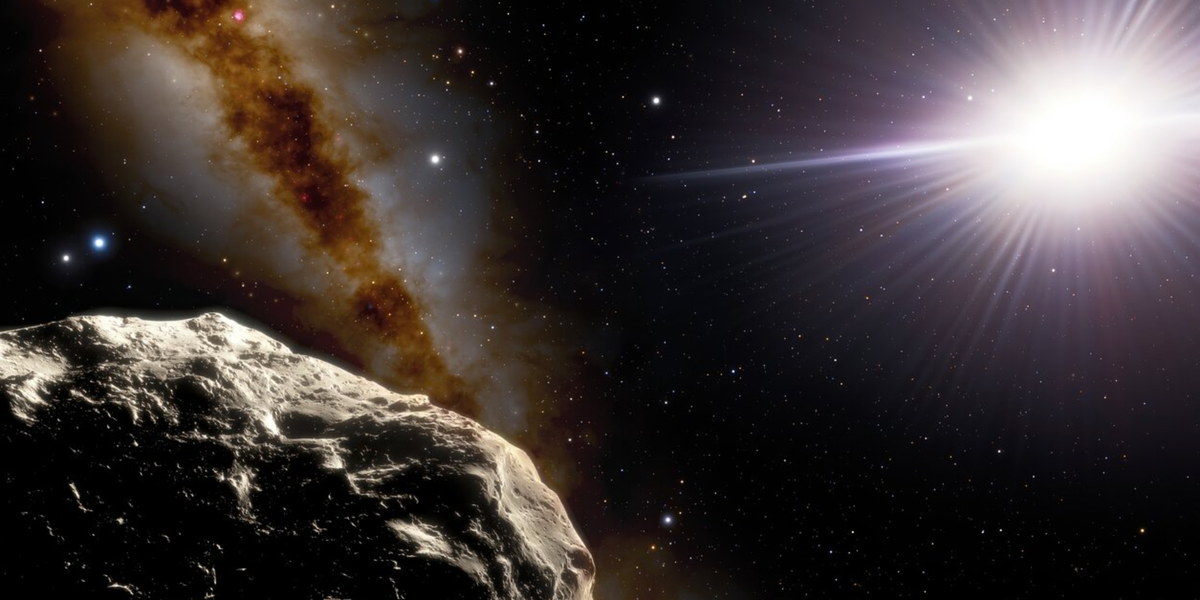
Space is full of objects that behave badly. Some tumble, some zip past Earth like cosmic speeders, and some spend billions of years minding their own business until astronomers suddenly notice them and say, “Wait a second, that one is basically traveling with us.” That is the story behind 2020 XL5, the asteroid at the heart of this headline-friendly mystery.
The object was discovered in late 2020 and confirmed in 2022 as only the second known Earth Trojan asteroida rare kind of space rock that shares Earth’s path around the Sun. It is not a second moon. It is not parked in Earth orbit like a forgotten satellite. And no, it is not quietly preparing an alien Airbnb listing. Instead, it travels in a gravitationally protected neighborhood near one of the Sun-Earth system’s stable regions, moving in step with our planet around the Sun.
That alone would make 2020 XL5 fascinating. But the bigger reason scientists care is what it represents. Earth co-orbital asteroids may preserve clues about how the inner solar system formed, why small bodies end up where they do, and how future missions might use near-Earth objects as training grounds, science targets, and perhaps one day even stepping-stones for deeper space travel. In other words, this is not just a weird rock. It may be a rehearsal stage for humanity’s next era in space.
What Exactly Was Discovered?
The asteroid known as 2020 XL5 is an Earth Trojan, meaning it shares Earth’s orbit around the Sun in a 1:1 resonance. It does not follow directly behind or ahead of Earth like a child tailing a parent through a grocery store. Instead, it oscillates around a stable region called the L4 Lagrange point, which lies about 60 degrees ahead of Earth in its orbit.
If that sounds suspiciously mathematical, here is the plain-English version: gravity and motion have struck a truce. The Sun pulls, Earth pulls, the asteroid moves, and the result is a special zone where an object can remain in a repeating pattern for a long time. Not forever, in this case, but long enough to make astronomers sit up straight.
Researchers found that 2020 XL5 is likely around 0.75 mile wide, or roughly 1.2 kilometers across, making it the largest known Earth Trojan identified so far. It also appears to belong to the C-complex, a broad class of dark, carbon-rich asteroids. That matters because carbonaceous asteroids are often treated as scientific treasure chests: they can preserve ancient material from the early solar system, including compounds connected to water chemistry and the raw ingredients that existed before life emerged on Earth.
In short, 2020 XL5 is unusual in three ways at once. It is rare, it is relatively large for an Earth Trojan, and it may be made of primitive material that scientists love because it has not been thoroughly “cooked” by planetary geology. Earth changes its rocks constantly. Asteroids are much less dramatic. Geology on them is often more like a filing cabinet than a bonfire.
How Can an Asteroid Share Earth’s Orbit Without Hitting Earth?
This is the question everyone asks, usually with a facial expression that says, “That sounds fake, but continue.” Fortunately, orbital mechanics is weird enough to be true.
Trojan asteroids occupy regions around Lagrange points, places where the gravitational forces of a planet and the Sun balance with the object’s orbital motion. These points are not magic parking spots, but they are dynamically favorable regions where objects can remain trapped or semi-trapped in repeating patterns.
Earth’s Trojan regions are much harder to study than Jupiter’s. Jupiter has thousands of known Trojans, which is one reason NASA built the Lucy mission to explore them. Earth’s Trojans are much rarer to detect because they tend to appear in parts of the sky close to the Sun from our point of view. That means astronomers often have to search during twilight, low on the horizon, with limited observing windows and lots of atmospheric interference. In astronomy terms, that is roughly equivalent to trying to spot a charcoal pebble in a smoky sunset while standing in a wind tunnel.
That challenge helps explain why Earth’s first confirmed Trojan, 2010 TK7, was discovered only in the last decade, and why 2020 XL5 drew so much excitement. Its confirmation strongly suggests that Earth may have more co-orbital companions still waiting to be found. Not a swarm worthy of a disaster movie, but enough to matter scientifically.
There is another twist: 2020 XL5 is probably not a permanent resident. Studies suggest it is a transient Trojan, meaning it is temporarily locked into this orbital arrangement. Simulations indicate it should remain in the L4 region for at least about 4,000 years, after which gravitational nudgesespecially from the inner planetswill likely boot it into a different path. That is a long time by human standards, but in solar system terms it is more like borrowing a seat, not owning the theater.
Why Scientists Care So Much About Earth Trojans
The excitement around 2020 XL5 is not just about orbital novelty. Scientists care because these objects may help answer some deceptively big questions.
1. They may preserve ancient solar system material
Trojan asteroids are scientifically attractive because they can act like time capsules. NASA describes Trojan populations as relics from the solar system’s earliest days, and the logic extends beyond Jupiter’s swarms. If an Earth Trojan contains primitive material, it could preserve clues about the conditions that existed when the planets were still forming.
That matters more than ever now that missions like OSIRIS-REx have shown just how valuable asteroid samples can be. NASA’s returned Bennu material revealed carbon-bearing chemistry, water-related minerals, and compounds associated with the ingredients of life. No one knows whether 2020 XL5 would tell the same story, but the broader lesson is clear: asteroids are not rubble with bad publicists. They are archives.
2. They may reveal how planets and small bodies evolved together
Earth Trojans can also help researchers understand the dynamical evolution of the inner solar system. How did certain bodies become trapped in co-orbital configurations? How long do those configurations last? Are the currently known Earth Trojans leftovers from ancient times, or were they captured more recently? Every confirmed object helps refine the models.
And because Earth’s Trojan population is still barely mapped, each discovery carries extra weight. It is like finding a second page of a document you thought had only one paragraph. Suddenly, you realize the file is bigger than expected.
3. They may improve planetary defense knowledge
There is a practical angle, too. Earth Trojans travel on Earth-like paths, which makes them valuable for understanding the population of nearby small bodies we may not yet see very well. Studying them helps astronomers refine search strategies, orbit models, and long-term risk assessments. That does not mean 2020 XL5 is a threat. It is not. But learning what kinds of objects lurk in difficult-to-observe regions of near-Earth space is never a bad idea.
Could an Asteroid Like This Really Be Key to Space Travel?
This is where the headline earns both its sparkle and its footnote.
The short answer is possibly, yesbut not in the simplistic movie-trailer sense. An Earth Trojan does not automatically become a refueling station with vending machines and a panoramic cupola. Still, the broader category of near-Earth asteroids with Earth-like orbits is genuinely important for future exploration.
Mission planners already think this way
NASA has long tracked near-Earth asteroids that may be suitable for future human missions. The agency’s Near-Earth Object Human Space Flight Accessible Targets Study, or NHATS, was created specifically to identify objects that might be reachable for round-trip exploration missions. That tells you something important: asteroid accessibility is not science fiction. It is an active engineering conversation.
Why are such objects interesting? Because a body with an Earth-like orbit may require less energy to reach than a more distant or more steeply tilted target. In mission design, this matters enormously. Every bit of saved velocity changedelta-v, in mission-speakcan reduce fuel demands, mass constraints, and mission complexity. Space travel is not just about distance. It is about how hard the trajectory fights you.
Asteroids could become proving grounds
Before humans head routinely to Mars or more distant destinations, space agencies and private companies will need places to test deep-space operations: navigation, autonomous rendezvous, surface interaction in microgravity, sample extraction, communication delays, long-duration spacecraft systems, and maybe even in-space resource processing. Near-Earth asteroids are excellent candidates for that kind of rehearsal.
An Earth co-orbital object adds another layer of appeal because it occupies a neighborhood dynamically related to our own planet. That makes it scientifically interesting and operationally tempting. Even if a particular asteroid is not the ideal first human destination, studying the class teaches engineers and mission planners what is realistic.
Resources are part of the conversation
Then there is the resource question. Some asteroids may contain water-bearing minerals, carbon-rich compounds, or metals useful for future space industry. Water is especially valuable in space because it supports life and can be split into hydrogen and oxygen for rocket propellant. A carbon-rich asteroid in an Earth-like orbital environment naturally gets people thinking ahead.
That said, responsible analysis requires a pause here. We do not yet know that 2020 XL5 is a practical mining target, or that it would make economic sense anytime soon. The point is not that this one asteroid will become a cosmic gas station next Tuesday. The point is that discoveries like this sharpen the case for learning how to use nearby small bodies as part of a long-term exploration architecture.
The Reality Check: Great Science, Careful Hype
Space reporting loves a dramatic phrase, and “key to space travel” is the kind of phrase that wears aviator sunglasses indoors. But there is a more grounded version of the story that is just as interesting.
2020 XL5 is valuable first as a scientific target. It may help researchers understand co-orbital dynamics, early solar system material, and the hidden population of Earth-sharing asteroids. It is valuable second as a strategic example. It reminds mission planners that nearby small bodies exist in more varieties than the public usually hears about. And it is valuable third as a symbol of where exploration is going. The future of space travel will probably not be a straight highway from Earth to Mars. It will be a networkof cislunar space, deep-space habitats, asteroid encounters, robotic prospecting, sample returns, and gradually more ambitious human missions.
In that future, Earth Trojans matter. Maybe not because they become luxury rest stops with docking lounges and freeze-dried espresso bars, but because they could help bridge the gap between low Earth orbit and truly sustained deep-space exploration.
The Future of Earth’s Co-Orbital Companions
One of the most exciting implications of 2020 XL5 is that it is probably not alone. Astronomers suspect more Earth Trojans may be hiding in the glare near the Sun, overlooked not because they are unimportant but because they are annoying to observe. This is one of the rare cases where the universe has not hidden the answer in some distant galaxy. It just tucked it into lousy lighting.
As sky surveys improve and algorithms get better, more co-orbital discoveries are likely. Each new object will help scientists compare sizes, compositions, orbital stabilities, and origins. Over time, that could transform Earth Trojans from a curiosity into a meaningful subfield of near-Earth object science.
And as that science grows, so will the exploration case. Robotic scouts may map these bodies in more detail. Sample-return missions could test the scientific value directly. Human mission planners may use the growing catalog to identify realistic targets for future operations beyond the Moon. The asteroid itself may not hand us the future of space travel. But it may hand us a blueprint for how to find it.
What a Mission to an Earth-Trojan Asteroid Might Actually Feel Like
Imagine the first time a future crew sees an Earth Trojan out the windownot as a bright point on a plotting screen, but as a real object, slowly swelling from a dot into a worldlet with its own ridges, shadows, and battered personality. It would not feel like arriving at a planet. It would feel stranger than that. Planets announce themselves. Asteroids sneak up on you, as if the universe forgot to label them.
Long before arrival, the experience would already be different from anything in low Earth orbit. There would be no quick rescue, no dramatic blue arc filling the window every ninety minutes, no constant reminder that home is just below. Earth would still be there, of course, but psychologically it would feel farther away. A mission to an Earth-Trojan asteroid would be close enough to remain connected to home in a meaningful way and far enough to make every procedure matter more. That makes it the kind of destination engineers love and astronauts respect.
Approaching the asteroid would be an exercise in patience. In microgravity, nothing behaves with the cinematic urgency people expect. You do not swoop in like a fighter pilot and slam on the brakes at the last second. You creep. You measure. You correct. Then you measure again because one wrong assumption can turn a tidy rendezvous into an expensive lesson. Every pebble, every spin rate, every odd puff of dust becomes a detail worth studying.
Once nearby, the asteroid would probably look less like a polished sci-fi object and more like a cosmic construction site after everyone went home a few billion years ago. Dark terrain. Sharp edges. Maybe boulders, maybe loose regolith, maybe the kind of surface that seems solid until you disturb it and discover it has the structural confidence of a stale cookie. Working there would require a mix of delicacy and stubbornness. Push too hard, and you might bounce off. Move too fast, and you could drift into trouble. The entire mission would be a lesson in doing important work without the comfort of weight.
Scientifically, though, the place could feel electric. Every drilled core, every scooped sample, every spectrometer reading could carry information older than Earth’s oceans as we know them. Crew members might hold material that has spent eons preserving chemical clues from the early solar system. That kind of moment changes people. It turns abstract science into physical reality. You are no longer reading about planetary origins. You are touching a fragment of them.
There is also the emotional side. A mission like this would probably be remembered as a threshold eventthe kind of expedition later generations point to and say, “That was when we stopped treating deep space like a stunt and started treating it like a destination.” Visiting an Earth Trojan would not be as famous as the Moon landing on day one, but it could become just as important in hindsight. It would prove that human and robotic teams can operate around small bodies, extract meaningful science, and build routines that later missions to Mars, the asteroid belt, or resource-rich targets might depend on.
And maybe that is the real experience tied to 2020 XL5 and objects like it. Not the thrill of finding one oddball asteroid, but the growing realization that nearby space is not empty. It has terrain, opportunities, and waypoints. The map around Earth is getting more detailed, and every new object redraws the boundary between “too far to matter” and “close enough to plan for.”
That is why an asteroid sharing Earth’s orbit feels like more than a neat astronomy headline. It feels like a preview. A small, dark, ancient previewbut a preview all the same.
Conclusion
2020 XL5 is not just another asteroid on a giant celestial spreadsheet. It is a rare Earth Trojan, a probable scientific time capsule, and a reminder that some of the most important discoveries in space are not flashy explosions or giant planets. Sometimes the breakthrough is a quiet realization that our own orbital neighborhood is more populated, more useful, and more interesting than we thought.
If future space travel is built in stagesand it almost certainly will bethen objects like this matter. They give astronomers better models, engineers better targets, and mission planners better reasons to think beyond the Moon in practical steps rather than giant leaps alone. That may not be as dramatic as a warp drive, but it is how real exploration works. First you find the strange rock. Then you figure out why it matters. Then, if history is feeling generous, you build a mission around it.