

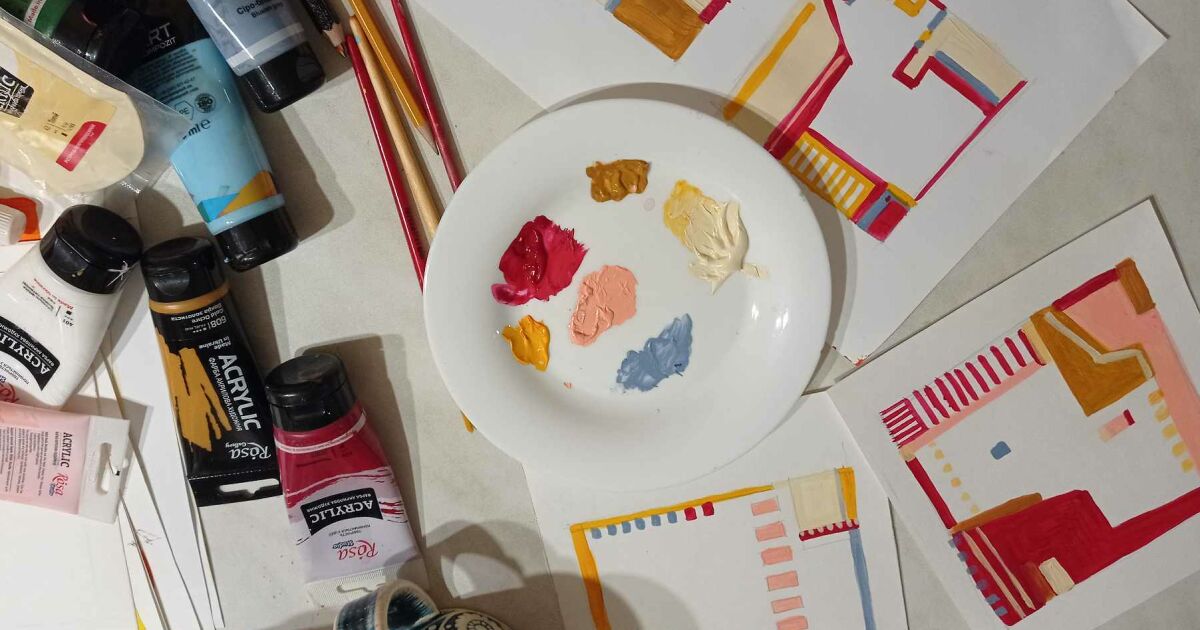
If you’ve ever tried to “relax” while your phone is blowing up with alerts, you already understand the plot twist of modern life: calm isn’t a settingyou have to build it. For a Ukrainian artist living in Dnipro, that building material is paint, paper, and the kind of quick sketch that doesn’t ask permission before it shows up on the page.
The artist works under the pseudonym Ulyana Koloda, and she’s described making abstract paintings and fast drawings as a way to distract herself during rocket attacksless terrifying now than early 2022, but still a psychological grind that makes daily life feel surreal, like watching your own reality in a special-effects theater.
This piece is a story about how abstraction and speedtwo things art teachers love and perfectionists fearcan become survival tools. It’s also a gentle invitation to look at 14 “pics” with your eyes and your nervous system, because sometimes the real subject of a painting isn’t what’s depicted. It’s what you’re able to keep feeling.
Meet the Artist, Meet the City: Dnipro Isn’t a “Backdrop”It’s a Pressure System
Dnipro is often described as one of Ukraine’s major industrial citiesbig infrastructure, heavy industry, long roads, and the kind of scale that makes you walk faster even when you’re not late. That industrial muscle matters because war doesn’t just target people; it targets power grids, logistics, factories, and the ordinary systems that let a city breathe.
In recent years, the city has repeatedly been hit by drones and missiles, and the headlines tend to do what headlines do: flatten the story into numbers. But inside those numbers are routinessleep interrupted, plans canceled, a mind that can’t decide whether to brace or pretend it didn’t hear the siren. Koloda’s point is brutally simple: even if you “get used to it,” your psyche may not. So she draws.
What makes her approach interesting isn’t only the setting. It’s the strategy: she doesn’t paint the war. She paints away from it. While many artists document trauma directly, she describes fighting for the right to live in a world where the terrible thing isn’t the only thing. Her rule is basically: “Life is precious; creativity is precious; don’t spend a single second feeding the horror.” That’s not denial. That’s triage.
Why Abstract Art Makes Sense When Reality Stops Making Sense
Abstraction has a reputation problem. People think it’s either (1) a prank, (2) a money-laundering scheme, or (3) something you say you love to impress a date who owns too many black turtlenecks. But historically, abstraction has often been a serious response to serious pressure: a way to make meaning when the visible world is too loud, too political, too unstable, or too painful to describe literally.
Directness over “perfect depiction”
Museums and art historians often explain Abstract Expressionism as a movement that valued immediacygesture, energy, and the feeling of a painting as an event, not a neat illustration. The “value” of the work could be in its directness, in how openly it reveals an identity or inner state. That’s useful context here, because Koloda’s abstract “spots,” fields, and marks aren’t trying to be a postcard. They’re trying to be a pulse.
Two powerful modes: big feelings and quiet fields
Abstract Expressionism is often described in two major tendencies: gestural action (movement, sweeping brushwork, visible effort) and color-field approaches (large expanses of color, unified fields, fewer surface details). Koloda’s approachabstract paintings plus fast sketchescan be read as a modern hybrid of those impulses: movement when the mind is agitated, and calmer fields when the mind needs a place to rest.
Abstraction as a “container” for the unsayable
In a war zone, language can fail in two opposite ways: you can’t find words, or you can’t stop finding them. Abstraction offers a third option: you don’t have to translate everything into sentences. You can let color carry mood. You can let a line carry urgency. You can let negative space be the part of the day that didn’t break you.
Quick Sketches: Small Paper, Big Relief
Koloda describes grabbing paper and making quick drawingscapturing ideas fast, not wasting time, letting the page take the hit for her brain. That speed is not a gimmick. It’s the point.
The power of “less than a minute”
Art educators often teach gesture drawing as a rapid method to capture overall form and energykeeping the pencil moving, working quickly, and letting the sketch be a record of attention rather than a polished product. The time limit is the feature, not the bug: it blocks overthinking and keeps the body involved.
What art therapy research suggests (in human terms)
Formal art therapy and informal art-making aren’t the same thing, but they overlap on one critical idea: making images can help people process feelings that are hard to access through words alone. Professional organizations describe art therapy as particularly useful during crisis, trauma, grief, and major life disruption, partly because the creative process can restore a sense of agency (“I can make something”) when life feels out of control.
Research on creative arts therapies for PTSD is still evolving and varies by method and population, but studies and reviews have reported reductions in PTSD symptoms following creative arts therapy interventions, while also emphasizing limitations and the need for more rigorous evidence. In other words: it’s not magic, but it can be meaningfulespecially as part of broader support.
Why drawing can feel like “turning down the volume”
A quick sketch demands three things: a boundary (this page), a rhythm (this hand), and a focus (this mark). Even if the outside world is chaotic, the act of drawing creates a small system that obeys you. That’s not escapism. That’s regulation.
Making Art When Supplies Become “Main Value”
Koloda writes with striking practicality: sleep, food, water, and supplies of paint, canvas, and paper become the main value. That line lands because it’s both ordinary and radicalordinary because those are basic needs, radical because it frames art materials as survival-adjacent. Not luxury. Not hobby. “Main value.”
And that’s not unique. Other wartime stories describe artists improvising with what’s available. A Ukrainian soldier and artist profiled in international reporting described painting with mud, clay, and ashmaterials literally under his boots making art “to keep my sanity,” and insisting that beauty is part of what people fight for. Different artist, different medium, same emotional logic: creation as mental steadiness.
What changes when time is scarce
- The work gets lighter. Paper and pencil travel. Canvas and oils are a commitment.
- The work gets faster. You can’t wait for the “right mood” if the mood is sirens.
- The work gets more honest. Perfectionism tends to lose arguments when life is unstable.
In peacetime, you might ask, “Is it good?” In wartime, the question can become, “Did it help me keep going today?” That shift is a quiet revolution.
Gallery: 14 Pics (Placeholders You Can Swap with the Artist’s Originals)
Because this article is intended for web publication without reposting copyrighted images, the gallery below uses placeholders. Replace IMAGE-01.jpg and friends with properly licensed files (for example, images provided directly by the artist). Captions are written to match the themes described in the artist’s statement: abstraction, speed, and choosing life in the middle of threat.


How to Look at Abstract Art Without Faking a PhD
You don’t need to “get it.” You need to notice. Here are a few viewer-friendly ways to read abstract workespecially work made under stress.
1) Start with your body before your brain
Does the piece make you hold your breath? Relax your shoulders? Squint? Lean in? Those reactions are data. Abstract painting often communicates through scale, contrast, and rhythm more than recognizable objects.
2) Track the motion
Follow the direction of the marks. Do they slash, float, spiral, cluster, fade? Gestural traditions in abstraction often treat the canvas like a record of movementan “event” you can replay with your eyes.
3) Ask a better question than “What is it?”
- What feels loud here?
- What feels protected?
- If this painting were a sound, would it be a drum, a hum, or a siren?
In Koloda’s case, the goal isn’t to narrate violence. It’s to create a pocket of life that isn’t owned by violence. That’s a meaningful “subject,” even if the painting never depicts a single literal thing.
Motivation, Reframed: Art as Daily Resistance (Without Turning into a Slogan)
In coverage of Ukraine’s cultural sphere since 2022, one pattern keeps showing up: artists create to preserve identity, to protest, to document, to fundraise, to remember, to grieve, and sometimesquietlyto keep themselves functional. Exhibitions in the U.S. have highlighted Ukrainian artists and the shifting meaning of their work in wartime. Documentaries have followed artists turning fragile materials like porcelain into acts of defiance. And individual projectslike daily sketch practices responding to war newshave shown how a small habit can become a long moral thread.
Koloda’s version of this isn’t the “headline” version. It’s the private, human-scale version: paper, paint, quick sketches, and a personal refusal to let the worst thing be the only thing. That’s motivation in the most literal sense: the thing that moves you, one day to the next.
If you’re looking for a tidy lesson, sorrywar doesn’t do tidy. But the story does offer a usable idea: when reality becomes surreal, you can still practice making something real.
Conclusion: The Point Isn’t “Pretty”It’s “Possible”
Abstract art and quick sketches can look like opposites: one is expansive and atmospheric, the other is small and urgent. In Koloda’s hands, they’re two halves of the same survival mechanism. Abstraction gives feelings a home without forcing them into words. Sketching gives the mind a fast exit ramp from panic and rumination. Together, they form a practice of choosing lifedaily, stubbornly, imperfectly.
And if you take nothing else from these 14 pics, take this: creativity doesn’t need perfect conditions. Sometimes it just needs a pencil, a page, and permission to make something that says, “I’m still here.”
Extra: of Lived-Style Experiences Around Abstract Art & Quick Sketching in Wartime
Think of this as a set of “field notes” gathered from the way artists, educators, and therapists describe the experience of drawing under stress. Not a single heroic montagemore like a series of small moments that add up.
Experience #1: The first mark feels like breaking a spell.
When your day is shaped by uncertainty, your brain loves looping: replaying what happened, rehearsing what might happen, scanning for threats. The page interrupts that loop. The first markespecially a fast, messy onedoes something oddly physical. It tells your body, “We’re doing a task now.” Not tomorrow. Not after you’ve calmed down. Now.
Experience #2: Speed is compassion.
Quick sketches are forgiving by design. If you give yourself sixty seconds, you can’t bully the drawing into perfection. You can only pay attention. That time limit turns into a kind of mercy: you stop negotiating with your inner critic and start cooperating with your hand. Art educators often teach this on purposegesture drawing that keeps the pencil moving, scribbling that captures shape fast, pressure changes that build light and shadow without fuss. It’s training in “good enough,” which in crisis is not lazinessit’s survival.
Experience #3: Abstraction becomes a safe language.
For some people, depicting the traumatic event directly can feel like touching a hot stove with your eyes. Abstract shapes and colors offer distance without avoidance. A smear can represent dread without re-enacting it. A field of color can become a place to rest. A cluster of marks can hold agitation without requiring a literal scene. In trauma-focused settings, clinicians have described art-making as a way to access emotion and create healthy distancingclose enough to process, far enough to tolerate.
Experience #4: The materials start to matter more than you expect.
In stable life, supplies are a shopping list. In unstable life, supplies become continuity. A favorite pen means you can still make a line you recognize. Paper means you can still make a decision that leaves a trace. Artists in wartime accounts talk about improvisationusing what’s available, even dirt or ash and about keeping “beauty” in view as a reason to endure. It’s not about romance. It’s about morale.
Experience #5: The drawing doesn’t fix the world. It fixes the next minute.
That might sound smalluntil you’ve lived a day that needs fixing minute by minute. A sketch can’t stop a missile. But it can stop you from turning into a numb witness of your own life. It can reconnect you to choice: where the line goes, what color you pick, when you stop. And in a context where so much is out of your hands, “choice” is not a philosophical concept. It’s oxygen.