

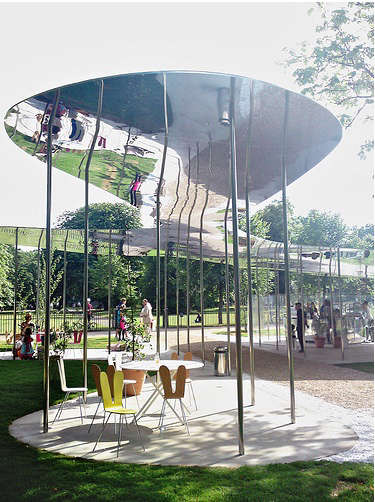
Some buildings announce themselves with a trumpet. SANAA’s 2009 Serpentine Pavilion preferred a whisper, a shimmer, and the architectural equivalent of a wink. Set in London’s Kensington Gardens, the pavilion by Kazuyo Sejima and Ryue Nishizawa looked less like a temporary building and more like a silver cloud that had politely decided to hover at human height. It had no conventional walls, no heavy façade, no grand staircase demanding that visitors behave dramatically. Instead, it offered a thin, reflective aluminum canopy, supported by slender columns, drifting between the trees like a quiet thought made visible.
For architects, design students, and curious visitors, the Serpentine Pavilion by SANAA remains one of the most memorable examples of temporary architecture in the 21st century. It was delicate without being weak, minimal without being boring, and experimental without turning into an architectural science fair project. The pavilion did what great architecture often does: it changed how people noticed the place they were already standing in.
This architect visit explores what made the SANAA Serpentine Pavilion so special, how it worked as a spatial experience, and why its lessons still matter for contemporary architecture, landscape design, public space, and anyone who has ever looked at a roof and thought, “Could this be lighter, shinier, and maybe a little more magical?”
What Was the Serpentine Pavilion by SANAA?
The 2009 Serpentine Pavilion was a temporary summer structure designed by SANAA, the acclaimed Japanese architecture practice founded by Kazuyo Sejima and Ryue Nishizawa. It was commissioned by the Serpentine Gallery as part of its annual pavilion program, a series that began in 2000 with Zaha Hadid and has since become one of the most watched experimental architecture commissions in the world.
SANAA’s pavilion was located on the Serpentine Gallery lawn in Kensington Gardens, London. Unlike a typical building, it did not try to dominate the site. It stretched, curved, reflected, and dissolved into the surrounding park. Its roof was an undulating sheet of polished aluminum, held above the ground by a forest of thin columns. From one angle, it resembled a floating pool of water. From another, a metallic leaf. From another, a UFO that had taken a course in Japanese minimalism and decided to become emotionally available.
The pavilion was open during the summer of 2009 and functioned as a public gathering space, café, event venue, and shaded extension of the park. It invited visitors to read, rest, talk, wander, and look. That last activitylookingwas perhaps the most important. SANAA created a building that made people look at trees, sky, clouds, people, and movement with renewed attention.
Meet SANAA: The Architects Behind the Pavilion
SANAA, short for Sejima and Nishizawa and Associates, was founded in Tokyo in 1995. Kazuyo Sejima and Ryue Nishizawa are known for architecture that often feels light, transparent, fluid, and almost impossibly calm. Their work avoids visual shouting. Instead, it asks visitors to slow down and notice relationships: between inside and outside, public and private, structure and landscape, person and place.
Their best-known projects include the 21st Century Museum of Contemporary Art in Kanazawa, the New Museum in New York, the Rolex Learning Center in Lausanne, and the Louvre-Lens in France. Across these projects, SANAA often uses simple geometries, pale surfaces, thin structural elements, and open plans to create buildings that feel generous rather than controlling.
In 2010, Sejima and Nishizawa received the Pritzker Architecture Prize, often described as architecture’s highest honor. The recognition confirmed what the 2009 Serpentine Pavilion had already made clear: SANAA had mastered the art of making architecture feel effortless while hiding enormous discipline behind the scenes. Like a perfect soufflé, the result looked light, but nobody should mistake that lightness for accident.
The Design Concept: A Roof That Behaves Like Weather
The central idea of the Serpentine Pavilion by SANAA was a floating aluminum canopy that moved visually through the landscape. The roof was thin, reflective, and irregular in outline. It did not sit above visitors like a rigid lid. Instead, it wandered. Its edges curved in soft, organic lines, creating pockets of shade and open-air rooms without enclosing them.
The reflective surface was crucial. It captured images of trees, grass, sky, and people, then blurred them into a constantly changing collage. On a sunny day, the pavilion could gleam like a polished tray. On a cloudy day, it could turn quiet and gray, almost disappearing into the atmosphere. After rain, its relationship with light and reflection became even more dramatic. The pavilion did not have one fixed appearance. It performed with the weather.
This is where SANAA’s intelligence becomes especially clear. Many buildings use materials to show power, permanence, or luxury. SANAA used aluminum to create ambiguity. Was the pavilion solid or liquid? Natural or artificial? Building or landscape? Sculpture or shelter? The answer was yes, and also no, and that was the fun of it.
A Pavilion Without Walls
One of the most important features of the SANAA Serpentine Pavilion was its lack of walls. Instead of defining space through enclosure, the architects defined it through a roof plane, columns, furniture, shadows, reflections, and movement. Visitors could enter from any side. There was no ceremonial front door, no bossy entrance sequence, and no architectural bouncer asking whether you understood the concept before stepping inside.
This openness made the pavilion feel democratic. People could approach casually, drift through, pause, or leave without feeling that they had crossed a hard boundary. The design encouraged informal use, which is one of the hardest things to achieve in public architecture. Too much design can make people nervous. Too little design can feel neglected. SANAA found a middle ground: precise architecture that felt relaxed.
The no-wall strategy also preserved uninterrupted views across the park. Standing beneath the canopy, visitors remained visually connected to Kensington Gardens. The pavilion did not compete with nature; it edited nature. It framed, reflected, shaded, and intensified what was already there.
Structure: Thin Columns, Big Effect
The pavilion’s roof appeared to float, but of course architecture has to obey gravity, even when it would rather not. The aluminum canopy was supported by many thin columns placed throughout the structure. These columns were delicate enough to recede visually, yet strong enough to do the hard work. Their slenderness reinforced the illusion that the roof was hovering.
From a distance, the columns looked almost like tree trunks translated into metal punctuation marks. They did not form a heavy grid that shouted “engineering.” Instead, they blended into the park’s existing vertical rhythm. Trees, people, and columns all became part of the same visual field.
This structural subtlety is a classic SANAA move. The architects often push buildings toward apparent simplicity, but the simplicity is carefully constructed. In the Serpentine Pavilion, the technical challenge was not merely to hold up a roof. It was to hold up a roof while making the act of support feel nearly invisible.
Why the Pavilion Felt So Different
Many temporary pavilions try to impress through drama: wild forms, loud colors, complex patterns, or theatrical materials. SANAA’s pavilion impressed by doing less. Its power came from restraint. Instead of presenting architecture as an object to admire from a distance, it created an atmosphere to inhabit.
The experience was subtle but memorable. Visitors walking under the canopy might first notice the cool shade. Then the reflections. Then the way the roof seemed lower in some places and higher in others. Then the way people gathered naturally in certain areas. Then the strange pleasure of seeing the park doubled overhead, as if the sky had developed a second draft.
That layered experience made the pavilion more than a photogenic object. It became a lesson in perception. SANAA showed that architecture does not always need to add more stuff to make a place richer. Sometimes it can add a carefully shaped surface and let the world do the decorating.
Serpentine Pavilion and the Tradition of Temporary Architecture
The Serpentine Pavilion program is famous because it gives leading architects a rare opportunity: design a temporary building in a highly visible public setting, free from many of the constraints of a permanent project. The result is often a concentrated experiment, almost like an architectural sketch built at full scale.
In this tradition, SANAA’s 2009 pavilion stands out for its quiet confidence. It did not try to be the loudest pavilion in the series. It did not depend on novelty for novelty’s sake. Instead, it explored a timeless architectural question: how little can a building do while still transforming the experience of a place?
The answer, in this case, was surprisingly little and remarkably much. With a roof, columns, reflections, and openness, SANAA created a space that felt both temporary and unforgettable. It was not a building in the conventional sense. It was a pause in the park, a silver breath, a public room made from shade and sky.
Material Lessons: Aluminum as Atmosphere
Aluminum is often associated with industry, aircraft, appliances, and modern construction. It can feel cold or technical. SANAA turned it into atmosphere. The reflective canopy did not simply cover space; it absorbed the visual life of the site. Trees, clouds, and visitors appeared on its surface in soft distortions, making the pavilion feel alive.
This use of material teaches an important lesson: the character of a material depends on how it is detailed, positioned, and experienced. A reflective metal surface can be flashy, but it can also be gentle. It can dominate, or it can disappear. In SANAA’s hands, aluminum became less like armor and more like water.
For designers, this is a valuable reminder. Sustainable, emotional, and memorable architecture is not only about choosing the newest material. It is about understanding how materials behave in light, weather, movement, and human use. SANAA’s pavilion was temporary, but its material intelligence remains highly relevant.
Spatial Lessons: Openness Is Not Emptiness
At first glance, a pavilion with no walls may seem simple. But openness is not the same as emptiness. In architecture, open space still needs rhythm, scale, orientation, and invitation. Otherwise, it becomes a vague zone where people are unsure what to do, and then everyone just checks their phone and pretends that was the plan.
SANAA avoided that problem by shaping the canopy into a series of connected zones. The roof’s curves created different spatial conditions beneath it. Some areas felt more intimate; others felt more exposed. Furniture and program helped define places for sitting, eating, talking, and gathering. The result was open but not blank.
This is one of the pavilion’s most useful lessons for modern public design. People enjoy freedom, but they also appreciate subtle cues. A successful public space does not command behavior. It suggests possibilities. SANAA’s pavilion did exactly that.
Why Architects Still Study the SANAA Serpentine Pavilion
Architects continue to study the 2009 Serpentine Pavilion because it compresses many big ideas into one small temporary project. It explores lightness, reflection, landscape integration, structural delicacy, public accessibility, and the blurred boundary between architecture and environment.
It also challenges the idea that important architecture must be monumental. The pavilion was temporary, low, open, and physically modest. Yet it produced a strong memory. In an era when buildings often compete for attention online, SANAA’s work suggests a different kind of impact: not shock value, but staying power through atmosphere.
The pavilion also demonstrates the value of restraint. Good design is not always about adding more features. Sometimes it is about removing the unnecessary until the essential relationships become visible. In this case, those relationships were between roof and tree, shade and sunlight, visitor and park, reflection and reality.
Design Takeaways for Homes, Gardens, and Small Spaces
You do not need a famous architecture commission in Kensington Gardens to learn from SANAA’s Serpentine Pavilion. Many of its principles can inspire smaller projects, including homes, patios, garden structures, cafés, galleries, and community spaces.
Use Shelter Without Closing Everything In
A roof, pergola, awning, or canopy can define an outdoor room without building walls. This keeps air, views, and movement open while still creating comfort. In a backyard, for example, a light canopy over a seating area can make the space feel intentional without turning it into a bunker.
Let Materials Reflect the Environment
Reflective or semi-reflective materials can make small spaces feel larger and more connected to their surroundings. This does not mean covering everything in mirror panels like a 1970s disco with a zoning permit. It means using reflection carefully: a polished metal detail, a water feature, glass, or light-toned surfaces that respond to changing daylight.
Create Soft Boundaries
Not every boundary needs to be a wall. Changes in ceiling height, floor texture, planting, lighting, or furniture arrangement can define areas while preserving flow. SANAA’s pavilion is a masterclass in this approach.
Design for Movement, Not Just Photos
The pavilion changed as visitors moved around it. That is a powerful reminder that architecture is not a still image. Whether designing a home entry, garden path, or retail interior, consider how the space unfolds from multiple angles.
Architect Visit Experience: Walking Through SANAA’s Serpentine Pavilion
Imagine arriving at Kensington Gardens on a mild summer day. From a distance, the pavilion does not look like a typical building. There is no heavy mass, no obvious front, no dramatic wall announcing itself. Instead, something silver glints between the trees. You walk closer, and the shape begins to stretch horizontally across the lawn, low and fluid, as if someone had poured mercury into the air and persuaded it to stay there.
The first experience is visual curiosity. The canopy catches the sky, but not perfectly. It bends and softens what it reflects. Tree branches appear above you and below you at once. People walking nearby become brief moving shadows in the metallic surface. The pavilion makes the familiar park feel slightly unreal, like a dream that remembered to hire a structural engineer.
As you step underneath, the atmosphere changes. The shade is gentle, not cave-like. The edges of the roof do not trap you; they invite you to keep moving. There is no single correct route. You can drift through the pavilion the same way you might drift through a garden, guided by curiosity rather than instruction. This is one of the most enjoyable aspects of the design. It trusts the visitor.
Standing beneath the canopy, you begin to notice how carefully the pavilion handles scale. The roof is low enough to feel present, but not so low that it becomes oppressive. The columns are thin enough to almost disappear, but they still create a delicate rhythm. People gather in small groups, sit with drinks, look outward, look upward, and occasionally take the kind of photograph that makes them feel like they have discovered a secret, even though everyone else is discovering it too.
The pavilion also changes with time. Morning light makes it crisp and bright. Afternoon light adds warmth. Clouds soften it. Rain would make it moodier and more reflective. This constant transformation is part of the experience. You are not visiting a finished object so much as a responsive environment. The building is never exactly the same twice.
What makes the visit memorable is not one spectacular moment but a series of small perceptions. You notice that the park feels larger because the canopy reflects it. You notice that the roof seems to float because the supports are so slender. You notice that people behave casually because the architecture does not intimidate them. You notice that the boundary between pavilion and landscape is almost impossible to locate. Is the pavilion in the park, or has the park slipped into the pavilion? SANAA leaves that question pleasantly unresolved.
For an architect, this visit becomes a lesson in humility. The pavilion does not try to conquer the site. It listens to it. It borrows sky, trees, grass, weather, and human activity, then returns them in altered form. It proves that architecture can be powerful without being heavy, memorable without being loud, and experimental without forgetting that people need places to sit, talk, and enjoy the day.
For a general visitor, the experience is simpler but just as meaningful. It feels good to be there. That may sound basic, but it is one of architecture’s highest achievements. The pavilion creates comfort, curiosity, and delight with very few elements. It makes people slow down. It makes them look twice. It turns a summer walk into a small architectural event.
The most lasting impression is lightness. Not just physical lightness, though the structure certainly appears delicate, but emotional lightness. The pavilion does not burden the visitor with theory, even though there is plenty of theory hiding inside it. It offers pleasure first, analysis second. That is why it remains such a beloved project. SANAA made a building that architects can study deeply and ordinary visitors can enjoy immediately. That combination is rare, and when it happens, it deserves a long, appreciative look.
Conclusion: A Silver Cloud With Serious Architectural Lessons
The Serpentine Pavilion by SANAA remains one of the most poetic temporary structures of the Serpentine Gallery program. Designed by Kazuyo Sejima and Ryue Nishizawa in 2009, it transformed a patch of Kensington Gardens into a reflective, open, and deeply atmospheric public space. Its undulating aluminum canopy, delicate columns, and wall-free plan challenged conventional ideas about what a pavilion should be.
More than a beautiful object, the pavilion was a study in perception. It showed how architecture can frame nature without overpowering it, create shelter without enclosure, and deliver complexity through apparent simplicity. For designers, it remains a lesson in restraint, material sensitivity, and spatial generosity. For visitors, it was simply a lovely place to pause beneath a floating roof and see the park with fresh eyes.
In a world full of buildings trying very hard to be iconic, SANAA’s Serpentine Pavilion succeeded by being almost weightless. It did not shout. It shimmered. And sometimes, in architecture, the shimmer is what stays with you longest.