

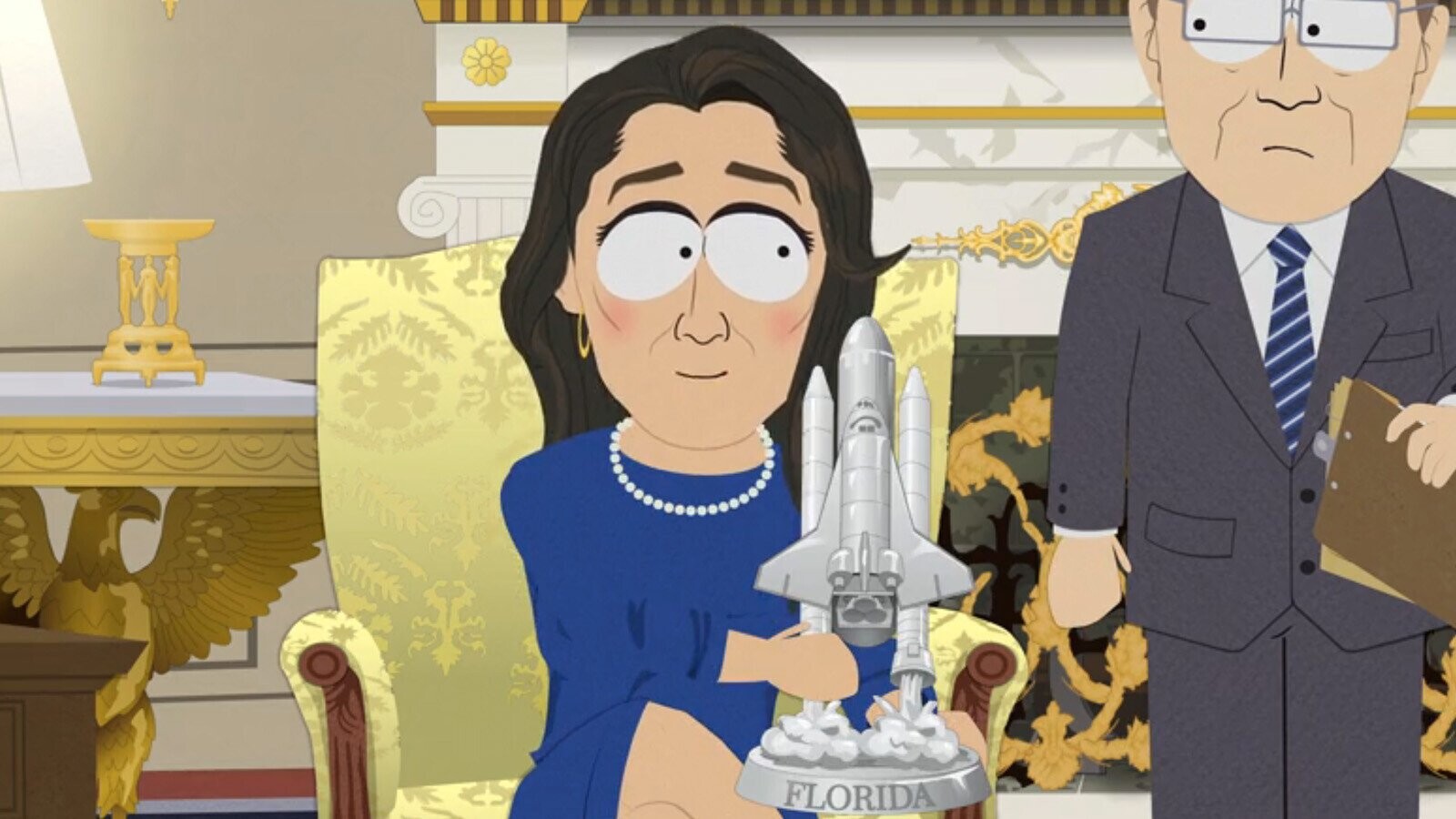
There are two kinds of people in the world: (1) those who do not want to be roasted on national television, and (2) those who claim they love being roasted on national televisionright up until the moment the roast lands and they realize the grill marks spell “satire.”
That’s the vibe swirling around Florida Congresswoman Anna Paulina Luna after South Park featured a cartoon version of her in Season 27’s episode “Sickofancy,” and she responded in the most 2025 way possible: by leaning in online. Or, at least, leaning in… briefly. Because in the modern attention economy, the line between “I can take a joke” and “Oh no, the joke is taking me” is about one refresh away.
This isn’t just a story about one congresswoman and one animated show. It’s a story about how political figures try to manage mockery in an internet culture that rewards speed, irony, and screenshotsespecially when the mockery comes from a franchise that has spent decades turning powerful people into punchlines with the emotional subtlety of a cannonball.
Why Being Parodied on South Park Still Matters
For all the hot takes about whether any long-running show is “still relevant,” South Park has a unique kind of cultural currency: it’s a comedic stamp that says, “Congratulations, you have become part of the national conversation… whether you wanted to or not.” The show’s production modelfast turnaround, headline-chasing instinctslets it pounce on current events in a way most scripted TV can’t.
That speed is why a cameo can feel less like a random joke and more like a pop-culture verdict. For politicians, that’s intoxicating. Getting parodied can read like notoriety. And notoriety can be translated into fundraising, follower growth, and the evergreen political slogan of our time: “Look how much they’re talking about me.”
But there’s a catch: South Park parodies aren’t participation trophies. The show doesn’t gently tease. It does not “playfully rib.” It takes an ideasycophancy, hypocrisy, vanity, opportunismputs it in a clown car, then drives it through a wall labeled “nuance.”
What Happened: Anna Paulina Luna Meets Her Cartoon Doppelgänger
In “Sickofancy,” a parody of Luna appears in a scene built around political and corporate flattery. The episode’s title is a not-so-subtle riff on “sycophancy,” and the gag is straightforward: powerful people showing up to praise power. The cartoon Luna is presented as part of that parade of loyalty, delivering over-the-top admiration that’s written to sound absurd on purpose.
Shortly after the episode aired, Luna posted about the parody on social media and used the screenshot as a kind of badgean “I made it” moment. Observers online quickly interpreted the move as either (a) a deliberate attempt to “own” the joke, or (b) a misread of the joke’s intent. Either way, the public reaction was immediate: if you’re going to embrace satire, you have to embrace the part where the satire is… about you.
And that’s the awkwardness at the center of this mini-saga. Embracing a parody works best when the parody is affectionate or neutral. But when the parody’s entire point is “this person is comically flattering,” using it as a profile photo doesn’t exactly flip the script. It can accidentally underline the script in fluorescent highlighter.
Context: Season 27 Went Full Political, Full Speed
Luna’s cameo didn’t happen in a vacuum. Season 27 has been one of the show’s most aggressively political stretches in years, taking aim at the Trump administration, media companies, and the ways institutions bend under pressure. The season premiere, “Sermon on the ’Mount,” drew major attention for its blunt depiction of President Donald Trump, its corporate satire aimed at Paramount/CBS, and the kind of surreal shock humor that South Park uses the way other shows use background music: constantly and at high volume.
The ratings and coverage around the premiere mattered because they amplified everything that followed. When a season is drawing headlines for being bold, every subsequent episode becomes a bigger spotlightespecially for anyone who pops up as a target.
The New Political Playbook: “If I Joke First, I Win”
Politicians have always tried to control narratives, but social media turned narrative control into a contact sport. In that environment, a familiar strategy has emerged: preemptively laugh at yourself so critics can’t “use it against you.” It’s a cousin of the classic “owning the libs” posture, except now it’s “owning the meme.”
Done well, it can work. A quick, witty acknowledgment can humanize a public figure and make them look confident. Done poorly, it reads like someone high-fiving the hand that just slapped them.
The tricky part is that satire often contains two layers:
- Layer 1: “Look, it’s you!” (the recognizable impression)
- Layer 2: “And here’s what we’re actually saying about you.” (the critique)
If you celebrate Layer 1 while ignoring Layer 2, the internet tends to respond by screaming Layer 2 in 4K.
She’s Not Alone: The Republican “Badge of Honor” Trend
Luna is part of a broader pattern this season: several right-wing figures have responded to South Park by treating parody as proof of cultural importance. Vice President JD Vance, for example, publicly joked that he’d “finally made it” after the show depicted him in an unflattering, exaggerated way. The line played as self-awareshort, punchy, meme-friendly.
Another widely discussed example involved conservative activist Charlie Kirk. After the episode “Got a Nut” featured a Cartman-based parody of Kirk’s debate style, Kirk praised the episode publicly, describing it as hilarious and framing it as cultural dominance. He even used the parody image as a social avatar. That’s the “badge of honor” approach in its purest form: if your opponents are laughing, declare it a victory lap.
But the badge-of-honor strategy has a built-in risk: it can encourage audiences to rewatch the joke with fresh eyes and notice all the parts you’d rather they didn’t notice. Satire is rarely a compliment, even when it’s catchy.
When Embracing the Joke Backfires
The internet doesn’t just watch people react; it watches how they react. If the reaction seems too eager, too defensive, or too carefully staged, it triggers the same response humans have had since the dawn of time: “Sure, you’re fine. That’s why you posted about it five times.”
In Luna’s case, critics argued that using the parody as a profile image (even temporarily) looked less like “good sport” confidence and more like a missed cue. In “Sickofancy,” the joke isn’t simply that she exists; it’s that she’s written as an exaggerated flatterer in a scene designed to mock exaggerated flattery. When you adopt that image as a personal brand moment, you risk confirming the caricature rather than defusing it.
This is why “leaning in” requires precision. A smarter approach often looks like:
- Acknowledge the parody without treating it as praise
- Make one joke, not a whole campaign
- Move on quickly so the story doesn’t become “your reaction”
In short: be a person for 10 seconds, then return to being a politician. Lingering is how you turn a cameo into a weeklong headline.
South Park, Government Agencies, and the “Accidental Promo” Effect
If all this sounds like a PR fever dream, consider one of the season’s most surreal plot twists: a federal agency effectively using South Park imagery in recruitment promotion. After “Got a Nut” took swings at the Department of Homeland Security and ICE, official social accounts circulated a screenshot pointing viewers toward an ICE recruitment site. The show’s own account responded with the kind of maturity you’d expect from a series that once made a full episode about… never mind.
The point isn’t that government should (or shouldn’t) use pop culture. The point is that we’ve entered a moment where satire can be repurposed as marketing even when it’s hostile. That’s the ultimate sign of the attention economy: if it gets clicks, someone will treat it as an asset.
What “Sickofancy” Was Really Satirizing
Even though Luna’s parody is the headline here, the episode’s broader satire fits the season’s themes: institutions courting power, public figures performing loyalty, and political spectacle blending with corporate behavior. The message isn’t subtle: sycophancy isn’t just a personality trait; it’s a system.
That’s why the Luna moment resonated beyond a simple cameo. People aren’t only laughing at the cartoon. They’re arguing about what it says about modern politics: the incentives to flatter leaders, the incentives to turn everything into content, and the incentives to treat mockery as momentum.
Why This Keeps Happening: Three Incentives Driving “Awkward Embraces”
1) Parody as Proof of Power
In politics, being ignored is often worse than being criticized. A parody can feel like evidence that you matter. That’s why some politicians treat satire like a weird award: “They wouldn’t mock me if I wasn’t effective.”
2) The Meme Shield
People believe that if they repeat a joke first, it can’t hurt them. Sometimes that’s true. But satire isn’t a single punchline; it’s a framing device. Sharing the frame doesn’t break it.
3) Base Signaling
For partisan audiences, a parody can be used as proof of persecution (“Look how they treat us!”) or dominance (“We’re so big they can’t stop talking about us!”). Either interpretation can energize supporters, at least temporarily.
What It Means for Politicians (and Anyone Public Online)
The Luna episode is a case study in how online identity works in 2026-adjacent America: you don’t just get portrayed; you get clipped, captioned, remixed, and measured by your reaction time. If you’re a public figure, you’re not only managing policy narrativesyou’re managing your meme footprint.
The irony is that “leaning in” often works best when it’s authentic. But authenticity is hard to perform on command. When you try too hard to look unfazed, you can look extremely fazedjust with better lighting.
Luna’s “awkward embrace” became news because it sits right on that fault line. It’s an example of a political figure trying to harness a parody as a cultural flex, only to be reminded that parody is not a participation ribbon. It’s a commentary. And commentary doesn’t stop being commentary because you retweeted it.
Real-World Experiences: What It’s Like When a Political Parody Hits (500+ Words)
If you’ve never worked around politics, it can be hard to understand how fast the mood changes when a satire clip goes viral. One minute, a team is arguing over whether a press release should say “prioritize” or “accelerate.” The next minute, everyone is staring at a cartoon version of their boss trending under a hashtag that includes the word “manbaby.” The phones start buzzing like angry hornets with LTE.
The first experience most people have in that situation is pure whiplash. Not because parody is newpolitical satire is older than the nationbut because the distribution is instant and the audience is relentless. In the old days, you got mocked on TV and you waited for the next news cycle. Now, you get mocked on TV and within minutes there are screen recordings, reaction videos, side-by-sides, and a teenager on TikTok explaining your entire career using only emojis and a sound effect of a cash register.
The second experience is the internal debate: do we respond? Someone will argue for ignoring it (“It dies faster if we don’t touch it”). Someone else will argue for humor (“If we can laugh, we look confident”). And someoneusually the person who has not been awake for more than four hours in the last weekwill suggest a “bold strategy” that sounds like a hostage negotiation conducted via GIFs.
This is where “leaning in” becomes tempting. It feels proactive. It’s content you didn’t have to produce. It’s an opportunity to look unbothered. But the third experience kicks in right after: the realization that the parody has a message, and the message may not be flattering. With South Park, especially, the joke is rarely “Ha, look, it’s you.” The joke is “Ha, look what your behavior represents.” That means a casual embrace can accidentally amplify the criticism you were trying to smother with a wink.
A fourth experience is what I’d call the “supporter split.” Some fans love the embrace. They treat it like a trophy: proof their side is big enough to be targeted. Others don’t like it at all. They want offense, not self-deprecation. They want a counterpunch, not a selfie. So a parody response becomes a Rorschach test for your own coalition: are they here for humor, outrage, or a rotating combination of both?
Then comes the fifth experience: the internet’s rule that you only get credit for the joke if you tell it correctly. If a response looks too earnest, too proud, or too oblivious, people treat it like a second punchline. That’s why a move like swapping in a parody profile picture can be so risky. If the parody implies sycophancy, and you use it as your avatar, the crowd doesn’t see “confidence.” They see “accidental product demo.”
Finally, there’s the most practical experience of all: fatigue. After the clip runs its course, you still have a schedule, hearings, votes, interviews, donors, critics, and the everyday chaos of public life. The parody feels huge in the momentbut it becomes one more item in the endless queue of “things that happened online.” The lesson most teams learn (sometimes painfully) is that the best response is often the shortest one: a single line, a small laugh, then back to work. Not because the satire doesn’t matter, but because making it matter more is exactly what the satire wants.
And that’s why the Luna moment landed the way it did. It felt like a very human impulseturn the spotlight into a mirror you can control. But satire doesn’t behave like a mirror. It behaves like a funhouse window: you can pose in front of it, but you can’t stop it from bending the image.