

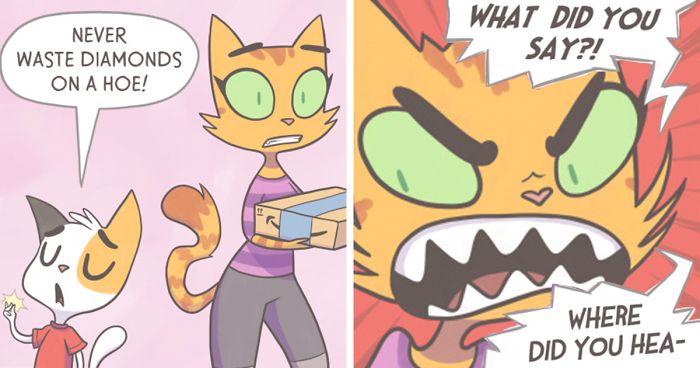
Parenting two boys can feel like living inside a tiny action movie where nobody has read the script, the props are sticky, and the soundtrack is mostly snack requests. Now add a feline twist: whiskers, tails, dramatic stares, sudden zoomies, and the mysterious ability to ignore a perfectly good meal until it belongs to someone else. That is the irresistible charm behind comics inspired by motherhood, family chaos, and the everyday comedy of raising kids who behave suspiciously like kittens with better vocabulary.
The idea behind I Illustrate My Experience As A Mom Of Two Boys In 25 Comics With A Feline Twist works because it turns ordinary parenting moments into something both silly and deeply recognizable. Bedtime battles become tiny theatrical productions. Cleaning up toys becomes a negotiation with creatures who appear to have no memory of making the mess. Sibling rivalry becomes a fuzzy, high-energy sport. Instead of presenting motherhood as polished and perfect, these comics celebrate the parts of family life that are messy, loud, affectionate, and funny five minutes after they stop being exhausting.
That is why parenting comics have such a loyal audience. They offer a wink across the internet: “Yes, this happens in my house too.” The feline angle makes the humor softer and sharper at the same time. Cats are independent, affectionate on their own schedule, easily offended, wonderfully weird, and experts at turning a simple room into a disaster zone. In other words, they are excellent stand-ins for children, parents, and occasionally everyone in the family before breakfast.
Why Parenting Comics Feel So Relatable
Great parenting humor does not need giant plot twists. It usually begins with something small: a child asking for help and then rejecting every form of help offered, a parent trying to drink coffee while it is still hot, or two siblings fighting over a toy neither of them cared about until the other one touched it. These tiny domestic scenes are funny because they are familiar. They make parents feel seen without turning their lives into a lecture.
When the family is drawn as cats, the comedy becomes even more flexible. A child’s sudden burst of energy can become a kitten-style sprint through the living room. A dramatic refusal to wear socks can be shown as a full-body feline meltdown. A parent’s exhausted stare can be rendered with the blank, majestic expression of a house cat who has witnessed too much and would like to speak to management.
This format also protects the tenderness inside the joke. Parenting two boys is often described in loud terms: wild, rough, energetic, nonstop. But funny comics can show more than noise. They can capture curiosity, insecurity, sweetness, loyalty, imagination, and the intense emotional weather that moves through childhood. One panel may show a chaotic toy explosion; the next may show a small child curling up beside a parent because the world suddenly feels too big. That contrast is where the heart lives.
The Feline Twist: Why Cats Make Parenting Funnier
Cats are already natural comedians. They sit in boxes that are too small. They knock things off shelves with the confidence of laboratory scientists. They act offended when loved and offended when ignored. They demand independence, then immediately require attention. Put that behavior into a parenting comic, and suddenly the metaphor almost writes itself.
Children and cats share a surprising amount of comic DNA. Both can be suspicious of new food, deeply attached to random objects, and capable of ignoring clear instructions while maintaining intense eye contact. Both can turn a cardboard box into a luxury vehicle, a cave, a spaceship, or a courtroom. Both can be asleep one second and sprinting the next. And both have a gift for making adults rearrange entire schedules around needs they did not know existed ten minutes earlier.
The feline twist also adds visual personality. A puffed tail can say “panic” faster than a paragraph. Flattened ears can communicate stubbornness, embarrassment, or the horror of being told it is bath time. Tiny claws and giant eyes make frustration look adorable without denying that the parent is, in fact, one spilled juice away from becoming a dramatic opera singer.
Motherhood, Mess, and the Comedy of Survival
One reason comics about motherhood work so well is that they transform pressure into perspective. Parenting can be rewarding, but it is not always graceful. The daily routine may include school forms, laundry piles, grocery runs, missing shoes, emotional negotiations, and the ancient mystery of why children ask for bananas and then reject bananas because they are “too banana.” Humor gives parents a way to breathe.
In a comic, a frustrating moment can become a story. The toddler who refuses to clean up becomes a tiny philosopher of ownership. The older child who insists he is “not tired” while lying sideways on the floor becomes a furry little monument to denial. The parent who tries to maintain authority while wearing pajama pants and stepping on building blocks becomes the brave captain of a very sticky ship.
This does not make the hard parts disappear. It simply changes the frame. Instead of asking, “Why is this happening to me?” humor allows a parent to ask, “How would this look as a comic?” That small shift can turn an overwhelming moment into material, and material into connection.
What the 25 Comics Reveal About Raising Two Boys
A collection of 25 parenting comics gives room for many moods. Some strips may focus on household chaos: toys underfoot, snacks everywhere, mysterious stains, and the kind of silence that makes every parent suspicious. Others may explore sibling dynamics, where two brothers can be best friends, sworn rivals, and co-conspirators within the same five-minute window.
Raising two boys often means watching two different personalities grow in the same home. One child may be dramatic, verbal, and ready to debate bedtime like a tiny lawyer. The other may be quieter, sneakier, and capable of creating a mess with the stealth of a trained raccoon. In comic form, these differences become running jokes. One kitten may be the chaos engine; the other may be the commentator. Together, they create the perfect double act.
The best comics do not present boys as a stereotype. Instead, they show childhood as a mix of energy, imagination, sensitivity, and surprise. A child who spends the day roaring like a dinosaur may still need reassurance at night. A boy who pretends not to care may secretly save every drawing from his brother. A kid who covers the couch in crumbs may also deliver a sentence so unexpectedly sweet that the parent forgets to be annoyed for almost eleven seconds.
Why Parents Love Seeing Themselves in Comics
Parenting can sometimes feel isolating, especially when everyone else’s life appears cleaner, calmer, and more coordinated online. Comics cut through that illusion. A funny panel about a parent hiding in the bathroom for one minute of peace can feel more honest than a perfectly lit family photo. A joke about snack negotiations can be more comforting than a thousand polished captions about “cherishing every moment.”
Readers respond because these comics admit the truth: you can love your children completely and still be tired. You can be grateful for your family and still need silence. You can laugh at the madness without being a bad parent. In fact, laughing may be one of the healthiest ways to stay human inside the beautiful circus of family life.
The feline style makes that honesty easier to enjoy. It keeps the tone playful. Instead of feeling exposed, readers feel invited. The cats are not perfect parents or perfect children. They are expressive, dramatic, loving, ridiculous, and familiar. Their whiskered world gives real parenting experiences just enough distance to become entertainment without losing their emotional truth.
The Art of Turning Real Life Into a Comic Strip
Creating parenting comics requires more than drawing cute characters. The artist has to notice timing, body language, and the strange logic of children. A good comic often begins with a tiny moment that would disappear if no one wrote it down: a child’s bizarre sentence, a failed attempt at discipline, a family rule invented under pressure, or a parent’s inner monologue during a public meltdown.
The structure is usually simple but precise. First comes the setup: a normal family situation. Then comes the escalation: the child misunderstands, overreacts, invents a new problem, or reveals a hilarious interpretation of the world. Finally, the punchline arrives, often through a facial expression, a pause, or one final line that makes the whole situation click.
With cats, the artist gains extra tools. A tail can become punctuation. A sideways glance can replace a full sentence. A tiny kitten body can make a huge emotion look both absurd and endearing. This is why animal comics can sometimes express human feelings better than human characters. They exaggerate without becoming cruel.
Specific Moments That Make This Topic Shine
Imagine a comic about cleaning day. The mom cat announces that everyone must help tidy the house. One kitten picks up a single toy, becomes emotionally exhausted, and declares the job complete. The other kitten discovers a forgotten box and immediately turns it into a spaceship, undoing the cleaning in spectacular fashion. The mom cat stands in the center of the room, holding a laundry basket, wearing the expression of someone who has briefly seen the afterlife.
Or picture a bedtime comic. The boys are suddenly thirsty, philosophical, afraid of shadows, concerned about tomorrow’s breakfast, and deeply interested in whether cats can dream about being people. The parent answers every question with decreasing confidence. At last, the kittens fall asleep. The mom cat tiptoes away, triumphant, only to step on the loudest toy in the known universe.
Another classic scene: the family meal. One child rejects dinner because the sauce is touching the noodles. The other child eats something from the floor with the confidence of a food critic. The parents exchange a look that contains love, confusion, and the deep knowledge that nobody is winning tonight.
Why Humor Helps Parents Feel Less Alone
Parenting humor is not just entertainment; it is a form of recognition. When readers see their private frustrations turned into a comic, the moment becomes communal. The joke says, “This is not only your house. This is houses everywhere.” That matters because many parents quietly worry that they are the only ones struggling with routines, patience, clutter, sibling fights, or the emotional whiplash of raising young children.
Comics give those experiences a friendly shape. They are short enough to read during a chaotic day and expressive enough to deliver instant relief. A parent can scroll past a strip, laugh, and return to real life with slightly more oxygen in the room. Sometimes that is enough.
There is also something generous about turning family chaos into art. It says the imperfect parts are worth saving too. Not just birthdays, vacations, and first-day-of-school photos, but also the cereal on the floor, the weird questions in the car, the sibling negotiations, the bedtime delays, and the sticky little hands that somehow find every clean shirt.
Extra Reflections: Experiences Related to This Feline Parenting World
The longer you sit with the idea of illustrating motherhood through cat comics, the more brilliant it becomes. Parenting is full of moments that are too strange to explain in ordinary language. A child can be furious because the blue cup is blue. A parent can spend twenty minutes preparing a snack only to learn that the child wanted the snack “different,” which is not a recipe but a spiritual condition. A brother can scream because another brother is looking out “his” window, even though the window belongs to the house and possibly the bank.
These experiences are funny because they are irrational, but they are also developmentally honest. Children are learning ownership, independence, emotions, fairness, patience, and communication in real time. Unfortunately for parents, “real time” often happens in grocery stores, parking lots, restaurants, and the exact moment an adult finally sits down. A feline comic style captures that wild learning process beautifully. Kittens are curious, impulsive, affectionate, and occasionally convinced they are the rulers of all visible territory. So are children.
One of the richest parts of this topic is the way it shows the parent’s inner life. Many parenting stories focus only on what children do. But comics can show what the mother is thinking: the silent countdown, the dramatic internal narration, the hope that a simple errand will remain simple, the sudden pride when a child does something kind, and the tiny heartbreak when another stage of childhood quietly ends.
For example, a comic may begin as a joke about the boys refusing to share. But underneath the humor is a bigger truth: siblings are practicing relationship skills every day. They are learning when to defend themselves, when to compromise, when to apologize, and when to team up against a common enemy, such as vegetables. The parent watches all of it with a mix of exhaustion and awe. One minute the boys are fighting over a plastic sword. The next, one is comforting the other after a scraped knee. That emotional switch is so fast it practically needs its own sound effect.
The feline twist also makes room for the parent’s playful imagination. A living room can become a jungle gym for kittens. A laundry pile can become a mountain. A cardboard box can become the greatest toy ever manufactured, despite the expensive toy sitting ignored beside it. This is the secret many parents eventually learn: children often do not need perfect entertainment. They need space, attention, and permission to turn ordinary objects into adventures.
Another experience tied to this topic is the comedy of identity. Before children, a person may know themselves as an artist, worker, partner, friend, reader, gamer, runner, baker, or professional nap enthusiast. After children, those identities do not vanish, but they do get interrupted. Constantly. A parenting comic can show that tension without bitterness. The mom cat may be trying to draw, relax, or enjoy one quiet thought, while two kittens burst in with urgent news about imaginary lava. The joke is funny because the interruption is real, but so is the love.
In the end, comics about being a mom of two boys with a feline twist are not just about cats or kids. They are about translating chaos into meaning. They remind readers that family life is not made only of big milestones. It is built from repeated tiny scenes: the bedtime questions, the snack debates, the sibling alliances, the messes, the cuddles, the ridiculous arguments, and the laughter that arrives just in time to save the day. The house may not be quiet. The couch may not be clean. But somewhere in the madness, there is a story worth drawing.
Conclusion
I Illustrate My Experience As A Mom Of Two Boys In 25 Comics With A Feline Twist succeeds because it understands the emotional math of parenting: love plus exhaustion plus absurdity equals comedy. By turning a real family into a cast of expressive cats, the comics make daily motherhood feel lighter, funnier, and more shareable. They honor the mess without pretending it is easy. They laugh at the chaos without mocking the children. Most importantly, they remind parents that the moments that test patience today may become the stories everyone laughs about tomorrow.
Note: This article is written as an original editorial-style feature inspired by the topic. It does not reproduce copyrighted comic panels, captions, or dialogue.