

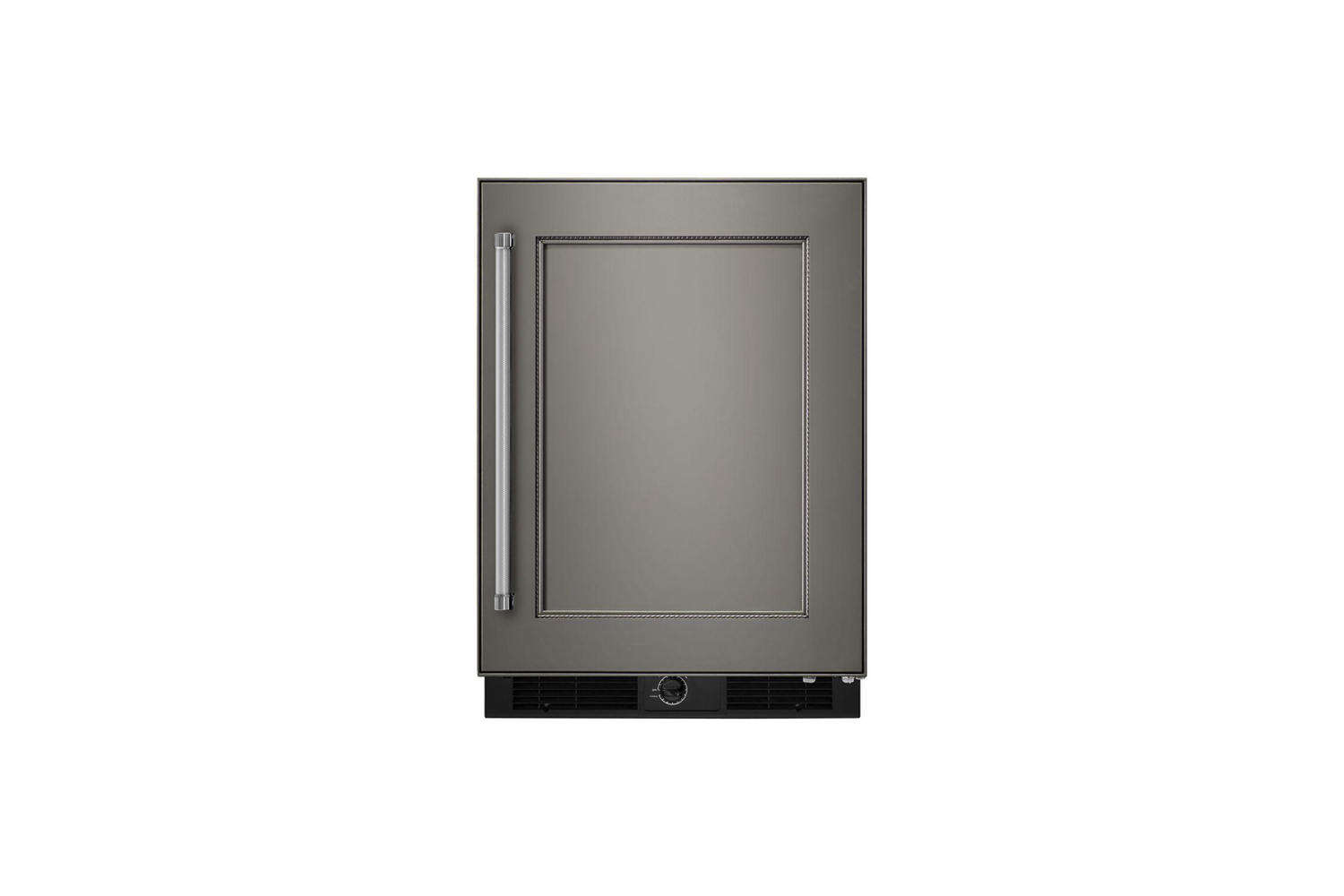
A full-size refrigerator handles weekly groceries, leftovers, and that mysterious container nobody wants to investigate. The KitchenAid 24-inch panel-ready undercounter refrigerator has a more focused mission: keeping frequently used food and drinks cold while disappearing neatly into your cabinetry.
Designed for home bars, entertainment spaces, kitchen islands, butler’s pantries, and secondary food-preparation areas, this premium compact refrigerator combines approximately 5 cubic feet of storage with a customizable exterior. Instead of advertising itself with a shiny appliance door, it accepts a cabinet panel that helps it blend into the room.
That seamless appearance is the star attraction, but there is more happening behind the custom panel. Depending on the exact model, buyers may get fully flush installation, adjustable glass shelves, removable door bins, electronic temperature controls, LED lighting, automatic defrost, temperature monitoring, and useful alarms.
Before ordering one, however, you need to understand the dimensions, hinge direction, panel requirements, ventilation needs, and practical limitations. A panel-ready appliance rewards careful planning. It is less forgiving of “close enough,” the same philosophy used by toddlers assembling puzzles and homeowners measuring expensive cabinetry.
What Is the KitchenAid 24-Inch Panel-Ready Undercounter Refrigerator?
The KitchenAid panel-ready undercounter refrigerator is a compact, single-door refrigerator built to fit beneath a standard-height countertop. Models such as the KURR114KPA provide about 5.0 cubic feet of refrigerated storage within a cabinet roughly 24 inches wide.
Unlike a typical mini fridge, this appliance is designed for an integrated or built-in appearance. Its front can be covered with a custom panel made to coordinate with nearby cabinets. The panel and decorative handle are generally purchased or fabricated separately.
Panel-ready does not mean the panel is included
The refrigerator arrives prepared to receive a compatible custom overlay, but KitchenAid does not magically know whether your kitchen is walnut, white oak, navy blue, or something your designer calls “whispering mushroom.” A cabinetmaker or kitchen installer typically fabricates the panel based on the manufacturer’s dimensional guide.
This approach gives homeowners far more design flexibility than stainless steel. It also creates additional work and expense, so the panel-ready version makes the most sense when visual integration is an important part of the project.
Right-hinge and left-hinge versions matter
KitchenAid commonly uses model designations that indicate hinge orientation. The KURR114KPA is a right-hinge configuration, while closely related KURL models use a left-side hinge. The door is not necessarily field-reversible, so buyers should verify the exact model before placing an order.
Imagine installing a beautiful custom panel and then discovering that the door opens directly into a wall. That is not an appliance problem so much as an expensive lesson in alphabet soup.
Key Specifications at a Glance
| Specification | Typical KURR114KPA Details |
|---|---|
| Configuration | Single-door undercounter refrigerator |
| Nominal width | 24-inch appliance class |
| Product width | Approximately 23 7/8 inches |
| Product height | Approximately 34 3/8 inches |
| Depth without handle | Approximately 23 5/8 inches |
| Capacity | Approximately 5.0 cubic feet |
| Temperature range | About 32°F to 42°F |
| Defrost system | Automatic |
| Interior lighting | LED |
| Door finish | Accepts a compatible custom panel |
| Freezer compartment | None |
| Ice maker | None |
| Installation environment | Indoor residential use |
Specifications can change between product generations. Newer KitchenAid models may have different cabinet depths, lighting systems, capacities, or panel instructions. The planning document supplied for the exact model should always overrule a retailer’s generic 24-inch description.
Design and Appearance
Fully flush installation
One of the refrigerator’s most valuable design features is its ability to sit flush with surrounding cabinet fronts when correctly installed. Hidden hinges reduce visible hardware and help the door align with adjacent cabinetry.
On compatible models, the hinge can allow the door to open to approximately 115 degrees. This wider swing improves access to shelves and door bins, provided nearby walls, handles, and cabinets do not obstruct it.
A convincing built-in look
A successful panel-ready installation makes the refrigerator difficult to identify when the door is closed. This is especially attractive in open-plan homes where the kitchen, dining space, and living area share one visual field.
The appliance can disappear into a run of cabinets in a kitchen island, wet bar, media room, or pantry. It provides cold storage without making the room look as though someone parked a dorm refrigerator beneath a quartz countertop.
Interior materials
Inside, solid glass shelves provide a stable surface for containers and are easier to wipe clean than wire racks. Removable door bins can hold condiment bottles, cans, small jars, and other narrow items that would otherwise roll around the shelves like loose bowling pins.
The exact shelf arrangement varies by model, but the approximately 5-cubic-foot interior is designed to handle a useful mix of beverages, platters, snacks, and food-preparation ingredients.
Cooling and Temperature Controls
Adjustable 32°F to 42°F range
The KURR114KPA generation offers an adjustable temperature range of approximately 32°F to 42°F. The recommended general-purpose setting is around 37°F, but users can choose colder or warmer settings depending on the contents.
Preset options may include settings for meat, beverages, assorted foods, and deli items. Typical preset temperatures are approximately 32°F for meat, 34°F for beverages, 37°F for assorted foods, and 39°F for deli storage.
These presets are convenient, although they do not transform the refrigerator into multiple independent cooling zones. It remains a single-temperature compartment.
Max Cool mode
Max Cool temporarily lowers the temperature setting, generally for up to 24 hours. It is useful before a party, after loading a large quantity of room-temperature drinks, or when the door will be opened frequently.
This feature is best used proactively. Activating it before guests arrive is more effective than waiting until everyone has opened the refrigerator 47 times in search of the same sparkling water.
Temperature monitoring
Temperature sensors monitor conditions inside the compartment. On the KURR114KPA, an over-temperature warning can activate when temperatures remain above approximately 45°F for more than four hours.
The alert does not prevent every food-safety problem, but it can warn owners about a door that was not closed properly, an interruption in cooling, or another issue requiring attention.
Door-open alarm
A door alarm provides an audible reminder when the refrigerator has been left open for several minutes. This is valuable in busy households and entertainment spaces, where someone may walk away while mixing drinks or arranging a platter.
The alarm is also a polite mechanical substitute for shouting, “Who left the fridge open?” into an empty room.
Storage Capacity and Organization
Five cubic feet sounds modest compared with a full-size refrigerator, but the rectangular interior can accommodate a surprising amount of food when organized carefully.
What fits well
- Bottled water, soda, juice, mixers, and canned drinks
- Cheese boards, appetizer trays, and prepared platters
- Condiments and garnishes for an outdoor-facing bar
- Meal-preparation ingredients stored near an island
- Children’s snacks and lunch supplies
- Fresh produce that does not require a dedicated humidity-controlled drawer
- Overflow food during holidays and parties
What does not fit as efficiently
The refrigerator has no freezer, ice maker, water dispenser, or large produce crisper. It is also not optimized exclusively for wine bottles. A dedicated wine refrigerator usually provides racks designed to support bottles horizontally and may offer more specialized temperature control.
Bulky gallon containers, tall pitchers, and oversized platters may require shelf adjustments. Before buying, consider the objects you actually plan to store rather than admiring an empty showroom interior where every bottle appears to have graduated from modeling school.
Installation Requirements
Installation is where a panel-ready refrigerator either becomes a beautiful design feature or an expensive cabinet-shaped headache. Accurate planning is essential.
Cabinet opening
The KURR114KPA is designed for an opening approximately 24 inches wide and 24 inches deep. Depending on the installation configuration, the required opening height is generally around 34 1/2 to 35 inches. Adjustable leveling legs provide limited flexibility.
The opening must be square and level. An uneven floor can interfere with door alignment, panel spacing, and proper closing. Shimming the cabinet opening may be necessary when the finished floor does not extend evenly beneath the appliance.
Custom panel requirements
For the KURR114KPA, the custom solid-door overlay is typically specified at 3/4 inch thick and should not exceed approximately 20 pounds. Panel size, drilling locations, edge clearances, and handle placement must follow the model-specific template.
Do not reuse an old refrigerator panel merely because both appliances are described as 24 inches wide. Door construction and mounting points can differ between models and generations. An existing panel may require modification or complete replacement.
Electrical connection
The refrigerator requires a properly grounded household outlet. The receptacle must be positioned so the power cord does not become crushed behind the unit or prevent a flush installation.
Some plans place the outlet in an adjacent cabinet and route the cord through a protected opening. Other configurations use a recessed receptacle in the recommended area behind the appliance. The installer should follow local electrical codes and KitchenAid’s planning guide.
Handle clearance
The custom handle must be chosen with surrounding clearances in mind. A long appliance pull may look elegant but collide with a wall, drawer front, or nearby cabinet handle. The mounting screws must also be compatible with the panel thickness without extending into the refrigerator door.
Energy Efficiency and Everyday Operation
The KURR114KPA is ENERGY STAR certified, helping distinguish it from basic compact refrigerators that may use less efficient cooling systems. Actual electricity consumption depends on ambient temperature, door-opening frequency, temperature setting, ventilation, and how much warm food is loaded.
Automatic defrost reduces frost accumulation and eliminates routine manual defrosting. During operation, users may hear compressor hums, fan sounds, clicks, refrigerant movement, or water entering the defrost pan. These noises are generally normal, although unusual vibration may indicate that the appliance is not level or that containers are touching inside.
Because it uses a high-efficiency compressor, the refrigerator may run longer than an older compact model while maintaining stable temperatures. Longer operation does not automatically mean something is wrong.
Advantages of the KitchenAid Panel-Ready Refrigerator
- Seamless appearance: A matching cabinet panel minimizes visual interruption.
- Useful secondary storage: Five cubic feet can significantly reduce traffic around the main refrigerator.
- Flexible temperature settings: The adjustable range works for beverages and many fresh foods.
- Monitoring features: Door and temperature alerts add practical protection.
- Easy-clean shelving: Glass surfaces contain many spills and wipe down quickly.
- Automatic defrost: Routine maintenance is easier than with manual-defrost compact units.
- Premium installation: Hidden hinges and flush alignment provide a true built-in effect.
Potential Drawbacks
Premium total cost
The refrigerator itself is only part of the expense. Buyers may also need a custom panel, decorative handle, professional appliance installation, cabinetry adjustments, and electrical work. The completed project can cost considerably more than a freestanding beverage refrigerator.
No freezer or ice production
This is a refrigerator-only appliance. Anyone expecting frozen snacks, cocktail ice, or an emergency pint of ice cream will need another solution.
Hinge direction must be selected in advance
The door may not be reversible after purchase. Ordering the wrong orientation can create clearance problems and may require exchanging the entire appliance.
Panel compatibility requires precision
Custom panel dimensions, weight, hole placement, and handle installation must be correct. Even a small alignment error is noticeable when the refrigerator sits between carefully fitted cabinet fronts.
Limited specialty storage
There is no humidity-controlled crisper, dedicated freezer, connected app, or elaborate smart-home system. For some buyers, that simplicity is refreshing. For others, a refrigerator that does not send push notifications may feel suspiciously well adjusted.
Best Places to Use It
Kitchen island
Installed beneath an island countertop, the refrigerator can keep meal-preparation ingredients close to the work surface. It can also store drinks and snacks on the seating side, keeping family members away from the main cooking zone.
Home bar
The adjustable temperature and door-bin storage work well for mixers, garnishes, bottled beverages, and prepared cocktail ingredients. Remember that the appliance does not produce ice.
Butler’s pantry
A secondary refrigerator in a pantry can hold entertaining supplies, desserts, overflow groceries, and prepared dishes without crowding the primary refrigerator.
Media or game room
A panel-ready door prevents the space from looking like a convenience store break room. Snacks and drinks remain nearby without requiring repeated trips to the kitchen.
Guest suite
The refrigerator can provide convenient cold storage for visitors while blending into a cabinet wall. Local building regulations should be checked when creating a kitchenette or accessory living space.
Cleaning and Maintenance
Wipe the interior with warm water and mild detergent, then dry the surfaces thoroughly. Avoid harsh abrasives, flammable cleaners, and tools that could scratch the liner or damage the cooling system.
Glass shelves and removable door bins should be taken out carefully and allowed to reach room temperature before contact with very hot water. Sudden temperature changes can stress glass components.
Keep the door gasket clean so it can maintain an even seal. Crumbs, sticky drink residue, and misaligned containers can prevent the door from closing completely.
The base grille and condenser area should be inspected periodically. Dust and pet hair restrict airflow and make the cooling system work harder. Always disconnect electrical power before performing maintenance described in the owner’s manual.
Who Should Buy This Refrigerator?
The KitchenAid 24-inch panel-ready undercounter refrigerator is best for homeowners who value integrated design and need convenient secondary refrigeration. It is particularly appropriate for a planned renovation where cabinet panels, handles, electrical placement, and appliance clearances can be coordinated from the beginning.
It is less suitable for renters, budget-focused buyers, or anyone who needs a portable mini fridge. It is also unnecessary when the custom panel will be hidden in a utility room where appearance provides little practical value.
Choose it when the visual result matters almost as much as refrigeration performance. Choose a simpler compact refrigerator when cost, portability, or easy replacement is the priority.
Realistic Ownership Experience: What Daily Use May Feel Like
The first noticeable benefit is not cold air or electronic controls. It is the absence of an obvious appliance. When the panel matches the surrounding cabinetry, the refrigerator becomes part of the room rather than another rectangle of stainless steel competing for attention.
That subtle appearance can be especially satisfying in a kitchen island. Guests may not even realize a refrigerator is present until someone opens what appears to be a cabinet door and produces a cold drink. This tiny moment feels surprisingly luxurious, even though the refrigerator is essentially performing the ancient technological miracle of making soda chilly.
During everyday use, the 5-cubic-foot interior works best when assigned a specific role. Owners who try to use it as a miniature version of the main refrigerator may become frustrated by tall containers and irregular packages. Owners who designate it as a beverage station, snack refrigerator, or meal-preparation zone usually get more value from the space.
For example, a family might reserve the upper shelf for yogurt and lunch supplies, the middle shelf for cans and bottles, and the lower area for produce or prepared food. Door bins can hold condiments and smaller drinks. This arrangement allows children or guests to find what they need without standing in front of the main refrigerator while debating the meaning of life.
Before a party, Max Cool can be activated and the shelves loaded with beverages several hours in advance. The refrigerator then becomes a traffic-management tool. Guests can serve themselves at the bar or island while the main kitchen remains available for cooking and plating food.
The door alarm becomes more useful than it initially sounds. A custom panel can make the door feel heavier than a conventional compact refrigerator door, and a hurried user may fail to close it fully. An audible warning helps catch the problem before the interior warms significantly.
Temperature presets also simplify experimentation. A beverage-focused setup can run around 34°F, while a mixed-food compartment may be more comfortable near 37°F. After changing the setting, users should allow roughly 24 hours for stabilization rather than repeatedly pressing buttons and expecting the laws of thermodynamics to become more responsive.
Noise perception depends heavily on the room. In a busy kitchen, normal compressor and fan sounds may be barely noticeable. In a silent media room or guest suite, occasional clicks, humming, or refrigerant movement may be easier to hear. Correct leveling and sensible container placement can reduce vibration-related noises.
The most demanding part of ownership usually occurs before the refrigerator is used. Measuring the opening, selecting the hinge side, fabricating the panel, positioning the outlet, and aligning the door require coordination. A panel that is too heavy or drilled incorrectly can create expensive problems. Professional installation is often worth considering, particularly when the appliance is surrounded by newly finished cabinetry.
Once properly installed, routine ownership is comparatively simple. Spills wipe easily from the glass shelves, automatic defrost handles frost management, and the electronic controls remain hidden inside. The exterior panel can be cleaned using the same method as the rest of the cabinetry, creating a consistent appearance.
The greatest long-term satisfaction generally comes from using the refrigerator in a location where convenience matters every day. A beautiful appliance used twice a month is still mostly expensive furniture. One placed beside the coffee station, food-preparation island, or home bar can save dozens of small trips and make the entire room function more smoothly.
The practical lesson is straightforward: plan the installation with obsessive precision, then keep the storage purpose simple. When those two conditions are met, the KitchenAid panel-ready undercounter refrigerator can feel less like an optional luxury and more like a small design decision that quietly improves daily life.
Final Verdict
The KitchenAid 24-inch panel-ready undercounter refrigerator combines discreet styling, useful storage, flexible temperature control, and premium built-in installation. Its approximately 5-cubic-foot capacity is large enough to support entertaining, food preparation, and family snack storage without taking over the room.
Its strongest feature is integration. With the correct custom panel, hinge orientation, cabinet opening, and handle, the appliance can sit flush with nearby cabinetry and virtually disappear.
The trade-offs are cost and complexity. Buyers must budget for more than the refrigerator and carefully verify every installation detail. There is no freezer, ice maker, or reversible-door shortcut to rescue a poorly planned layout.
For a thoughtful kitchen, pantry, or entertainment-space renovation, however, the KitchenAid panel-ready undercounter refrigerator is a polished and practical addition. It keeps refreshments nearby, reduces congestion around the main refrigerator, and does its job without demanding visual applause.