

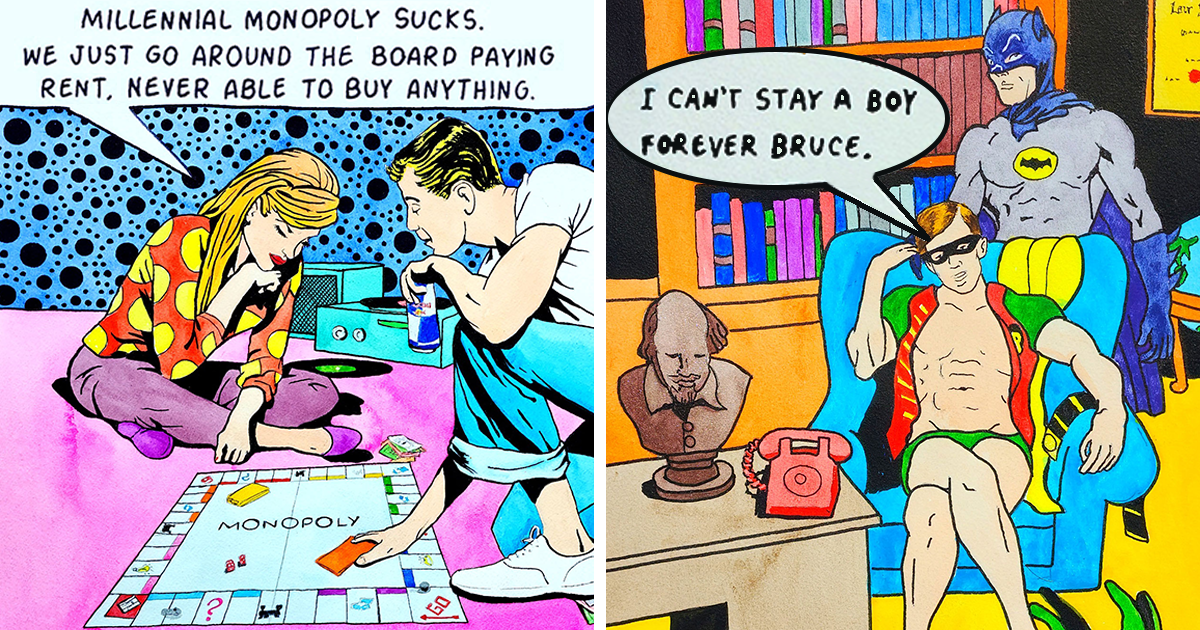
If you’ve ever laughed at a comic and immediately thought, “Wait… who’s been spying on my brain?”welcome.
That’s the sweet spot I aim for: social-commentary comics that feel like a group chat, a therapy session, and a
long exhale all at once. Because modern life is a lot. And sometimes the most responsible thing you can do is
turn the chaos into a punchline… then drink water and answer that email from Thursday.
Why “Ugh, Same” Comics Hit So Hard Right Now
People aren’t just “busy.” They’re overloadedfinancially, digitally, emotionally. Big surveys keep showing how
stress stacks up from multiple directions, and the feeling isn’t rare or niche; it’s mainstream. That’s
exactly why relatable comics work: they translate the invisible pressure into something you can see,
share, and laugh at without needing a five-slide explanation. [1][2]
And there’s another ingredient: connection. The U.S. Surgeon General has warned that loneliness and social
isolation are widespreadmeaning a lot of people are carrying heavy feelings quietly, even while surrounded by
notifications. Comics can’t solve that alone, but they can create a tiny bridge: “I see you.” [3]
The Big Themes Behind Today’s Punchlines
1) Connection… in an era of “seen” receipts
We can message anyone instantly, yet many people still feel disconnected. That contradictionhyperconnected
tools, underconnected heartsshows up constantly in my panels. [3]
2) Attention is the new “rent”
Teens and adults report heavy social media use, and “almost constantly online” isn’t just a phraseit’s a
lifestyle for many. Add doomscrolling (the emotional treadmill nobody enjoys but everyone somehow stays on),
and you get prime comic material: the joke lands because the pattern is real. [4][5][6]
3) Money math that never stops math-ing
Prices shift, bills stack, subscriptions multiply like gremlins. Even when inflation cools compared to prior
peaks, everyday expenses still feel personalbecause your budget has a memory. [7]
4) Work-life balance vs. work-life blender
Workplace research continues to flag low engagement, shaky wellbeing, and burnout riskespecially when people
feel unseen or permanently “on.” That’s not just a management problem; it’s a comedy problem too. [8]
5) Housing, adulthood, and the disappearing “starter” anything
Housing reports show persistent affordability pressurerents, home prices, and the general vibe of
“I guess my roommate is now my long-term spouse (financially).” [9]
My 24 Best Works (And the Issue Each One Pokes)
1) “The Five-Minute Break That Took 47 Minutes”
A character opens their phone for a “quick breather” and returns having learned three conspiracy theories,
adopted a sourdough starter, and forgotten their original name. (Digital overload is undefeated.)
2) “Reply-All: The Musical”
Everyone sings their opinions in harmonyexcept the one person who just wanted the PDF. It’s office life as a
full-contact sport. [8]
3) “Unread Messages, Unread Feelings”
Two bubbles: one says “Sorry, I was busy,” the other says “I didn’t know how to be a person today.” It’s about
connectionand how hard it can be to admit you’re not okay. [3]
4) “Subscription Hydration Reminder (Now $8.99/month)”
A water bottle app tries to upsell “premium sips.” The punchline is silly; the point is sharp: everything is
trying to become a recurring charge. [10]
5) “Doomscrolling: A Love Story (It’s Toxic)”
A character clutches the phone like a tragic romance novel. Caption: “It hurts me, but at least it’s
consistent.” [6]
6) “Adult Friendship: Scheduling the Sequel”
Two friends try to hang out. Their calendars respond with a laugh track. The final panel is them waving at each
other from separate errands. [3]
7) “The Group Chat Courtroom”
One friend says, “I’m tired,” and the chat demands evidence, a timeline, and a doctor’s note. A joke about how
we treat rest like a crime.
8) “Your Package Has Been Delivered (To Your Anxiety)”
A delivery notification arrives, and suddenly the character is convinced the box contains judgment, not socks.
Modern stress loves a doorway. [2]
9) “Inflation Bingo”
A grocery receipt is so long it gets a ZIP code. The character circles items like they’re tracking rare birds:
“Ah yes, the $6 carton… in its natural habitat.” [7]
10) “The ‘Just Getting By’ Starter Pack”
The panel shows a budget spreadsheet, a half-charged phone, and a brave little snack. It nods to how many adults
report living “okay” but still feel the squeeze. [11]
11) “Emergency Fund? I Have Emergency Vibes”
A character labels a jar “Rainy Day Fund,” and it immediately rains bills. The last line: “I have three months
of expenses… if I stop eating.” [12]
12) “Student Debt: The Ghost That Pays Rent”
A friendly ghost floats by whispering, “It’s me again, monthly.” The comic doesn’t shame anyoneit just says
the quiet part out loud. [13]
13) “Home Tour: My Apartment’s Personality Is ‘Laundry’”
A character gives a proud tour: “Here’s the living room, and here’s the other living room (also known as the
laundry chair).” Small-space humor with big-space feelings. [9]
14) “The Starter Home Is a Mythical Creature”
A realtor shows a unicorn labeled “Affordable.” The character asks, “Does it come with wings or just
disappointment?” Housing jokes land because the pressure is real. [9]
15) “Streaming Menu Paralysis”
The character scrolls for so long the app asks, “Are you still watching?”even though nothing has been watched.
Choice overload, beautifully roasted. [14][15]
16) “Wellness Era: I’m Optimizing My Exhaustion”
A character holds a smoothie, a gratitude journal, and a thousand-yard stare. Caption: “I’m thriving, but make
it trembling.” (A gentle jab at performative self-care.)
17) “The Side Hustle Renaissance Fair”
Everyone is selling something: candles, courses, coaching, and “vintage vibes.” The main character whispers,
“I miss hobbies.” A joke about turning rest into productivity. [8]
18) “Meeting That Could’ve Been an Email (Extended Cut)”
A conference room. A whiteboard. A single bullet point. The comedic twist: the bullet point is “Schedule a
meeting.” Workplace absurdity, timeless. [8]
19) “Push Notifications: The Gremlins of Peace”
A character tries to meditate; the phone yells: “Your screen time is up 14%!” The punchline is the meditation
app also sending notifications. [4][5]
20) “Dating Apps: The Paradox of Infinite Options”
Two panels: in one, someone says “There’s nobody out there.” In the next, they’re overwhelmed by profiles and
still somehow lonely. (Modern romance is a UX problem.)
21) “The Algorithm Thinks I’m a Different Person”
After watching one gardening video, the character’s feed becomes 90% compost. Caption: “I clicked once. I am now
a farmer.” A joke about personalization spirals. [5]
22) “News Cycle Neck Pain”
A character’s shoulders creep up with every headline. The final panel shows them lowering the phone and
choosing one helpful action instead of 200 panics. (Humor with a tiny coping skill baked in.)
23) “Kindness, But Make It Awkward”
Someone offers genuine support, then immediately apologizes for “being weird.” The joke is the awkwardness;
the message is the kindness. Connection isn’t always smooth. [3]
24) “The Tiny Joy Rebellion”
A character finds a small momentsunlight on the floor, a good song, a perfectly toasted bageland declares it a
“victory.” The comic ends optimistic on purpose: you’re allowed to feel good.
What Readers See in These Panels (Even When They Don’t Say It)
The most common reaction I hear is some version of: “I thought it was just me.” That’s the whole game. Stress
isolates; humor reconnects. When surveys describe widespread strain and disconnection, it makes sense that
people crave a format that says, “This is happening to a lot of us.” [1][2][3]
How to Turn Modern Struggles Into Funny, Human Comics
Keep the target “the problem,” not the person
Punch up at systems, patterns, and contradictionsnever down at someone’s pain. The best relatable comics feel
like a warm nudge, not a roast.
Use specificity (that’s where the laugh lives)
“Stress” is abstract. “Staring at a cart total like it’s a plot twist” is a scene. Specific examples turn
emotions into shareable moments. [7]
End with a little oxygen
Even if the middle is messy, give the reader a soft landing: a kind line, a small solution, or a reminder that
they’re not alone. [3]
From My Drawing Desk: The Experiences Behind These Comics
Making comics about modern struggles is basically a daily exercise in noticing what people joke about when they
don’t want to admit they’re overwhelmed. I’ll hear someone say, “I’m fine,” and then watch them open their
calendar like it’s a horror movie. That gapbetween the polite script and the real momentis where my best ideas
come from. The trick is to treat that gap with respect, not sarcasm.
I’ve learned to keep a running list of “micro-stressors,” because big issues usually show up as tiny behaviors.
Nobody wakes up announcing, “Today I will experience the crushing weight of modern life.” They say, “I forgot my
password again,” or “Why is everything a subscription,” or “I’ll respond after I mentally reboot.” When I draw
those moments, readers recognize themselves immediatelyoften with a laugh that sounds suspiciously like relief.
Research helps, toonot because I want my comics to feel like homework, but because it keeps me honest. When
national reports talk about loneliness, stress, money worries, and workplace burnout, it confirms what people are
already telling each other in comments: “You’re not imagining it.” The facts don’t replace the jokes; they give
the jokes a backbone. [2][3][8][9]
The hardest part is balancing humor with tenderness. If I draw money anxiety as a monster, I don’t want the
punchline to be “ha-ha, you’re bad at budgeting.” I want it to be “ha-ha, this monster is ridiculousand also,
you’re not a failure for feeling it.” That’s why I avoid perfect protagonists. My characters are a little messy,
a little tired, and still trying. That’s most of us.
Over time, I’ve also noticed a pattern: people don’t only share the funniest panels. They share the ones that
name the thing they couldn’t name. A comic about doomscrolling gets reposted because someone wants permission to
put the phone down without feeling “uninformed.” A comic about friendship scheduling gets shared because someone
misses their people and doesn’t know how to say it. Humor becomes a socially acceptable way to ask for connection.
If there’s a “secret” behind my 24 favorites, it’s this: I’m not chasing perfection. I’m chasing recognition.
The laugh is the doorway, not the destination. The destination is that tiny moment where a reader thinks,
“Okay. It’s not just me. I can handle today.”