

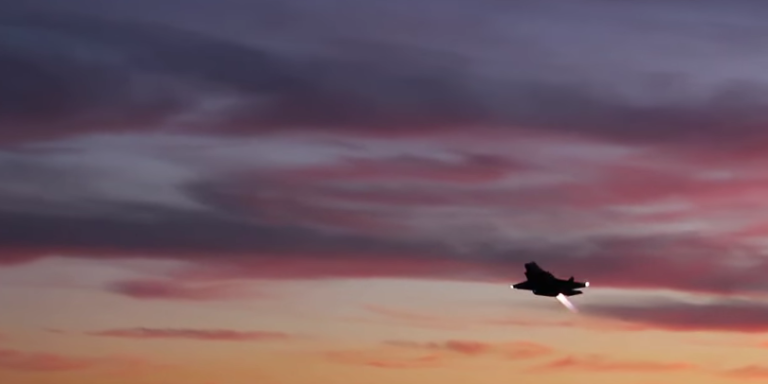
Some sunsets politely ask to be admired. Others get photobombed by a fifth-generation fighter jet and immediately become the kind of moment that makes aviation fans forget how to blink. That is the magic behind the phrase “Nothing Improves a Sunset Like an F-35A With Full Afterburners.” It captures a scene that is both wildly modern and strangely timeless: golden light fading across the horizon, a runway glowing like a ribbon, and one very expensive, very loud F-35A Lightning II turning dusk into a private fireworks show.
The image is irresistible because it combines two things humans have always loved: fire and flight. A sunset already has drama. Add the orange-blue spear of a full afterburner, the muscular shape of a stealth fighter, and the thunder of a Pratt & Whitney F135 engine, and suddenly the sky is not just pretty. It is performing.
But beyond the spectacle, the F-35A is not merely a poster-worthy aircraft with a flair for dramatic lighting. It is the U.S. Air Force’s conventional takeoff and landing version of the F-35 Lightning II, a stealthy multirole fighter designed for air superiority, strike missions, intelligence gathering, electronic warfare, and networked operations. In less poetic terms: it flies, sees, shares, fights, and occasionally turns sunsets into heavy-metal album covers.
Why an F-35A at Sunset Looks So Unfairly Cool
Aviation photography loves contrast, and sunset provides it for free. During the day, a jet can be impressive, but the details compete with sunlight, clouds, heat shimmer, and the general busyness of the sky. At dusk, everything simplifies. The airframe becomes a silhouette. The horizon turns orange, red, purple, or deep blue. Then the afterburner lights, and the scene gains a focal point brighter than a campfire and more aggressive than a barbecue grill with a defense budget.
When an F-35A takes off with full afterburner, the exhaust plume glows because additional fuel is sprayed into the jet’s exhaust stream behind the turbine and ignited. This produces extra thrust, which helps during high-performance takeoffs, combat maneuvers, and demonstrations. It is not fuel-efficient, so pilots do not use it casually for “vibes.” Still, when the throttle goes forward and the burner lights, the result is a long tongue of flame that makes dusk feel cinematic.
That is why footage of an F-35A launching from Luke Air Force Base at twilight became so memorable. The aircraft itself was already newsworthy, but the sunset gave it personality. Instead of looking like a technical briefing with wings, it looked like the future had just punched a hole through the evening sky.
Meet the F-35A Lightning II: The Air Force Variant
The F-35 family includes three main versions: the F-35A for conventional runways, the F-35B for short takeoffs and vertical landings, and the F-35C for aircraft carrier operations. The F-35A is the version flown by the U.S. Air Force and many allied air forces. It is the lightest and most widely used variant, built for traditional air bases rather than carrier decks or vertical landing pads.
Officially, the F-35A is a fifth-generation fighter, which means it combines stealth design, advanced sensors, sensor fusion, network connectivity, high performance, and modern weapons integration. Unofficially, it is a flying computer with a jet engine, a helmet that looks borrowed from science fiction, and enough sensors to make a smartphone feel like a sundial.
Key F-35A Characteristics
The aircraft is powered by a single Pratt & Whitney F135-PW-100 engine producing roughly 43,000 pounds of thrust in maximum afterburner. It can reach about Mach 1.6, carry weapons internally to preserve stealth, and operate as part of a wider network of aircraft, ships, ground forces, satellites, and command systems. Its design is not simply about flying fast; it is about seeing first, sharing information quickly, and surviving in contested airspace.
That “single engine” detail matters. Many people expect a fighter this powerful to have two engines, especially when they hear it at an airshow. But the F-35A’s lone F135 engine is a heavyweight. When it lights the afterburner, it does not whisper, “Excuse me.” It announces itself like a bowling ball dropped into a drum kit.
What Full Afterburner Actually Does
A jet engine normally compresses incoming air, mixes it with fuel, ignites the mixture, and pushes hot exhaust out the back to create thrust. An afterburner adds another stage of combustion in the exhaust section. More fuel enters the hot exhaust stream and ignites, creating additional thrust. The trade-off is simple: more power, much more fuel burn.
For military aircraft, that extra thrust can be useful during takeoff, rapid acceleration, high-energy maneuvers, or combat situations where performance matters more than fuel economy. For spectators, the afterburner adds the part everyone remembers: the flame, the roar, the pressure wave in the chest, and the brief suspicion that the sun has filed a noise complaint.
Why It Looks Brighter at Dusk
In bright daylight, an afterburner can still be visible, especially from certain angles, but it does not dominate the scene. At sunset or night, the flame becomes a star performer. The darker background makes the exhaust plume look longer and more intense. Photographers can also capture reflections on the runway, heat distortion behind the aircraft, and the glowing line of the jet as it climbs away.
This is why evening launches and night sorties produce some of the most dramatic F-35 imagery. The aircraft becomes part machine, part meteor. A full-burner departure at dusk can make even people who normally say “aircraft are just transportation” suddenly become deeply interested in thrust-to-weight ratios.
Stealth, Sensors, and the Serious Side of the Spectacle
The F-35A is famous for its stealth shaping, but stealth is only one part of its value. The aircraft’s mission systems are built around sensor fusion: collecting information from radar, infrared sensors, electronic warfare systems, targeting sensors, and data links, then combining that information into a more useful picture for the pilot. Instead of forcing the pilot to manually interpret a pile of separate sensor feeds, the aircraft helps organize the battlespace.
That matters because modern air combat is not only about who can turn tighter or fly faster. It is about who understands the environment first. A fighter that detects threats, shares data, and coordinates with other platforms can influence a fight even before weapons are launched. In that sense, the F-35A is not just a shooter. It is a sensor node, a data hub, and a flying decision-making platform.
This is also why the aircraft can be misunderstood when judged only by airshow performance. A sunset takeoff shows power. A demonstration pass shows agility. But the F-35A’s deeper advantage is less visible: the information it collects, processes, and distributes.
The F-35A Demo Team: Turning Capability Into Theater
The U.S. Air Force F-35A Demonstration Team exists to show the public what the aircraft can do. Demonstration routines have included high-speed passes, tight turns, high-angle-of-attack maneuvers, weapons-bay passes, climbs, rolls, and other profiles designed to display the jet’s flight envelope. A strong demo is not just about noise and vapor, although those certainly help. It is a carefully planned routine that balances safety, aircraft limits, pilot skill, and public engagement.
Airshow demonstrations are especially important because they translate abstract capability into something people can feel. “Advanced sensor fusion” sounds impressive but not exactly popcorn-friendly. A roaring F-35A climbing away in full afterburner, however, needs no PowerPoint slide. Children point. Adults record shaky phone videos. Someone in the crowd says, “That was loud,” despite everyone already knowing this because their ribs have been informed.
Why the F-35 Program Is Both Admired and Debated
No serious article about the F-35 should pretend the program is only about heroic silhouettes and glowing exhaust. The F-35 is one of the most ambitious and expensive military aviation programs ever built. It has faced criticism over development delays, sustainment costs, spare parts shortages, software modernization, and readiness challenges. Government oversight reports have repeatedly highlighted production and maintenance concerns, including late deliveries and supply chain issues.
That complexity is part of the story. The F-35 is not a simple aircraft in the way older fighters were simpler. It is a multinational, multi-variant, software-heavy weapons system designed to evolve over decades. That makes it powerful, but it also makes it difficult to build, maintain, upgrade, and afford. The sunset image is beautiful, but behind it stands an enormous industrial network of engineers, maintainers, suppliers, pilots, planners, and taxpayers.
In other words, the F-35A is both a jaw-dropping machine and a serious policy topic. It can inspire aviation fans and frustrate budget analysts in the same afternoon. That is quite a résumé.
What Makes the F-35A Different From Older Fighters?
Comparing the F-35A to fourth-generation aircraft like the F-16, F-15, or F/A-18 can be tricky because the F-35 was not designed to win every argument in the same way. Some older fighters may be faster in certain profiles, carry more external weapons in non-stealthy configurations, or look more dramatic in traditional dogfight maneuvers. But the F-35A was designed for a different era.
Its value lies in low observability, advanced data processing, electronic warfare, networking, and survivability in threat environments where older aircraft may require significant support. It can carry weapons externally when stealth is less important, but its internal weapons bays allow it to reduce radar signature during high-threat missions. This flexibility is central to its role.
The “Quarterback” Comparison
One common way to describe the F-35 is as a quarterback in the sky. That comparison is not perfect, but it helps. The aircraft can gather information, interpret the field, share data, and help other assets act more effectively. It may take the shot itself, or it may enable another platform to do so. Either way, it is designed to make the whole team more effective.
Of course, unlike a quarterback, it can also go supersonic and shoot missiles, which would make football substantially more complicated.
Why Aviation Fans Love Afterburner Moments
Aviation enthusiasm is partly technical and partly emotional. People may study engine specs, radar systems, wing loading, mission profiles, and procurement history. But ask most aviation fans why they love jets, and eventually the answer becomes sensory. The sound. The heat shimmer. The smell of jet fuel. The sight of a fighter rotating off the runway and climbing into a sky that suddenly seems too small for it.
Afterburner moments compress all of that into a few seconds. They are easy to understand even if you know nothing about aircraft. Fire comes out. Jet goes faster. Crowd grins. It is the ancient language of “whoa.”
At sunset, the emotional effect doubles. The aircraft looks less like equipment and more like a story. A daytime takeoff says, “Training sortie.” A sunset full-afterburner takeoff says, “Somebody call the soundtrack department.”
The Photography Appeal: Light, Heat, and Motion
For photographers, an F-35A at sunset is a gift wrapped in noise. The aircraft’s angular lines catch the last light. The exhaust produces distortion that bends the background. The afterburner creates a warm focal point. If the runway is slightly reflective, the flame may echo on the surface. If the air is dusty or humid, the plume becomes even more dramatic.
Timing is everything. Too early, and the sky is bright enough to flatten the flame. Too late, and the aircraft may become difficult to track without specialized technique. The sweet spot is often blue hour or late golden hour, when the sky still has color but the burner can dominate the frame. That is when an F-35A looks like it is dragging a piece of the sun behind it.
Experiences Related to “Nothing Improves a Sunset Like an F-35A With Full Afterburners”
Anyone who has stood near a runway during an evening fighter launch knows the experience is not merely visual. It begins before the aircraft moves. You hear distant activity first: ground vehicles, radio chatter if you are near an event, the muted whine of systems coming alive, and then the deepening note of the engine. The sunset may be doing its best impression of a postcard, but attention slowly shifts toward the runway. People stop talking. Cameras rise. Even casual spectators sense that something large is about to happen.
Then the F-35A starts rolling. At first, it is surprisingly smooth, almost restrained. The aircraft gathers speed with a kind of heavy confidence. Then the afterburner lights, and restraint leaves the chat. The exhaust brightens into a concentrated flame, the sound thickens, and the runway seems to vibrate. It is not just loud in the ears; it is loud in the sternum. You feel it in your shirt, your camera strap, and possibly in memories you did not know had audio.
At sunset, the moment becomes strangely beautiful. The aircraft’s gray skin, designed for practical low visibility, turns painterly in the low light. Edges glow. Shadows sharpen. The canopy flashes. The flame behind the aircraft looks almost unreal, like a brushstroke of white-orange heat painted across a darkening sky. For a few seconds, technology and nature stop arguing and start collaborating.
There is also a communal thrill to it. At airshows, the crowd reaction often arrives half a second after the jet passes, as if everyone’s brain needs time to catch up with the pressure wave. Phones track the climb. Children laugh or cover their ears. Someone says, “That was awesome,” which is not original but is completely accurate. Aviation has a way of making adults sound like kids again, and honestly, that may be one of its finest public services.
The experience is different for photographers. They are thinking about shutter speed, autofocus, exposure, and panning technique, but the jet does not care about anyone’s settings. It moves fast, the light changes quickly, and the afterburner can fool a camera’s metering. A great shot feels earned. A missed shot feels tragic for about five seconds, until the sound catches up and reminds everyone that the real event was not the photo. It was being there.
For pilots and maintainers, the romance is balanced by discipline. A full-afterburner departure may look wild from the fence line, but it is built on checklists, training, inspection, coordination, fuel planning, and precise execution. The public sees the flame; the team sees the preparation behind it. That contrast makes the scene even more impressive. The drama is real, but it is not random. It is controlled power.
That is why the phrase works so well. “Nothing improves a sunset like an F-35A with full afterburners” is funny because it is exaggerated, but it feels true to anyone who has seen it. A sunset is already one of nature’s best daily performances. Add a stealth fighter climbing through it on a pillar of fire, and the evening suddenly has a plot twist.
Conclusion: When Engineering Meets the Evening Sky
The F-35A Lightning II is a serious aircraft built for serious missions, but it also creates moments of pure visual wonder. A full-afterburner takeoff at sunset brings together advanced engineering, military aviation, atmospheric color, and human awe in one unforgettable scene. It reminds us that machines can be functional and beautiful, practical and poetic, controversial and captivating.
The F-35A is not just impressive because it can fly fast or glow dramatically at dusk. It is impressive because it represents a major shift in airpower: stealth, sensors, networking, and software working together in a single platform. Still, even the most technical explanation cannot fully replace the feeling of watching one launch into a sunset with the burner lit. Some things are best understood with your eyes wide open and your ear protection properly seated.
Note: This article synthesizes public information from reputable U.S. aviation, defense, government, engine-manufacturer, and military media references. It is fully rewritten in original wording for web publication.