

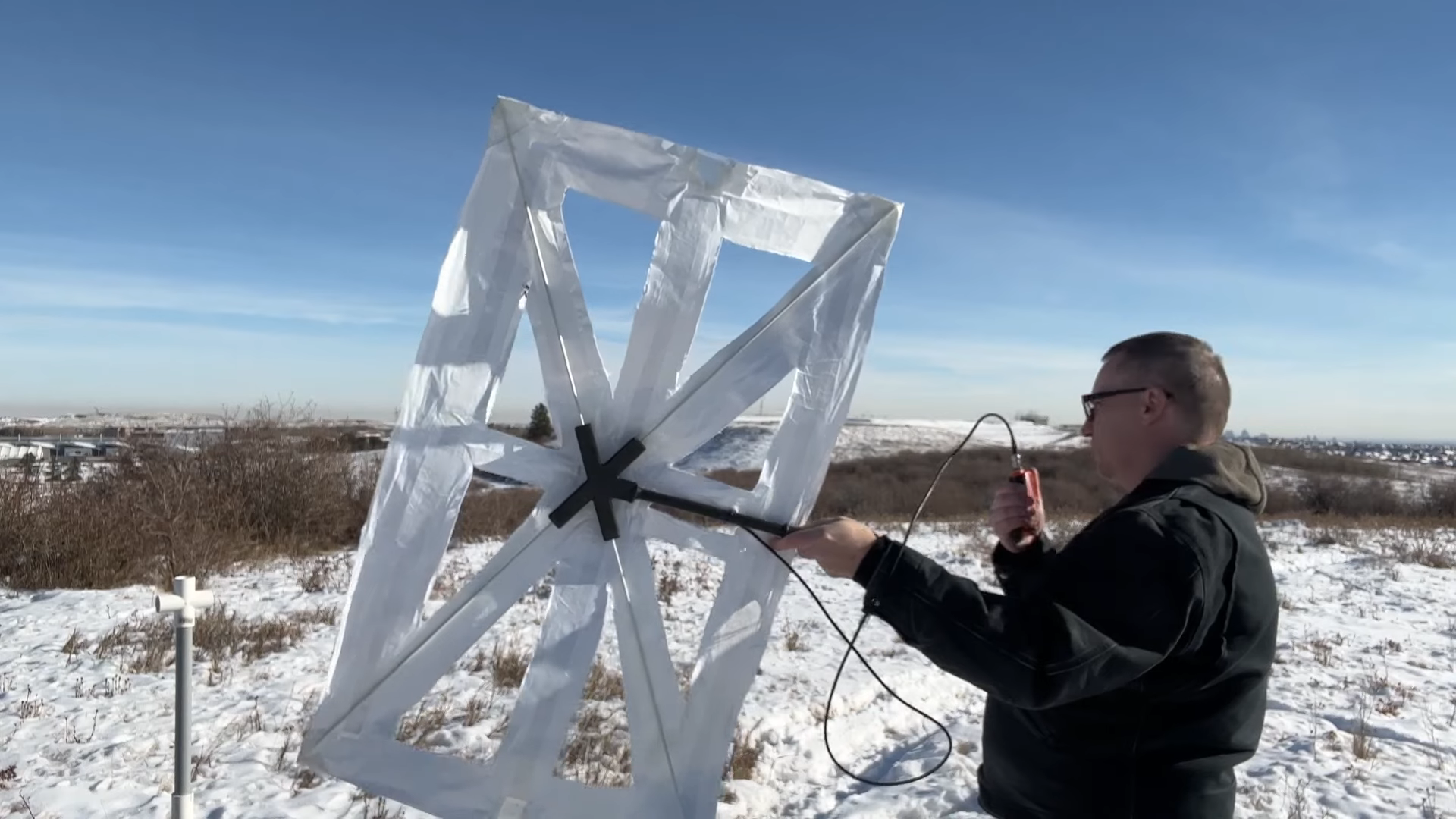
A pocketable Yagi antenna sounds like something a radio operator would invent after staring at a roll of copper tape and thinking, “You know what this needs? Superpowers.” Yet the idea is not science fiction. A compact, roll-up Yagi antenna can give a handheld radio a surprising boost in the direction that matters, especially on VHF bands such as 2 meters. It will not bend physics, bribe the ionosphere, or turn a five-watt handheld into a mountaintop repeater. But when designed carefully, aimed properly, and used in favorable terrain, it can turn a modest portable setup into a remarkably capable distance machine.
The phrase “Pocketable Yagi Antenna Really Shoots For Distance” captures why this little antenna has caught the imagination of amateur radio builders. Traditional Yagi-Uda antennas are known for gain, directionality, and long-distance communication, but they are usually not known for slipping into a backpack like a snack bar. The pocketable version changes the personality of the design. Instead of aluminum rods on a rigid boom, it may use copper foil tape, flexible backing material, packing tape reinforcement, fiberglass rods, and a compact handle. The result is a beam antenna that rolls up, deploys quickly, and points radio energy like a flashlight instead of a bare bulb.
What Is a Yagi Antenna?
A Yagi antenna, also called a Yagi-Uda antenna, is a directional antenna made from multiple elements arranged in a line. The basic design includes a driven element connected to the radio, a reflector behind it, and one or more directors in front. The reflector is typically slightly longer than the driven element, while the director is slightly shorter. These passive elements are not directly connected to the transmitter, but they interact with the radio waves and reshape the radiation pattern.
In plain English, a Yagi takes energy that would normally spread in many directions and concentrates more of it forward. That is why operators call it a “beam.” It does not create power out of nowhere. Instead, it focuses available power into a preferred direction. Think of squeezing a garden hose nozzle: the water source is the same, but the stream reaches farther because it is concentrated. A Yagi does something similar with radio-frequency energy.
Why Pocketable Matters
Most people imagine antennas as roof-mounted metal sculptures, vehicle whips, or wire contraptions that look suspiciously like laundry projects. Those work well, but they are not always convenient. Portable operators, hikers, emergency communicators, satellite chasers, and radio direction-finding fans often need something light, fast, and effective.
A pocketable Yagi antenna solves a practical problem: how do you bring directional gain into the field without carrying a rigid antenna that pokes your backpack, annoys your hiking partner, and tries to become a sail in the wind? A roll-up design made with copper foil tape on a flexible backing can be folded or rolled for transport. When needed, it can be stretched out, supported, connected to a handheld or portable radio, and aimed toward the target station.
This is especially useful on the 2-meter amateur radio band, where repeaters, simplex contacts, and local emergency communication are common. A rubber-duck antenna on a handheld radio is convenient, but convenience is not the same as performance. The stock antenna is often a compromise: small, rugged, and easy to use, but not very efficient. A compact Yagi adds direction and gain, which can make the difference between “nothing heard” and “full quieting.”
The Genius of a Copper-Foil Yagi
The pocketable Yagi concept became especially interesting when builders began using copper foil tape as the antenna conductor. Copper tape is thin, conductive, inexpensive, and easy to apply to flexible surfaces. Placed on a sheet of tough material such as Tyvek, it can form the reflector, driven element, and director without requiring rigid rods. Reinforcement with packing tape helps protect the copper and backing from wear. Fiberglass rods or similar lightweight supports can keep the antenna flat enough to maintain its shape during operation.
One well-known example used a three-element layout for the 2-meter band and reportedly reached repeaters roughly 90 kilometers away with usable signal reports, with an even more distant repeater around 150 kilometers barely reachable under favorable conditions. That is impressive not because a Yagi antenna can reach distancethat is what Yagis dobut because this one can roll up and fit into a pocket or small pack. It is the radio equivalent of a collapsible fishing rod that somehow lands a marlin.
Key Parts of the Design
The most important parts of a pocketable Yagi antenna are simple but precise. The reflector sits behind the driven element and helps reduce radiation to the rear. The driven element connects to the coax feed line and transfers energy between the radio and antenna. The director sits in front and helps reinforce the forward beam. Element length, spacing, alignment, and feed-point matching all matter. A Yagi is forgiving enough for home builders, but not so forgiving that measurements become optional decoration.
For VHF work, even small construction errors can shift resonance or reduce performance. Tape width, backing material, nearby hands, coax routing, and support rods can all influence the final result. That is why a successful pocketable Yagi is not just a craft project. It is a craft project that quietly took an RF engineering class.
How It Shoots for Distance
Distance in VHF radio is shaped by several factors: antenna gain, antenna height, terrain, line of sight, polarization, repeater location, feed-line loss, and the sensitivity of the receiving station. A pocketable Yagi helps with one major piece of the puzzle: gain in the desired direction. By focusing signal toward a repeater or station, it improves effective radiated power in that direction and improves received signal strength from that direction.
On VHF, line of sight is a big deal. Hills, buildings, trees, and the curve of the Earth are not sentimental about your radio goals. They block or weaken signals. But if the repeater is high on a mountain, tower, or tall building, and the operator has a reasonably clear path, a directional antenna can dramatically improve communication. A handheld radio with a stock antenna may struggle. The same radio connected to a properly aimed Yagi may open the repeater cleanly.
Gain Is Not Magic, but It Feels Like It
Forward gain is one reason Yagi antennas are popular. A three-element Yagi for VHF commonly offers useful gain while staying compact enough for handheld use. More elements can add more gain, but they also increase size, narrow the beam, and make the antenna more fussy. For a pocketable antenna, three elements are a sweet spot: simple enough to build, light enough to carry, and directional enough to matter.
Another important feature is the front-to-back ratio. A good Yagi not only strengthens signals from the front; it also rejects some signals from the back. This can help reduce interference and make the antenna useful for direction finding. Rotate the antenna slowly, listen for the signal peak or null, and suddenly radio becomes a treasure hunt with more beeping and fewer pirates.
Best Uses for a Pocketable Yagi Antenna
1. Reaching Distant Repeaters
The most obvious use is accessing repeaters that are too weak for a stock handheld antenna. If you are camping, hiking, or operating from a temporary location, a pocketable Yagi can help you aim at a known repeater and improve both transmit and receive performance. This is especially useful when terrain gives you a partial path but your standard antenna cannot quite make the trip.
2. Radio Direction Finding
Yagi antennas are favorites for fox hunting, also known as amateur radio direction finding. In a fox hunt, operators locate a hidden transmitter by comparing signal strength from different directions. A lightweight Yagi is perfect because it can be carried by hand, turned quickly, and used to find signal peaks or nulls. It turns the operator into a human antenna rotor, which is less glamorous than it sounds but very effective.
3. Emergency and Field Communication
In emergency communication, portability matters. A roll-up Yagi can be stored in a go bag and deployed when local infrastructure is limited or when a specific repeater must be reached. It is not a replacement for training, licensing, planning, or reliable power, but it is a practical tool that adds flexibility. When every decibel counts, directional gain is not a luxury; it is a small advantage that can carry a big message.
4. Satellite and Weak-Signal Listening
Directional antennas are also helpful for receiving weak signals, including satellites and weather transmissions, depending on frequency and design. A pocketable Yagi built for the correct band can make portable listening more practical. The operator still has to aim accurately, match polarization when possible, and avoid tangling the coax like spaghetti with ambition.
Building Considerations Before You Start
A pocketable Yagi antenna may look simple, but a good build requires careful choices. The backing material should be strong, lightweight, weather resistant, and dimensionally stable. Tyvek-style material is attractive because it is tough and flexible. Copper foil tape should have reliable conductivity, and builders should be careful where the adhesive is conductive and where it is not. The feed point should be mechanically supported so the coax does not peel the driven element loose.
Support matters too. A flexible antenna must become flat and predictable when deployed. Fiberglass rods are useful because they are light, nonconductive, and stiff enough to hold shape. A 3D-printed handle can make aiming easier and keep hands away from sensitive parts of the antenna. Hands contain water and salt, which are excellent for detuning antennas and reminding operators that the human body is basically a walking RF accessory.
Mind the Feed Line
The coax cable is not just a leash for your radio. Poor coax routing can affect the pattern, introduce loss, or cause common-mode current. A simple choke or ferrite near the feed point may help in some designs. The goal is to let the antenna be the antenna and not accidentally recruit the feed line into the performance. Antennas are team players until the coax starts freelancing.
Check SWR and Resonance
Anyone transmitting should test the antenna with an antenna analyzer or SWR meter suitable for the frequency and power level. A low standing wave ratio does not guarantee a perfect radiation pattern, but it helps confirm that the transmitter is seeing a reasonable load. If the SWR is high, adjust element lengths, inspect connections, and confirm the feed-point design before transmitting. For receive-only experiments, matching is less critical, but still useful for performance.
Limitations: What a Pocketable Yagi Cannot Do
No antenna is perfect. A pocketable Yagi antenna trades ruggedness and precision for portability. Wind can flex the surface. Rain can change the behavior of materials. Repeated rolling can stress copper tape. The antenna may be more fragile than a metal-rod Yagi, and it may need careful handling to preserve alignment.
It is also narrowband compared with many general-purpose antennas. A Yagi designed for one part of the 2-meter band may not perform equally across every nearby frequency. If you want one antenna to do everything from VHF repeaters to UHF satellites to Wi-Fi experiments, prepare for disappointment wearing a lab coat. Antennas are usually happiest when designed for a specific job.
Finally, users must follow radio regulations. In the United States, transmitting on amateur bands requires the proper amateur radio license, and operators must follow FCC Part 97 rules. A better antenna does not grant permission to transmit wherever you like. It only makes your legal signal more effective. That is less rebellious, but it keeps the hobby healthy.
Practical Experience: What It Feels Like to Use One
Using a pocketable Yagi antenna in the field feels different from using a normal handheld radio. With a rubber-duck antenna, you often key up, hope for the best, and perform the classic “radio operator dance,” which involves raising the radio, turning your body, stepping three feet left, and pretending this was your plan all along. With a Yagi, the process becomes more intentional. You aim, listen, rotate, compare signal strength, and learn the landscape through RF.
The first surprise is how directional the antenna feels. A weak repeater that sounds scratchy from one direction may become clearer when the antenna is pointed correctly. Turn it away, and the signal may fade. That immediate feedback is satisfying because it makes invisible radio waves feel almost visible. You are not just using equipment; you are steering energy through space.
The second surprise is how much location still matters. A pocketable Yagi can improve your odds, but it cannot bulldoze a mountain. Moving from a parking lot to a small hill, stepping away from a building, or getting above a metal railing may improve performance more than adding another element. The best field results often come from combining antenna gain with smart positioning. Height, clear line of sight, and patience are still the holy trio of VHF success.
In real use, setup speed matters. A design that rolls up neatly and deploys in a minute is more likely to be carried and used. If the antenna requires a toolbox, a folding table, three emotional support clamps, and a prayer to the soldering gods, it may stay home. The beauty of a pocketable Yagi is that it invites experimentation. You can carry it on a short hike, test a repeater from a scenic overlook, use it during a club fox hunt, or compare it against a standard whip antenna in your backyard.
There is also a learning curve. Aiming a handheld Yagi takes practice. Polarization matters: many FM repeaters use vertical polarization, so the antenna elements should be oriented accordingly. If the antenna is tilted the wrong way, signals can drop dramatically. Coax strain matters too. Let the feed line hang naturally and avoid wrapping it around the antenna structure. Keep your hand near the handle, not near the driven element. Small details can decide whether the antenna behaves like a beam or like a confused copper placemat.
The most enjoyable part is the sense of discovery. A pocketable Yagi turns radio operation into a small experiment every time. You begin noticing ridgelines, rooftops, valleys, towers, and open spaces. You learn which repeaters are easy, which are stubborn, and which only respond when the weather, terrain, and antenna aim all agree to cooperate. That is the charm of amateur radio: the equipment is technical, but the experience is wonderfully human. Sometimes the signal booms in. Sometimes it whispers. Sometimes it vanishes when you move your elbow. Either way, you learn something.
Conclusion
A pocketable Yagi antenna really does shoot for distance, not by cheating physics, but by using physics with excellent manners. It focuses radio energy forward, improves weak-signal reception, helps reach distant repeaters, and supports field activities such as fox hunting and emergency communication. Its real magic is portability. By replacing rigid metal elements with copper foil tape on a flexible backing, builders can create a directional antenna that rolls up, travels light, and deploys quickly.
It is not the strongest antenna, the widest-band antenna, or the best choice for every job. But for portable VHF work, it is clever, affordable, educational, and fun. It reminds us that great radio projects do not always require a tower, a machine shop, or a budget large enough to scare your wallet. Sometimes they start with copper tape, careful measurements, and the irresistible urge to see just how far a small antenna can reach.