

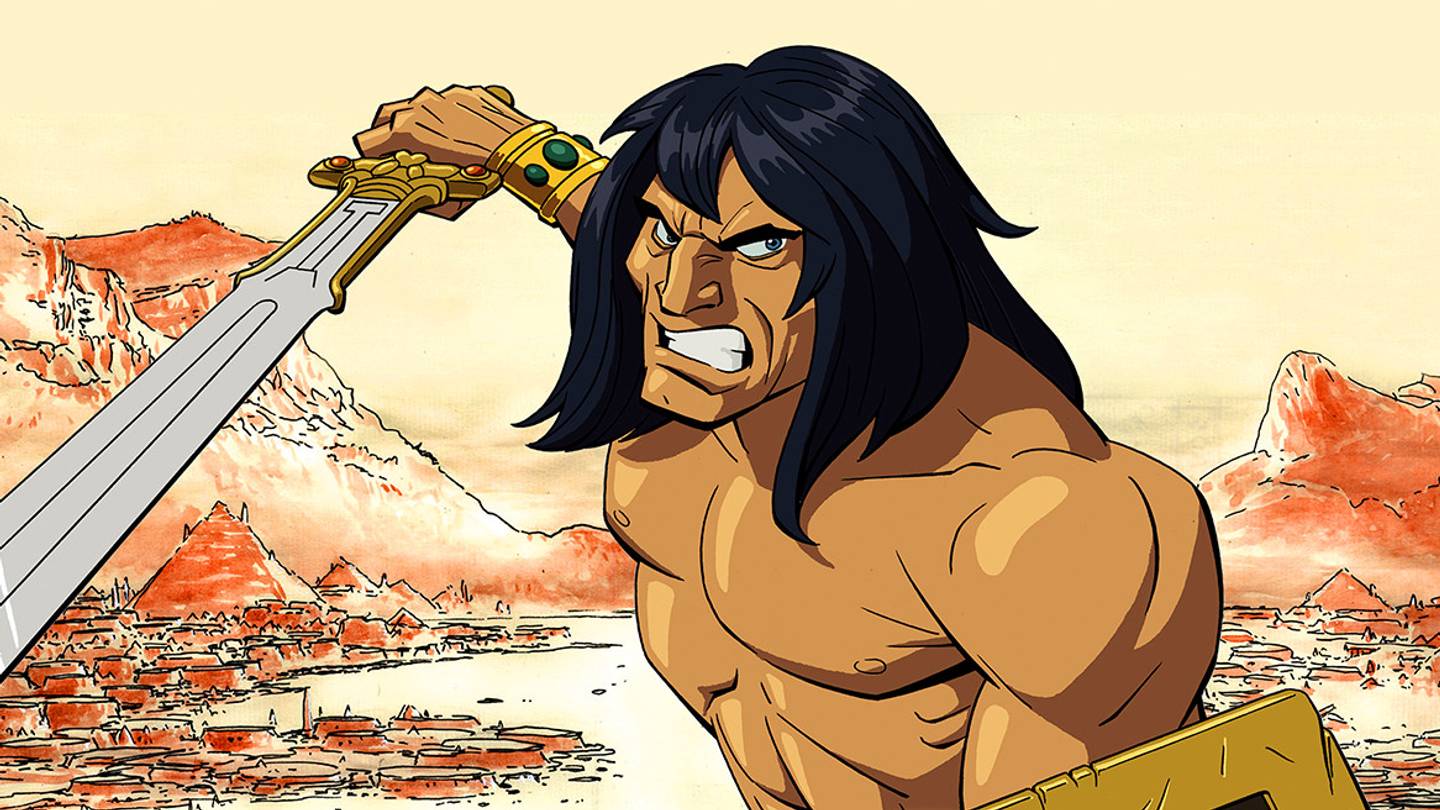
Some lost movies disappear quietly. Others leave behind enough concept art, casting news, fan chatter, and “what could have been” energy to haunt fantasy lovers like a cursed jewel in a forgotten temple. Conan: Red Nails belongs firmly in the second category.
Announced in the mid-2000s as a bold, adult-leaning animated adaptation of Robert E. Howard’s final Conan story, Red Nails promised something fans had been craving for decades: a Conan movie that leaned closer to Howard’s grim, muscular pulp fiction than the lighter Saturday-morning versions or the larger-than-life Arnold Schwarzenegger films. It had a famous cast, serious fantasy credentials, a brutal source story, and enough ambition to make a Cimmerian raise an eyebrow.
Then, like so many promising genre projects, it stalled. The movie was never finished. No proper release followed. No triumphant premiere. No collector’s edition Blu-ray with a commentary track titled “Oops, Financing Happened.” What remains is a fascinating case study in fantasy adaptation, animation economics, and the eternal difficulty of making an adult animated film in a market that often assumes animation must be either family-friendly or imported from Japan.
What Was Conan: Red Nails Supposed to Be?
Conan: Red Nails was planned as a feature-length animated movie based on Robert E. Howard’s novella “Red Nails.” The project came from Swordplay Entertainment, with Steve Gold involved as writer and producer, and Victor Dal Chele attached as director. The film was designed as a 2D/3D animated feature, initially aimed at a home-video release in 2006.
That alone made it unusual. In the 2000s, direct-to-DVD animation was booming, but most of it was built around superheroes, family franchises, or familiar TV properties. Conan was something else: pulp fantasy with a heavy sword, a darker worldview, and a body count that would make a network standards department faint into its bottled water.
The movie was not pitched as a goofy barbarian romp. Its creative team wanted a more faithful adaptation of Howard’s story, which is famous among Conan readers for its enclosed setting, decaying civilization, fatalistic tone, and relentless conflict. Instead of turning Conan into a quippy mascot with a sword-shaped lunchbox, Red Nails was meant to embrace the dangerous, grim, and primal energy that made the original stories last.
The Original “Red Nails”: Howard’s Final Conan Story
To understand why this unfinished movie still matters, you have to understand the source material. “Red Nails” was serialized in Weird Tales in 1936 and is widely recognized as the last Conan story Robert E. Howard wrote. It follows Conan and Valeria, a fierce pirate and warrior, as they enter the strange enclosed city of Xuchotl.
Xuchotl is not a cheerful fantasy city with singing villagers and a nice bakery. It is a sealed, claustrophobic nightmare where two surviving factions are locked in a long, bitter feud. The “red nails” of the title refer to marks of vengeance and death, hammered into a pillar as a record of enemies killed. In other words, it is basically the worst homeowners association in fantasy literature.
The story is pure sword-and-sorcery pressure-cooker fiction. Conan and Valeria are outsiders entering a civilization that has turned inward, rotted, and become obsessed with revenge. The tale includes lost-city mystery, monsters, political treachery, sorcery, and violent confrontations, but its deeper theme is decay. Howard often contrasted “barbarism” and “civilization,” and “Red Nails” is one of his bleakest examples of civilization collapsing under its own cruelty.
Why This Story Was a Perfect Fit for Animation
On paper, “Red Nails” practically begs for animation. The city of Xuchotl is enclosed, alien, and theatrical. Its corridors, chambers, and eerie architecture could be designed with expressionistic intensity rather than limited by live-action sets. The monsters could be larger than life. The action could be staged with impossible camera angles. Valeria and Conan could move with comic-book power instead of being trapped by practical stunt limitations.
Animation also offered a chance to present Conan in a way that live action had struggled to capture. Howard’s Conan is not merely a strong man in a loincloth. He is alert, predatory, skeptical, and surprisingly intelligent in a practical, survival-driven way. A good animated version could exaggerate his physicality while still preserving his watchful, dangerous presence.
That was the dream: a Conan movie that looked like pulp illustration had kicked open the door, stolen the torches, and declared war on safe fantasy.
The Voice Cast Was Ridiculously Promising
One reason Conan: Red Nails still gets discussed is its cast. Ron Perlman was set to voice Conan, which made instant sense. Perlman’s voice has the gravelly authority of a man who could order soup and make it sound like a battlefield command. After Hellboy, he already had credibility with comic-book and fantasy fans, and his natural vocal weight suited Conan’s blunt, hard-edged personality.
The broader announced cast reportedly included Mark Hamill, Marg Helgenberger, James Marsden, Clancy Brown, and Cree Summer. That is not a “we found three people near a microphone” lineup. That is a serious voice cast with range, genre recognition, and enough charisma to make even exposition about ancient feuds sound expensive.
Mark Hamill, in particular, brought major animation prestige thanks to his legendary voice work. Clancy Brown had the kind of commanding presence ideal for villainous or morally jagged characters. Cree Summer’s animation experience made her a strong fit for a fierce character like Valeria. The casting suggested the producers were not treating this as a disposable side project. They wanted the movie to land.
The Creative Team Had Real Genre Credentials
The project also had notable artists and creators attached. W. Michael Kaluta was named as a key concept designer, while Mark Schultz contributed additional designs. For fantasy and comics fans, those names mattered. Kaluta’s work carried the kind of elegant, moody detail that could bring Howard’s world to life, while Schultz’s adventure-art instincts fit Conan’s prehistoric danger and muscular action.
Victor Dal Chele, known for work in animation including series such as Spider-Man and The Real Ghostbusters, was attached to direct. Steve Gold had prior experience with Conan animation through Conan and the Young Warriors, a much more kid-friendly television version. That earlier show had to soften Conan considerably. Red Nails, by contrast, aimed to remove the foam padding.
The intention was not simply to make “Conan, but animated.” It was to make a Conan adaptation that took Howard seriously, respected the original tone, and used animation to go where live action and children’s television could not.
So Why Wasn’t Red Nails Finished?
The short answer is money. The longer answer is money wearing a horned helmet and swinging a battle axe at the production schedule.
Adult-oriented animation has always been a tricky business in the United States. In Japan, animation for older audiences has long had more cultural and commercial space. In the American market, however, animated features are often expected to be family films, comedies, or superhero-adjacent projects. A violent, faithful Conan adaptation aimed at older viewers sat in an awkward commercial zone.
The project was announced with enthusiasm and seemed to move through design and production planning. New Line Home Entertainment had North American distribution rights, and early reporting pointed toward a planned DVD release. But production momentum is not the same as completion. Financing, shifting animation trends, and market uncertainty appear to have weighed heavily on the film.
The mid-to-late 2000s were also a turbulent time for entertainment financing. The 2007–2009 economic downturn made risky projects even riskier. An adult animated sword-and-sorcery film based on a pulp story from 1936 may sound irresistible to fans, but to financiers, it could look like a spreadsheet with a sword wound.
The 2D vs. 3D Problem
Another challenge was timing. Conan: Red Nails emerged during a period when traditional 2D animation was losing ground in the American feature market. Computer animation was becoming dominant, and studios were chasing the success of 3D family films. A project originally imagined with strong 2D roots faced pressure from an industry increasingly obsessed with digital spectacle.
Reports and retrospectives suggest the film shifted toward a 2D/3D hybrid approach. That may have made creative sense for monsters, environments, and action staging, but hybrid animation can be expensive and technically complicated. It also requires a clear pipeline, consistent style, and enough funding to avoid looking like two different movies got into a tavern fight.
For a project already operating outside the safest commercial lane, those added complications mattered. A faithful, violent Conan feature needed confidence from investors and distributors. Instead, it seems to have encountered hesitation, delays, and eventually silence.
What Made This Conan Different?
The key difference was fidelity. Many Conan adaptations borrow the character’s muscles, sword, and general atmosphere, then build something new around him. That approach can work, but it often drifts away from Howard’s particular flavor of sword-and-sorcery.
Howard’s Conan is not a generic fantasy hero. He is not on a noble quest to restore balance to the Crystal Kingdom of Nice Feelings. He survives. He steals. He fights. He judges civilization with suspicion because, in Howard’s world, civilized people often disguise greed, cruelty, and corruption beneath perfume and architecture.
Red Nails captures that worldview sharply. The city of Xuchotl is technically “civilized,” but it is spiritually exhausted. Its people have inherited a feud that consumes them. Conan, the so-called barbarian, becomes the clearest-eyed person in the room. That irony is central to Howard’s appeal, and the animated film seemed designed to preserve it.
Valeria: More Than a Sidekick
Another reason fans remain intrigued by Red Nails is Valeria. She is one of Howard’s most memorable female characters: dangerous, independent, and capable in a fight. In a less thoughtful adaptation, she could have been reduced to decoration or a damsel. But the original story gives her agency, attitude, and sharp survival instincts.
A strong animated adaptation could have made Valeria a major selling point. She is not simply “the woman next to Conan.” She is a pirate, a fighter, and a character with her own pride. Her dynamic with Conan is tense, competitive, and charged with mutual respect. In modern terms, she is exactly the kind of character who could help sell the film beyond nostalgia.
Had the movie been completed, Valeria might have become one of the best reasons to revisit Conan animation. Instead, she remains another part of the project’s unfinished promise.
Why Fans Still Talk About It
Unfinished films often grow in reputation because imagination fills the gaps. A completed film can disappoint you in high definition. An unfinished one remains perfect in theory. Conan: Red Nails benefits from that strange magic.
Fans know enough to be excited: Ron Perlman as Conan, a serious source story, respected concept artists, a darker tone, and a plan to adapt Howard more faithfully. But they do not have enough to judge the final result. The missing movie becomes a fantasy object of its own.
It also represents a path not taken. Imagine if Red Nails had succeeded. It might have opened the door for more animated Conan features, perhaps adapting stories like “The Tower of the Elephant,” “Queen of the Black Coast,” or “Beyond the Black River.” It might have proven that American adult fantasy animation could live somewhere between children’s cartoons and niche imports.
The Bigger Problem: Adult Fantasy Animation in America
The failure of Red Nails to reach completion says something bigger about the entertainment industry. American animation has often struggled to escape the assumption that animation equals children’s entertainment. There are exceptions, of course, especially in television comedy and superhero projects. But adult dramatic animation, especially fantasy animation, has had a harder road.
Conan is a natural fit for animation, but he is not a natural fit for toy-aisle logic. His stories are violent, morally rough, and suspicious of polite society. That makes him compelling, but also harder to package. A faithful Conan animated movie would need to be marketed with confidence: not as a cartoon for kids, not as a parody, but as a serious pulp fantasy adventure.
Today, the market might be more ready. Streaming platforms have made room for adult animation, game adaptations, dark fantasy series, and mature genre storytelling. A completed Red Nails might have struggled in 2006, but in the current media landscape, the idea feels less strange. In fact, it feels obvious.
Could Red Nails Ever Be Revived?
Never say never in Hollywood, where dead projects sometimes rise again with new financing, new technology, and a new executive who just discovered the word “IP.” Conan remains a recognizable fantasy brand, and Robert E. Howard’s original stories still have passionate readers. A modern animated Conan project could absolutely work if handled with taste, confidence, and the right creative team.
That does not mean the original Conan: Red Nails will be completed as planned. Too much time has passed, and production materials, rights arrangements, and market strategies may have changed. But the concept remains powerful. A faithful animated Conan anthology or feature series could adapt Howard’s stories with visual ambition and tonal seriousness.
If that ever happens, Red Nails would still be one of the most logical stories to adapt. It is contained, intense, visually distinctive, and thematically strong. It has monsters, mystery, betrayal, and two memorable leads. It also has a setting that animation could transform into a jewel-toned nightmare. That is not a pitch; that is a treasure chest sitting in plain sight.
Why the Unfinished Movie Still Matters
Conan: Red Nails matters because it represents an ambitious attempt to treat pulp fantasy as serious visual storytelling. It was not trying to sand down Conan until he became safe. It was trying to bring the danger back.
The unfinished film also reminds us that adaptation history is not only made of hits and flops. It is also made of near-misses: projects that almost happened, careers that nearly intersected, designs that never moved beyond production art, and performances recorded for movies audiences never got to see.
In some ways, Red Nails has become the perfect Conan artifact. It is half legend, half ruin. Fans explore it like adventurers entering Xuchotl, finding traces of a lost civilization and wondering what disaster ended it. The answer, sadly, was not an ancient curse. It was production reality. Less poetic, perhaps, but far more common.
Experience Section: Watching the Ghost of a Movie That Never Arrived
There is a particular kind of frustration that comes with discovering an unfinished film years after the fact. It feels like arriving late to a feast and finding only a dented goblet, a torn banner, and one suspiciously confident guy saying, “You should have seen it earlier.” That is exactly the feeling many Conan fans get when they learn about Conan: Red Nails.
The experience begins with disbelief. Ron Perlman as Conan? Mark Hamill involved? A darker animated adaptation of one of Howard’s best stories? New Line attached for distribution? It sounds less like a lost production and more like a fan casting thread that somehow got a budget. Then the disappointment lands: the movie was never finished. The barbarian reached the gates, but the financing dragon was waiting inside.
For longtime fantasy readers, the loss feels especially sharp because “Red Nails” is not just another Conan adventure. It is one of those stories that sticks in the mind because of its atmosphere. Xuchotl feels airless and cursed. The feud between its factions is not heroic; it is obsessive and exhausting. Conan and Valeria are not entering a world that needs saving. They are entering a world that may already be too far gone. That kind of story could have made an animated film feel different from the usual fantasy formula.
There is also the “almost” factor. Some canceled projects are easy to shrug off because they never moved beyond vague announcements. Red Nails got further than that. It had names, designs, production goals, and a clear identity. That makes it more painful. It was not a cloud castle. It had foundations.
As a viewing experience, the surviving material creates a strange form of imaginary cinema. You picture Perlman’s Conan moving through green-lit corridors, Valeria watching every shadow, and ancient enemies whispering from behind carved doors. You imagine the animation blending comic-book boldness with pulp horror. You imagine the soundtrack rumbling like distant war drums. Then you remember none of it exists as a finished film, and suddenly your inner fan lets out a noise usually reserved for stepping on a LEGO barefoot.
But that disappointment also explains the project’s lasting appeal. Finished movies become fixed objects. Lost movies stay alive in speculation. Conan: Red Nails remains exciting because it still feels possible in the imagination. Every few years, when adult animation gains ground or another fantasy property succeeds, the same thought returns: maybe Conan’s best animated form is still waiting.
The lesson is not simply “Hollywood cancels cool things,” though that sentence could probably be printed on a studio parking pass. The real lesson is that timing matters. In 2006, an adult animated Conan feature was a risky bet. Today, after years of streaming experiments, mature animation, and renewed interest in fantasy worlds, it might look much more viable. The audience did not vanish. It was always there, polishing its sword and waiting for someone to take the genre seriously.
That is why Red Nails continues to fascinate. It is not just an unfinished movie. It is a glimpse of a Conan adaptation that understood the assignment before the market knew how to grade the paper.
Conclusion
Conan: Red Nails is one of the great “what if?” stories in fantasy animation. It had a rich source, a strong cast, a serious creative team, and a vision that aimed to honor Robert E. Howard’s fierce, shadowy world. Yet ambition was not enough. Financing challenges, market uncertainty, and the difficulty of selling adult American animation helped bury the project before it could reach audiences.
Still, the unfinished movie refuses to disappear. Like Conan himself, it keeps pushing through the ruins. Fans remember it because it represented a version of Conan that might have been raw, stylish, violent in purpose rather than spectacle, and closer to Howard’s original vision. Whether or not this exact project is ever revived, the idea behind it remains strong: Conan belongs in animation, and “Red Nails” may still be one of the best stories to prove it.