

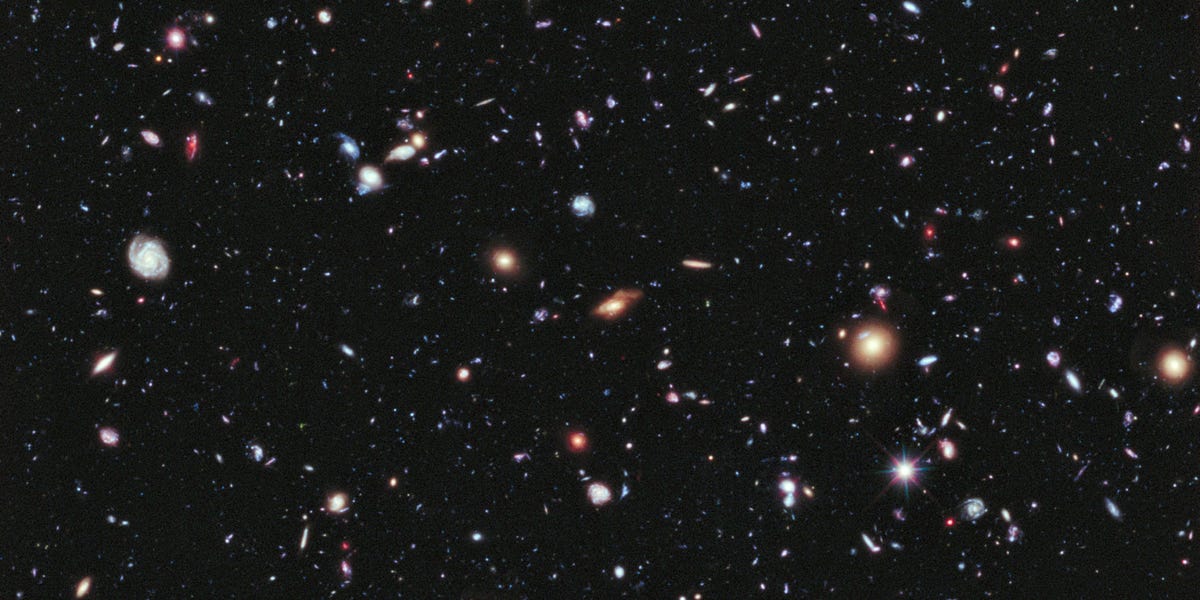
Note: The “20 times more galaxies” idea refers to the dramatic revision of galaxy-count estimates in the observable universe. The most widely cited scientific estimate places the number at about two trillion galaxies, far above older counts of roughly 100 to 200 billion. Some summaries describe the jump as “at least 10 times” higher, while others phrase it as “up to 20 times” higher depending on which older baseline is used.
A Crowded Universe Hiding in Plain Sight
For decades, the universe already seemed absurdly crowded. Astronomers looked at deep images from the Hubble Space Telescope and estimated that the observable universe contained somewhere around 100 billion to 200 billion galaxies. That number is so large it practically refuses to sit politely in the human brain. Yet the cosmos, with its usual flair for understatement, appears to have been hiding a much bigger guest list.
Newer analysis of deep-space surveys suggested that the observable universe may contain about two trillion galaxies. That is not two trillion stars. It is two trillion galaxies, each one potentially holding millions, billions, or even trillions of stars. Suddenly, the universe did not merely become “larger” in our imagination. It became more layered, more ancient, and much better at keeping secrets than we had given it credit for.
The key point is not that astronomers simply missed a few bright spirals hanging around the cosmic neighborhood. Most of the missing galaxies are thought to be small, faint, distant, and ancient. They are not easy to photograph. They are more like cosmic whispers than fireworks. Hubble helped reveal the pattern, but the majority of these galaxies are too dim or too far away to be seen directly with ordinary visible-light surveys.
How Did Scientists Recount the Universe?
Counting galaxies sounds simple until you remember that the universe is expanding, light takes time to travel, galaxies evolve, and a large fraction of the objects in question are too faint for today’s telescopes to see clearly. This is less like counting apples in a basket and more like counting every firefly that ever blinked in a foggy forest over 13 billion years.
The famous revision came from a team led by astronomer Christopher Conselice. Researchers used deep-space images from Hubble and other observatories, then converted those observations into three-dimensional models. Instead of only counting galaxies visible in a single image, they studied how galaxy numbers changed across cosmic time. They also used mathematical models to estimate the number of galaxies too faint or too distant for current telescopes to detect.
Why Hubble Deep Fields Changed Everything
The Hubble Deep Field, Ultra Deep Field, and eXtreme Deep Field are among the most important images ever taken in astronomy. They look at tiny patches of sky that seem nearly empty to ground-based observers. Hubble stared into those dark regions for long periods and found thousands of galaxies packed into areas so small they could be covered by a grain of sand held at arm’s length.
The Hubble Ultra Deep Field revealed nearly 10,000 galaxies in a tiny slice of sky. The eXtreme Deep Field, built from years of Hubble observations, showed about 5,500 galaxies, including some whose light has traveled for more than 13 billion years. These images gave astronomers a time machine. The deeper Hubble looked, the younger the universe appeared.
But even Hubble has limits. The faintest galaxies are incredibly difficult to detect. Some are small early galaxies that later merged into larger systems. Others are so redshifted by the expansion of space that their visible light has stretched into infrared wavelengths. That is where newer observatories, especially the James Webb Space Telescope, become essential.
Why Were So Many Galaxies Missed?
The missing galaxies were not hiding behind a curtain with a mischievous “guess again” sign. They were missed because the universe is vast, old, and not especially concerned with making astronomy convenient.
First, many early galaxies were small. Compared with the Milky Way, they may have looked like cosmic building blocks rather than grand spiral cities. Second, many were faint. A galaxy can contain millions of stars and still be difficult to detect if it is extremely far away. Third, the expansion of the universe stretches light. The farther away a galaxy is, the more its light shifts toward redder and longer wavelengths. Eventually, a telescope designed mainly for visible light begins to lose the trail.
Another reason involves cosmic history. The early universe may have contained far more small galaxies per volume of space than the universe contains today. Over billions of years, many of those smaller galaxies merged. Their stars, gas, dust, and dark matter combined to create larger galaxies like the Milky Way. So when astronomers count galaxies today, they are not just counting objects scattered across space. They are reconstructing a family tree.
Two Trillion Galaxies Does Not Mean Two Trillion Milky Ways
When people hear “two trillion galaxies,” it is tempting to imagine two trillion giant spiral galaxies like the Milky Way, all posing beautifully for a space calendar. That is not the best picture. Many galaxies in the estimate are believed to be much smaller than the Milky Way. Some may resemble dwarf galaxies, the kind that orbit larger galaxies as satellites.
Our Milky Way is already a heavyweight, containing hundreds of billions of stars. Smaller galaxies can contain far fewer stars, yet they still matter enormously. They are the bricks from which larger galaxies were built. In the early universe, these smaller systems formed stars, collided, merged, and helped shape the cosmic web we observe today.
This is why the revised galaxy count is so important. It does not merely inflate a number. It changes how scientists think about galaxy evolution. If the early universe was packed with small, faint galaxies, then galaxy growth was a far more active and messy process than a simple “small cloud becomes big galaxy” story. The universe built itself through collisions, mergers, bursts of star formation, and gravitational teamwork on a scale that makes even the busiest airport look relaxed.
What This Means for the Observable Universe
The phrase “observable universe” is crucial. It means the region of the cosmos from which light has had time to reach us since the Big Bang. It does not mean the entire universe. In fact, scientists do not know whether the whole universe is finite or infinite. We can estimate the size of the observable portion, but beyond that horizon, direct observation becomes impossible.
The observable universe is about 92 billion light-years across. That may sound strange because the universe is about 13.8 billion years old. The reason is that space itself has expanded while light has been traveling. A galaxy whose light has traveled for over 13 billion years is now much farther away than 13 billion light-years in current distance.
So when astronomers say the observable universe may contain about two trillion galaxies, they are talking about the part of the universe we can in principle observe from Earth. The total universe could be much larger. It may contain vastly more galaxies than we can ever detect. That thought is either thrilling, humbling, or a good reason to take a short walk and stare suspiciously at the sky.
How the James Webb Space Telescope Adds New Context
The James Webb Space Telescope does not simply take prettier pictures, although it certainly does that with style. Webb observes primarily in infrared light, making it ideal for studying galaxies whose light has been stretched by cosmic expansion. In other words, Webb is built to see some of the ancient, distant objects that Hubble could only hint at.
Webb’s first deep field showed thousands of galaxies in a tiny patch of sky, enhanced by gravitational lensing from a massive galaxy cluster. Gravitational lensing happens when gravity bends and magnifies light, turning a galaxy cluster into a natural cosmic telescope. It is one of the universe’s best party tricks: matter warps space, space bends light, and astronomers get a better view.
Webb has also identified extremely distant galaxies from the universe’s infancy. One major discovery, JADES-GS-z14-0, is seen as it existed less than 300 million years after the Big Bang. Finding such bright and developed galaxies so early raises fresh questions. How did stars form so quickly? How did galaxies grow so fast? Were early galaxies more efficient at turning gas into stars than expected?
These discoveries do not erase the Hubble-based galaxy-count estimate. Instead, they deepen the mystery. The more astronomers look, the more they find that the young universe was not a quiet waiting room. It was already busy forming stars, building galaxies, and setting the stage for cosmic structures that would later grow into the universe we see today.
Does This Solve the Dark Night Sky Problem?
The revised galaxy count also touches an old puzzle known as Olbers’ paradox. If the universe contains so many stars and galaxies, why is the night sky dark? Shouldn’t every direction eventually end at a star or galaxy, making the sky blaze like a giant cosmic billboard?
The answer involves several factors. The universe has a finite age, so light from every possible object has not had time to reach us. The universe is expanding, which stretches light and reduces its energy. Many galaxies are also too faint, too distant, or hidden by observational limits. So yes, the universe is full of galaxies, but it is not an infinite static lantern.
The new galaxy count actually makes the paradox more interesting. If there are far more galaxies than once thought, then the darkness of the night sky becomes even more informative. It tells us about cosmic expansion, the age of the universe, galaxy evolution, and the limits of observation. Darkness is not emptiness. It is data wearing a black hoodie.
What About New Horizons and the Cosmic Background Light?
In 2021, NASA discussed measurements from the New Horizons spacecraft that studied the cosmic optical background, the faint glow produced by all the stars and galaxies throughout cosmic history. Because New Horizons is far from the inner solar system, it can measure the darkness of space with much less interference from zodiacal light, the glow caused by sunlight reflecting off dust near the Sun.
Some headlines suggested that New Horizons meant there were fewer galaxies than the two-trillion estimate. The more careful interpretation is subtler. NASA clarified that those observations constrain the total amount of light emitted by galaxies in ultraviolet and optical wavelengths. They do not directly provide a final count of all galaxies. In simple terms, New Horizons helps measure the glow, while Hubble-based studies estimate the population.
This distinction matters. Astronomy often advances by comparing different types of evidence: images, spectra, background light, simulations, and models. When those tools disagree, science does not collapse. It gets interesting. The universe is not a spreadsheet with tidy columns. It is a crime scene, a history book, and a fireworks show all at once.
Why the Discovery Matters
The idea that the universe contains up to 20 times more galaxies than older estimates is not just a “wow” fact for science trivia night. It reshapes several major questions in cosmology and astrophysics.
1. Galaxy Formation Was More Active Than Expected
If the early universe contained far more small galaxies, then mergers played an even bigger role in building today’s massive galaxies. The Milky Way itself likely grew by absorbing smaller systems over time. In this view, large galaxies are not born fully grown. They are assembled through a long, chaotic process.
2. Star Formation History Becomes Richer
More galaxies means more places where stars could form. Even small galaxies can contribute to the total production of starlight across cosmic history. Understanding how many galaxies existed helps astronomers estimate how quickly the universe formed stars and how heavy elements spread through space.
3. Future Telescopes Have a Bigger Job
If most galaxies are still unseen, future observatories have an enormous mission ahead. Webb, Roman, Euclid, SPHEREx, and powerful ground-based telescopes will continue refining the census. Each new survey may reveal galaxies that were invisible to previous generations of instruments.
4. Our Place in the Cosmos Feels Even Smaller
There is no scientific law requiring discoveries to be emotionally convenient. Learning that the universe may contain two trillion galaxies makes Earth feel almost comically small. Yet it also makes our ability to understand the universe feel astonishing. A species on one planet, orbiting one star, in one galaxy, can infer the existence of galaxies it cannot directly see. That is not bad for creatures who occasionally misplace their car keys.
Experience: What It Feels Like to Understand a Two-Trillion-Galaxy Universe
The first time you truly sit with the idea of two trillion galaxies, the mind tends to do something funny. It either races outward or shuts down entirely. Numbers at this scale are not merely large; they are anti-intuitive. You can picture ten apples. You can picture a thousand people in a stadium section. You might even picture a billion grains of sand if you are feeling ambitious. But two trillion galaxies? That number breaks the furniture in the imagination.
One helpful experience is to go outside on a clear night and look at the darkest part of the sky you can find. At first, you see stars. If you are away from city lights, you may see the cloudy band of the Milky Way. But almost everything visible to the naked eye belongs to our own galaxy. The great cosmic census is not obvious from the backyard. The sky looks quiet because our eyes are small instruments with charming confidence and terrible exposure time.
Then look at a Hubble Deep Field image. What appears to be a black, empty patch of sky suddenly becomes crowded with galaxies. Not stars. Galaxies. Spirals, smudges, red dots, stretched arcs, tiny fragments of ancient light. Each one is a system with its own history. Some are young and chaotic. Some are mature and massive. Some are seen as they were billions of years before Earth existed. It feels less like looking at a picture and more like opening a trapdoor under reality.
That experience changes the way ordinary life feels. A traffic jam becomes less dramatic. A bad email becomes less apocalyptic. Even the daily chaos of human plans starts to look different when placed against a universe where galaxies collide over hundreds of millions of years and still somehow produce beauty. The two-trillion-galaxy idea does not make human life meaningless. If anything, it makes attention feel precious. We are brief observers in a vast universe, but we are observers nonetheless.
There is also a strange comfort in knowing that much of the universe remains unseen. Modern culture often acts as if everything important should be instantly visible, searchable, measurable, and available in high resolution. Astronomy says otherwise. The majority of galaxies may be beyond direct study for now. Some may remain faint forever. Knowledge grows not by seeing everything at once, but by learning how to ask better questions in the dark.
That is the real emotional power of this discovery. The universe did not become larger because humans noticed it. It was already there. What changed was our map. The cosmos reminded us that every confident estimate is provisional, every telescope is a beginning, and every dark patch of sky may be crowded with history. Somewhere in that darkness are galaxies too faint for Hubble, too ancient for easy measurement, and too numerous for casual imagination. And yet, piece by piece, we are learning how to count them.
Conclusion
The claim that the universe contains 20 times more galaxies than we thought is more than a dramatic headline. It captures a genuine shift in our understanding of the observable universe. Older estimates placed the galaxy population at roughly 100 billion to 200 billion. The revised estimate, built from deep-field observations and mathematical modeling, points toward about two trillion galaxies.
Most of those galaxies are not bright cosmic show-offs. They are likely small, faint, distant systems from the early universe, many of which merged over time into larger galaxies. Their existence helps explain how galaxies evolved, how stars formed across cosmic history, and why the universe we see today is the product of countless ancient collisions and transformations.
Hubble opened the door. Webb is pushing deeper into the infrared universe. New Horizons is helping measure the faint background glow of cosmic history. Future missions will sharpen the count. For now, the lesson is clear: the universe is not merely bigger than we imagined. It is richer, stranger, older, and far more crowded. The next time the night sky looks empty, remember that emptiness may simply be what the universe looks like before our instruments catch up.