

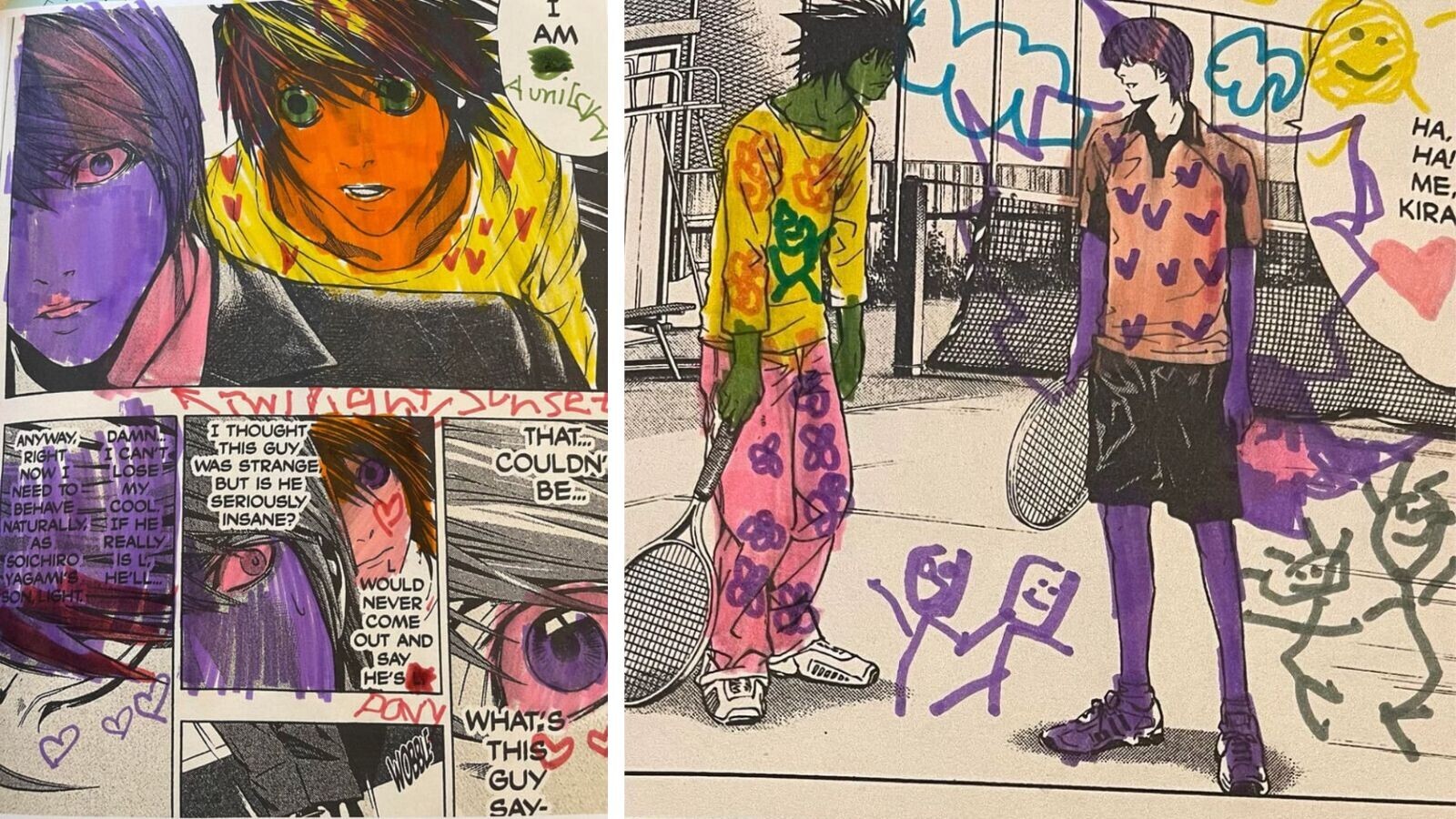
Every manga collector has a nightmare scenario. Some fear yellowing pages. Some fear sun-faded spines. Some fear the terrifying sound of a volume being opened flat like a pancake at a breakfast buffet. But there is one disaster that strikes faster than humidity, dust, and careless shelving combined: a 6-year-old with a box of crayons and the confidence of a museum artist.
One minute your manga shelf is peaceful. Your volumes are lined up like disciplined little soldiers, their spines shining in perfect order. The next minute, your prized copy has been “improved” with purple eyebrows, neon-green speed lines, a red sun in the corner of every panel, and a suspicious orange blob that may be a dragon, a meatball, or a commentary on modern society.
Welcome to the chaotic, colorful, slightly heartbreaking world of manga meeting childhood creativity. This article explores what really happens when a kid turns your black-and-white manga into a crayon-powered masterpiece, why children do it, what it means for collectors, how to respond without becoming a household villain, and how to protect your manga collection without banning joy from your home.
When Manga Becomes an Accidental Coloring Book
Manga is famous for its dramatic black-and-white artwork. The bold ink lines, expressive eyes, cinematic paneling, and intense emotional beats leave plenty of room for imagination. Unfortunately, to a 6-year-old, “room for imagination” often translates into “this page needs more blue.”
Children do not look at manga the same way collectors do. A collector sees first-print value, shelf condition, trim quality, page tone, and whether the spine has that tiny crease that ruins the vibe. A child sees a character with empty hair and thinks, “That person clearly needs rainbow bangs.”
That is the first thing that happens: your manga stops being a book and becomes a collaborative project. The original artist may have spent months refining the composition, but your tiny guest has strong opinions and a wax-based toolset. A serious battle scene becomes a birthday party. A mysterious villain receives pink cheeks. A tragic monologue gets a speech bubble that says, “I like pizza.”
The Collector’s First Reaction: Silent Screaming
If you love manga, your first reaction may not be graceful. You may experience several emotional stages in under ten seconds: confusion, disbelief, negotiation, dramatic internal music, and finally the painful realization that crayon does not politely erase itself from paper.
This is understandable. Manga collections can represent years of searching, saving, organizing, and emotional attachment. Some volumes are easy to replace, but others are out of print, limited edition, signed, imported, or simply tied to a memory. Maybe you bought that volume during a difficult time. Maybe it was your first manga. Maybe you found it in a used bookstore after hunting for months. Then suddenly, a small child named Lily has given the protagonist a mustache.
Still, before anyone panics, it helps to pause. The child probably did not think, “Today I will destroy market value.” More likely, they thought, “This picture is cool, and I can make it cooler.” Children draw to explore, communicate, imitate, and experiment. The problem is not creativity. The problem is that creativity chose the wrong canvas.
Why Kids Love Drawing on Manga Pages
There is a reason manga is so tempting to young children. The pages are full of clean outlines, expressive faces, action poses, and empty-looking spaces. To an adult reader, those open areas are part of the visual style. To a child, they look like an invitation.
1. Manga Looks Like a Coloring Page
Many manga pages are printed in black and white, which makes them visually similar to coloring books. A 6-year-old may not fully understand the difference between a printed storybook, an activity book, a comic, and an expensive collector’s edition. If it has outlines, it can be colored. That is the law of crayons.
2. Children Learn by Experimenting
Coloring helps children develop hand control, spatial awareness, decision-making, and cause-and-effect thinking. When they choose yellow for hair or red for a cape, they are not just decorating. They are making decisions, testing boundaries, and seeing what happens when their hand moves across the page.
3. They Want to Join the Story
A child may draw on manga because they are entering the world of the book. Adding hearts, stars, monsters, or extra dialogue is a form of participation. In their mind, they are not ruining the story. They are becoming part of it. That does not help your limited edition recover, but it does explain the motivation.
What Actually Happens to the Manga?
Crayon is made with waxy materials and pigments. On standard manga paper, it can leave a noticeable mark that sits partly on the surface and partly in the texture of the page. The softer and more absorbent the paper, the more stubborn the mark can be.
Here is the unfortunate truth: once crayon gets onto a manga page, perfect restoration is unlikely. You may reduce the mark, but you probably cannot make the page look factory-new again. Rubbing too hard can thin the paper, smear pigment, or create shiny spots. Moisture can warp pages or spread staining. Tape, glue, and aggressive cleaning methods can make the situation worse.
If the manga is valuable, rare, signed, or emotionally important, the safest choice is to stop experimenting and consult a professional conservator. If it is a common volume, you may choose to keep it as a funny family artifact, replace it, or carefully test gentle surface cleaning on a small area. But the most important rule is simple: do not turn a crayon problem into a full disaster by attacking the page like a crime scene investigator with sandpaper.
The Funny Side: Accidental Fan Art
Once the shock fades, the situation may become hilarious. A 6-year-old does not follow canon. They do not care whether a character is supposed to be brooding, elegant, cursed, mysterious, or emotionally unavailable. Everyone is eligible for a party hat.
In one possible version of events, the hero’s intense sword technique becomes “rainbow blast.” The villain’s sinister shadow is colored sunny yellow. A dramatic moonlit rooftop scene receives a smiling sun because “night is boring.” The quiet side character suddenly has green shoes, blue skin, and a speech bubble reading, “I am a pickle.”
This is where the story becomes oddly charming. Manga is carefully designed visual storytelling. Children’s drawings are impulsive visual storytelling. When the two collide, the result is absurd, chaotic, and weirdly sincere. Your manga may be damaged, but it has also become a time capsule of how a child saw the story: brighter, sillier, louder, and completely unbothered by narrative tension.
The Serious Side: Collectible Value and Condition
For collectors, condition matters. Manga with clean covers, crisp pages, tight binding, minimal yellowing, and no markings will usually be more desirable than a copy full of scribbles. Crayon marks can reduce resale value, especially if the volume is rare, out of print, or part of a matching set.
However, not every manga volume needs to be treated like a museum object. Some books are reading copies. Some are sentimental copies. Some are replaceable. Before reacting, ask yourself what category the damaged manga belongs to.
Reading Copy
If the manga is easy to replace and you mostly read it for fun, the damage may be annoying but not devastating. You can keep it as a “battle-scarred edition” and buy a cleaner copy later.
Collector’s Copy
If the book is rare, signed, or expensive, avoid DIY cleaning experiments. Store it safely, document the damage with photos, and consider professional advice.
Sentimental Copy
If the manga matters because of memory, not market value, the crayon marks may eventually become part of the story. Today it feels like damage. Ten years from now, it might become the page everyone laughs about.
How to Respond Without Crushing Creativity
The hardest part is balancing two truths: your manga matters, and the child’s creativity matters. You can protect your belongings without making a child feel ashamed for drawing.
A good response is calm, clear, and specific. Instead of saying, “You ruined it,” try: “Books on this shelf are for reading, not coloring. If you want to color manga-style pictures, I’ll give you paper.” That sets a boundary without attacking the child’s imagination.
Children need guidance about where art belongs. Walls, furniture, important books, homework folders, tax documents, and collector’s manga are not ideal canvases. Blank paper, coloring books, sketchbooks, cardboard boxes, washable mats, and digital drawing apps are much better options.
How to Protect Your Manga From Future Crayon Attacks
Prevention is less dramatic than rescue, but it works better. If children visit your home, assume they are curious. A manga shelf at child height is not a shelf; it is an interactive exhibit.
Move Valuable Volumes Higher
Keep rare, signed, or expensive manga above easy reach. The safest manga is the manga that does not enter the crayon zone.
Create a Kid-Friendly Reading Basket
Offer books that are okay for children to handle. Include coloring books, old comics, activity pages, or printable manga-style art sheets. This gives kids a clear alternative.
Use Sleeves or Protective Bags
Many collectors use acid-free protective sleeves or bags to reduce dust, shelf wear, and casual handling damage. They are not magical force fields, but they do add a layer between the book and the outside world.
Teach the “Ask First” Rule
Children can learn that some books are special. A simple rule helps: “Ask before taking books from this shelf.” Repeat it kindly. Repeat it often. Repeat it before the crayons appear.
Store Books Properly
Good manga care also means keeping books away from direct sunlight, high humidity, food, drinks, vents, and unstable storage areas. Shelve books upright without cramming them. Keep similar sizes together. Avoid forcing books open flat. Your manga is not doing yoga.
Can Crayon Be Removed From Manga?
Sometimes crayon can be reduced, but manga paper is delicate. The safest first step is doing nothing aggressive. Do not use water, cleaning sprays, alcohol, bleach, oil, or random internet hacks. A tiny mark is better than a warped page.
For ordinary books, some people gently lift surface wax with a soft eraser or conservation-style cleaning sponge, but results vary. If you try anything, test carefully in an inconspicuous area and stop immediately if the paper roughens, tears, or smears. For valuable items, professional conservation advice is the better route.
Also, accept that some marks may become permanent. That does not make you careless. It means paper is paper, children are children, and crayons have the confidence of permanent markers even when they are not invited.
Turning the Disaster Into a Family Story
One surprisingly healthy approach is to preserve the moment. Take photos. Write down what the child said about their “improvements.” Ask them to explain the new colors. You may discover that the villain is purple because purple means “extra sneaky,” or that the hero needed yellow boots because “fast people need lightning feet.”
This turns frustration into conversation. You still set boundaries. You still protect your books. But you also recognize that the child was trying to make meaning. The manga became a canvas because the artwork was engaging enough to invite participation.
In a strange way, that is a compliment to manga as an art form. Its lines are alive enough that even a child wants to jump in.
500-Word Experience Section: The Day the Crayons Won
Imagine this: it is a quiet Saturday afternoon. You have just finished organizing your manga shelf by series, volume number, and emotional importance. The room smells faintly of paper and victory. Everything is aligned. The spines form a perfect gradient. You step away for five minutes, which is apparently the exact amount of time required for civilization to collapse.
When you return, a 6-year-old is sitting on the floor with your manga open in front of them. Around them lies a battlefield of crayons: red, blue, green, purple, and one peeled yellow crayon that looks like it has seen things. The child looks up proudly and says, “I fixed it.”
You look down. The hero now has red hair, blue eyebrows, and a green sword. The villain has been given a smile because “bad guys should be happy too.” A serious rain scene has been enhanced with orange circles, which the child explains are “tiny suns because the rain was sad.” On one page, every character has rosy cheeks. On another, the background has been filled with stars, even though the scene takes place inside a classroom.
Your soul briefly leaves your body. It floats above the shelf, sees the damage, and considers moving to a household where everyone reads e-books.
But then the child begins explaining the story they created. The hero is not fighting anymore. He is going to a parade. The villain is not evil; he is misunderstood because nobody gave him crayons. The sidekick is wearing purple because purple is “the bravest color.” The final panel, once dramatic and silent, now contains a giant heart because “they are friends now.”
At that moment, the damaged manga becomes something else. It is no longer only a collector’s item with reduced condition. It is a snapshot of a child’s imagination at full speed. It is funny, frustrating, and oddly touching. You may still replace the volume. You may still move the rest of the collection to a higher shelf immediately. You may still need a quiet cup of coffee and a moment to mourn the clean line art. But you also have a story no mint-condition copy can offer.
The lesson is not that children should draw in manga. They should not. Please give them paper. Give them sketchbooks. Give them printable coloring pages. Give them anything except volume one of your favorite series. The lesson is that accidents can become memories when handled with patience. A child with crayons can create chaos, but they can also remind us why art matters in the first place: it invites people to look, feel, imagine, and respond.
So yes, when a 6-year-old with crayons gets a hold of your manga, your collection may suffer. Your resale value may take a dramatic bow and exit stage left. Your favorite character may never emotionally recover from those green eyebrows. But somewhere inside the mess is a small, sincere act of creativity. Protect your books better next time, but maybe keep the “crayon edition” too. One day, it might be the funniest volume on your shelf.
Conclusion
A manga volume attacked by crayons can feel like a tragedy, especially for collectors who care about condition, value, and preservation. But the situation is also a reminder that books live different lives in different hands. To you, manga may be art, story, investment, nostalgia, and shelf pride. To a child, it may be a world waiting for more color.
The best response is not rage. It is boundaries, prevention, and maybe a little humor. Move valuable manga out of reach. Give children their own drawing materials. Teach them to ask before using books. Store your collection properly. And when the damage has already happened, decide whether the volume needs replacement, conservation, or a permanent place in family legend.
Because sometimes the most unforgettable manga on your shelf is not the rarest one. It is the one where a 6-year-old decided the villain needed sparkles.