

Some kitchens look good in photos. A smaller, rarer group looks good in photos and survives a real week of spilled cereal,
muddy boots, birthday cupcakes, and someone (always someone) leaving the peanut butter lid only “emotionally” attached.
Whitetail Farmhousea Texas kitchen that earned top honors for kitchen organization in Remodelista’s Considered Design Awardslands squarely in that second category.
It’s a space that leans into early American, vintage-tinged farmhouse charm, but it’s not stuck in a sepia filter. It’s practical, modern, and thoughtfully zoned.
In this deep dive, we’ll break down what makes Whitetail Farmhouse’s kitchen so effective, what design moves are doing the heavy lifting,
and how you can steal the best ideas without needing a barn, a budget the size of Texas, or a staff of well-trained elves.
What “Whitetail Farmhouse” Means in Remodelista Terms
In Remodelista’s world, “farmhouse” doesn’t have to mean “everything is white, distressed, and somehow spelled with a missing vowel on a sign.”
Whitetail Farmhouse’s kitchen is described as having early American vintage charm paired with modern-day farmhouse organization and amenities.
Translation: it feels collected and lived-in, but it’s also engineered for daily usestorage that makes sense, stations that reduce clutter,
and details that are charming because they function, not because they’re auditioning for a catalog.
The Setting: A Farmhouse That’s Actually a Farmhouse
Whitetail Farmhouse sits in a small town in southeast Texas, near the coast and lakes, surrounded by woods. The property includes a white farmhouse and a red barn,
with the kind of outdoor planting that makes the whole place feel soft-edged and welcominghydrangeas, wisteria, and jasmine in the mix.
That context matters, because the kitchen doesn’t feel “themed.” It feels like it belongs there.
The Core Design Formula: Warm Nostalgia + Ruthless Function
A good farmhouse kitchen usually balances two forces that don’t naturally cooperate: romance (warm woods, paneling, old-world references)
and reality (where do the snacks go, why is the mixing bowl missing, and how did we acquire seventeen water bottles?).
Whitetail Farmhouse solves this by building a strong visual frameworkclassic cabinetry and vintage cuesthen hiding a highly modern organization system inside it.
1) Shaker-style simplicity as the “calm background”
Shaker-style doors work so well in farmhouse kitchens because they’re intentionally simple: clean lines, not a lot of fussy ornamentation,
and a “quiet” look that can handle busy life without looking busy. It’s the design equivalent of a white T-shirt that always looks righteven after you’ve lived in it.
2) Wood and paneling add warmth without demanding attention
Farmhouse kitchens often lean on wood elements (beams, paneling, reclaimed accents, warm floors) to keep the room from feeling sterile.
Whitetail Farmhouse uses that farmhouse-appropriate warmth, but keeps the look tidy by repeating materials and maintaining a cohesive palette.
3) “The charming detail” is also “the helpful detail”
This is the secret sauce. A plate rack isn’t just cuteit’s accessible storage. A sink skirt isn’t just nostalgicit’s flexible, forgiving storage.
Barn doors aren’t just a vibethey’re a space-saving solution in a tight traffic zone. When a design detail earns its keep, it stops feeling like décor and starts feeling like wisdom.
Organization That Feels Invisible (Until You Realize Your Counters Are Clear)
Whitetail Farmhouse didn’t win because it has a few baskets and good intentions. It won because the kitchen is organized like a workspace:
tools where you use them, zones that reduce back-and-forth, and storage that prevents clutter from ever “landing” on the counter in the first place.
Zone-based planning: the layout idea you can steal immediately
A zone system means you store items by task rather than by vague category. In practice:
oils and spices live near cooking; prep tools cluster near the sink; snacks have their own lane; baking supplies are grouped where baking actually happens.
Whitetail Farmhouse applies this with a built-in pantry/baking station, kid-friendly snack storage, and pantry zones that keep overflow out of the main kitchen.
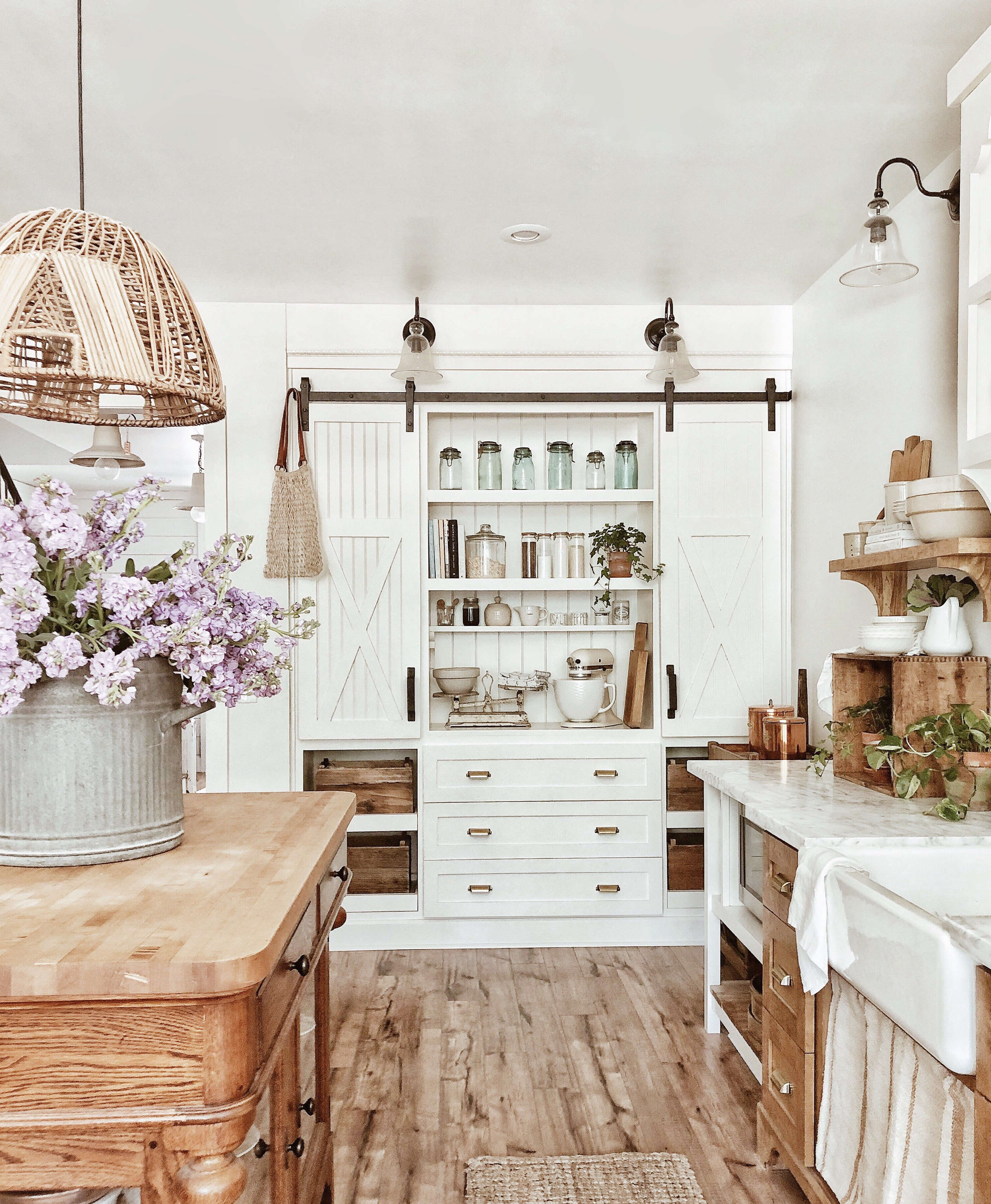
The built-in pantry + baking station
One standout feature is a pantry-baking station designed to flex with real life. There’s a clear baking center setup, and it can even shift into a coffee bar if needed.
That kind of adaptability is gold: your kitchen stays useful even as routines changenew school schedules, new diets, new hobbies, new “I’m into sourdough now” eras.
Pull-out wooden crates for produce
Instead of letting onions and potatoes roam freely like tiny rolling hazards, Whitetail Farmhouse uses sliding pull-out wooden crates for vegetables.
This is a small detail with a big impact: it keeps produce ventilated, visible, and easy to grab, while visually calming the pantry zone.
Drawers that make kids independent (and parents slightly more sane)
There are drawers dedicated to kid snacks and baking itemsan underrated strategy if you want less counter clutter.
When snacks are contained and accessible, kids don’t have to unload half a cabinet to find one granola bar.
Consider it a tiny peace treaty signed in cabinetry.
Barn doors on the pantry
The pantry uses barn doors with adjustable shelving inside. Sliding doors can be especially helpful when swing clearance fights with traffic flow,
stools, pets, and the general chaos of modern life. Adjustable shelves also mean the pantry can evolve as your storage needs change.
The “Farmhouse Details” That Actually Do Work
Sink skirt: the most charming cover-up in the house
A farmhouse sink paired with a skirted under-sink area is a classic look that also gives you flexible storage.
Unlike a hard cabinet configuration, a skirt can accommodate taller items, awkward plumbing, or a changing lineup of cleaning supplies.
It’s the rare design move that looks sweet while quietly hiding your least photogenic possessions.
Plate racks and display storage that doesn’t become clutter
The kitchen includes an oversized (double) plate rack used for ironstone dishes and creamersbeautiful, yes, but also practical.
Plate racks work when the collection is cohesive and used often. If you try to display every mug you’ve ever loved, the rack becomes a mug museum,
and your kitchen starts feeling like a gift shop. The lesson: curate.
Open shelving: airy and accessible, but not a free-for-all
Open shelving can make a kitchen feel bigger, brighter, and more personal. It can also make a kitchen feel like it’s perpetually mid-cleanup if you’re not careful.
Whitetail Farmhouse’s approach is best-in-class: keep the shelves for items you truly want to see and use, and keep visual noise on a short leash.
- Pro: Open shelves can be more budget-friendly than uppers and can visually “lighten” a kitchen.
- Reality check: If you hate seeing mismatched bits and bobs, open shelves will stress you out faster than a smoke alarm with low battery.
- Designer rule of thumb: Avoid storing dust magnets, clunky appliances, or random everyday clutter on open shelves.
Beadboard-style texture for cottage warmth
Beadboard (or beadboard-look paneling) is a farmhouse favorite because it adds texture without introducing a busy pattern.
It reads as classic, and it plays nicely with open shelves and white cabinetrycreating that soft, layered look that feels welcoming instead of showroom-stiff.
How to Recreate the Whitetail Farmhouse “Organized Farmhouse” Look
Step 1: Pick your “quiet classics” first
Start with timeless anchors: Shaker-style cabinetry, simple hardware, a restrained color palette, and warm natural materials.
These elements don’t compete with daily life. They support it.
Step 2: Build stations around real routines
Don’t design around the fantasy version of yourself who meal-preps silently in linen while birds sing.
Design around the real version who needs coffee, snacks, and a clean spot to roll cookie dough.
A baking station, coffee station, or snack drawer will pay you back every day by keeping “activity clutter” contained.
Step 3: Use bins, baskets, and cratesthen label like you mean it
Group items by type (breakfast, baking, snacks, canned goods), corral them in containers, and label so the system stays intact.
Labels aren’t “Type A.” They’re “I would like this to remain organized after Tuesday.”
Step 4: Balance open and closed storage
The best farmhouse kitchens rarely go fully open or fully closed. Mix it:
open shelves or racks for the beautiful daily-use pieces; closed cabinets for the cluttery necessities.
This keeps the kitchen feeling airy without requiring you to dust your plates like they’re museum artifacts.
Step 5: Make the backsplash earn its role
Backsplashes are functional (protecting walls from splatters and grease) but also a big style moment.
If you want cottage warmth, beadboard or similar paneling can be a lower-cost, cozy-looking option behind open shelving.
If you want something more dramatic, consider a countersplash or tile that complements your cabinet color and overall palette.
Why This Kitchen Works: The Real Takeaways
- It’s curated, not themed. Farmhouse cues show up as materials and functionnot as props.
- Organization is built-in. Stations, drawers, and pantry zones prevent clutter from forming.
- Flexibility is designed in. Adjustable shelving and a convertible station keep the kitchen future-proof.
- Display is intentional. Plate racks and shelves show off what’s cohesive and usednothing random.
- Warmth comes from texture. Wood and paneling add life without visual chaos.
Conclusion: A Farmhouse Kitchen That Lives Well
Whitetail Farmhouse stands out because it treats “farmhouse style” as a framework, not a costume.
The kitchen feels nostalgic, but it behaves like a modern workspacezones, storage, and smart decisions that keep the room calm even when life isn’t.
If you steal only one idea, steal the zone-based thinking: build stations for what you do, store tools where you use them,
and let charm show up as the natural result of a kitchen that genuinely works.
Experiences: What It’s Like to Live With a Whitetail Farmhouse-Style Kitchen
Living with a kitchen like Whitetail Farmhouse isn’t just about aestheticsit changes how the day feels. When your pantry is zoned and your stations make sense,
you stop “hunting” for ingredients and start cooking with momentum. The morning routine becomes smoother: coffee supplies live together, breakfast items are grouped,
and you’re not doing that chaotic cabinet dance where you open five doors to find the one thing that was right in front of you the whole time.
The kitchen feels less like a battleground and more like a base camp.
The most surprising lived-in benefit is how much clear counters affect your mood. When snacks have a drawer and baking supplies have a home,
the countertop stops being the default landing zone for every half-finished task. You can wipe down once and be done, instead of constantly relocating piles.
And yes, it’s easier to clean when you’re not cleaning around your life. You’ll still spill flour, but now you can actually see the surface you spilled it on.
Open shelving and plate racks add a particular kind of daily pleasurewhen they’re curated. Seeing a small collection of ironstone dishes or favorite bowls
makes the kitchen feel personal and warm. But open storage also teaches you discipline. If you’re the kind of household where mugs reproduce overnight,
you’ll quickly learn that “display” space has to be limited. Many homeowners end up adopting a simple rule: only put out what you’d happily see in a photo
and what you use at least weekly. Everything else gets cabinet privacy. (No judgment. We all need privacy.)
The sink skirt is an experience all its own. It’s charmingsoft fabric in a room full of hard surfacesbut it’s also deeply forgiving.
Real kitchens accumulate oddly shaped items: tall spray bottles, bulk refills, a bucket you swear you’ll use for composting, and that one mystery lid.
A skirt hides that visual mess while keeping access easy. The tradeoff is maintenance: fabric can pick up dust and splashes, so it’s smart to choose a washable material
and treat the skirt as part of your regular cleaning rhythm. The upside is that you can swap it seasonally and instantly refresh the kitchen without lifting a screwdriver.
If you have kids (or kid-like adults who snack with enthusiasm), dedicated snack drawers become the unsung hero of the household.
People can grab what they need without turning your pantry into a rummage sale. The kitchen becomes more social, too:
guests can help themselves without asking where everything is, because the organization is intuitivegrouped, labeled, and consistent.
Over time, the system starts training everyone who uses it. You’ll notice fewer “Where is the…” questions, and more “Wow, this is easy.”
That’s the real luxury: not marble, not a fancy faucetjust a kitchen that supports the way you live.