

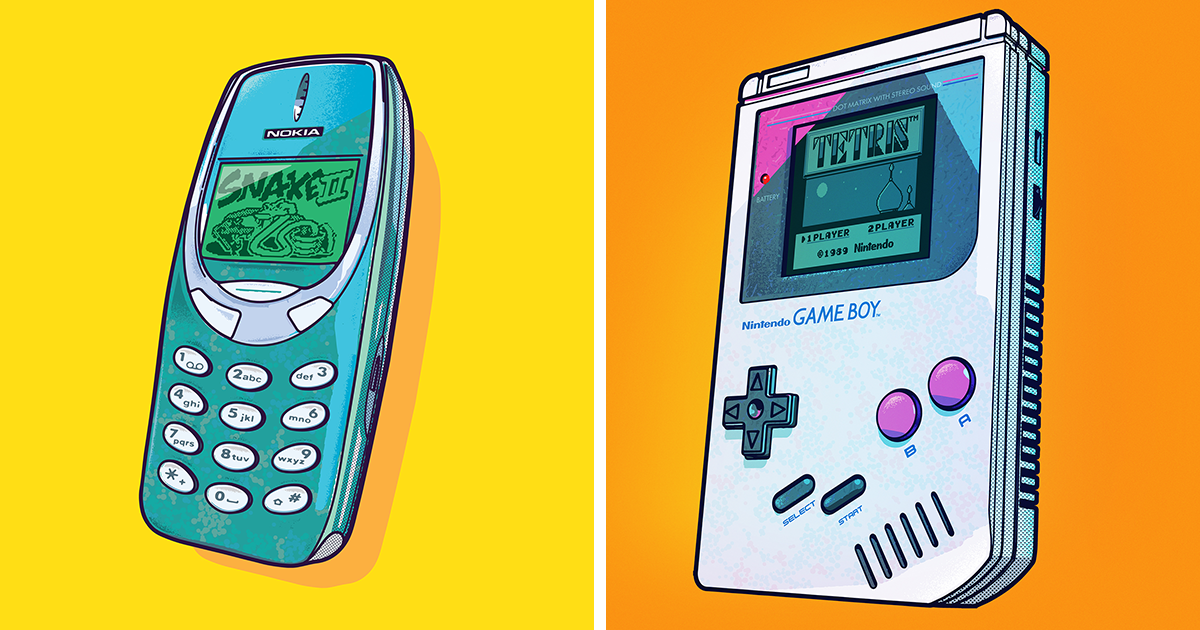
Some people keep childhood memories in photo albums. Others keep them in shoeboxes, junk drawers, old backpacks, or that mysterious plastic bin in the garage labeled “stuff” because nobody had the emotional strength to be more specific. And then there are artists who do something more ambitious: they take those objects, dust off the memories, and turn them into detailed drawings.
The project behind “It Took Me Around 116 Hours In Total To Create All These Drawings Of My Childhood Objects From The Nineties (29 Pics)” is exactly the kind of creative time capsule that makes the internet collectively say, “Oh no, I remember that.” Created as a daily drawing challenge, the series revisits familiar childhood objects from the 1990sportable game consoles, digital watches, cassette tapes, old phones, toys, and other small treasures that once felt like the height of modern life.
What makes the project so satisfying is not only the nostalgia. It is the discipline behind it. Twenty-nine objects. One object per day. Around four hours per illustration. About 116 hours total. That is not a casual doodle session; that is a full creative marathon powered by memory, patience, and possibly the ghost of a Game Boy battery pack.
Why 1990s Childhood Objects Still Hit So Hard
The 1990s were a strange and wonderful bridge between analog life and digital obsession. Kids played outside, but they also carried electronic pets in their pockets. They made mixtapes from the radio, then later burned CDs. They rented VHS tapes, memorized cheat codes, traded collectible cards, and treated a new pack of stickers like it contained the secrets of the universe.
That is why 90s nostalgia feels so specific. It is not just about remembering old things. It is about remembering the way those things behaved. A cassette tape had to be rewound. A Game Boy screen needed the right angle. A Tamagotchi demanded attention at the worst possible time. A calculator watch made you feel like a tiny accountant from the future. A plastic toy could become a whole afternoon’s adventure if you had enough imagination and not enough homework.
Childhood objects also carry emotional weight because they were often connected to routines. A handheld console meant long car rides. A VHS tape meant Friday night. A lunchbox meant school mornings. A Casio watch meant feeling responsible even if the most important appointment on your calendar was “cartoons at 4.” These objects were ordinary, but they formed the scenery of growing up.
The Beauty of Drawing Everyday Objects
At first glance, drawing a childhood object may sound simple. After all, a toy is just a toy, right? Not quite. The most recognizable objects are often the hardest to draw because everyone remembers them. A slight mistake in proportion, button placement, color, or shape can make a familiar object feel wrong. The audience may not know technical illustration terms, but they know when a beloved gadget looks like it came from the discount dimension.
That is why this kind of project requires more than nostalgia. It requires observation. The artist has to study edges, shadows, textures, logos, curves, and tiny design details. A Game Boy is not just a gray rectangle. It has a particular screen border, a red power light, rounded buttons, speaker grooves, and the slightly chunky charm of 1980s engineering that carried deep into 90s childhood. A cassette tape is not just a flat plastic shape; it has reels, screws, labels, transparent windows, and that unmistakable “please do not tangle my entire life” energy.
In digital illustration, especially vector illustration, precision matters. Vector art is built from points, lines, shapes, and curves rather than fixed pixels, which means it can be scaled up or down without losing clarity. That makes it a strong choice for clean, polished drawings of objects. It also demands patience. Every shadow, highlight, curve, label, and color block must be intentionally placed. There is nowhere to hide. The drawing either clicks, or it looks like a bootleg memory from a parallel universe.
Why 116 Hours Is More Impressive Than It Sounds
One hundred sixteen hours can disappear quickly when you are binge-watching shows, scrolling through old memes, or trying to fix a printer that has chosen violence. But in an art project, 116 hours is a serious investment. Spread across 29 days, it means showing up daily even when inspiration is not politely waiting at the desk with coffee.
A daily drawing challenge sounds romantic from a distance. In reality, it is a battle against time management, perfectionism, tired eyes, and the occasional urge to redraw one button for 45 minutes because it is “almost right.” Each object needs research, sketching, structure, color decisions, refinement, and final polish. Multiply that by 29, and the project becomes less like a cute nostalgia experiment and more like a disciplined creative routine.
The best part is that the time shows. The drawings feel intentional. They do not treat childhood objects as random props; they treat them as tiny cultural artifacts. That is the difference between drawing a thing and honoring a thing. A quick sketch says, “Here is an old toy.” A careful illustration says, “This was part of a childhood. This lived in someone’s hand, backpack, bedroom, or memory.”
The Objects That Defined a 90s Childhood
Handheld Gaming: The Pocket-Sized Revolution
Few objects scream 90s childhood louder than a handheld gaming device. The Nintendo Game Boy, originally released in 1989, became a defining part of the decade because it made gaming portable, personal, and wonderfully addictive. It was not flashy by modern standards. The screen was monochrome, the sound was simple, and the graphics were modest. But that was part of the magic. It did not need cinematic cutscenes to own an afternoon.
Games like Tetris, Super Mario Land, and later Pokémon turned long waits into private adventures. For many kids, the Game Boy was the first device that felt truly theirs. Not the family TV. Not the shared computer. A personal portal. Drawing it brings back the click of buttons, the weight of batteries, and the heroic struggle of trying to play in the backseat at night using passing streetlights as a lighting system.
Tamagotchi and the Birth of Digital Responsibility
The Tamagotchi was one of the great emotional experiments of childhood technology. A small digital pet in an egg-shaped case taught kids to feed, clean, entertain, and check on a pixel creature with a schedule more demanding than some adult jobs. Released in Japan in 1996 and soon embraced internationally, it became a global craze because it combined cuteness, urgency, and guilt in one tiny beeping package.
In hindsight, the Tamagotchi feels like a preview of the notification era. It trained a generation to respond to beeps, check screens, and worry about a digital life form while teachers tried to explain fractions. As a drawing subject, it is perfect: simple shape, bright colors, tiny screen, and huge emotional baggage. Anyone who ever panicked because their virtual pet needed attention during class understands.
Cassette Tapes, Mixtapes, and the Art of Waiting
Before playlists could be made in seconds, music took effort. A mixtape was not just a list of songs; it was a strategic operation. You waited by the radio. You hovered near the record button. You prayed the DJ would stop talking before the chorus. You accepted that one song might include three seconds of weather report at the beginning because life was imperfect.
Cassette tapes represent a slower, more tactile relationship with music. They could be labeled by hand, decorated with stickers, rewound with a pencil, and gifted like emotional evidence. Drawing a cassette is an invitation to remember the physicality of sound: the plastic case, the spinning reels, the handwritten title, the little clicks and clacks of a player closing.
Casio Watches and Tiny Wrist Technology
A digital watch in the 90s was more than a way to tell time. It was a statement. A Casio watch could include a calculator, alarm, stopwatch, calendar, or enough buttons to make a child feel ready to launch a space shuttle. Casio’s digital design language became part of everyday fashion and function, especially for kids who wanted something practical but also a little futuristic.
Today, when smartphones handle everything, those watches feel charmingly focused. They did not track your sleep, count your steps, or remind you to breathe. They simply told time, beeped proudly, and occasionally helped with math homework in a way no teacher fully appreciated.
Old Mobile Phones and the Era Before Touchscreens
Late-90s mobile phones had personality. They were chunky, durable, and often more emotionally reliable than the people borrowing them. Models like the Nokia 5110 became famous for their simple screens, removable faceplates, and games that turned basic pixels into cultural icons. Before smartphones became glass rectangles with anxiety installed, phones had buttons you could press without looking.
Illustrating an old phone is a reminder of how much design has changed. Antennas, rubber keypads, tiny monochrome screens, and physical menus all belonged to a world where texting required commitment. Typing one sentence could feel like playing a piano concerto with your thumb.
Why These Drawings Work So Well Online
Nostalgic art performs well on the internet because it invites instant participation. People do not just look at the image; they comment with memories. One person remembers carrying a Game Boy everywhere. Another remembers making mixtapes. Someone else remembers a toy they had forgotten for 25 years until one drawing unlocked the drawer in their brain where it had been hiding.
This is why visual nostalgia is so shareable. It is personal and communal at the same time. The object belongs to one artist’s childhood, but it also belongs to thousands of other childhoods in slightly different forms. Maybe your cassette was a different brand. Maybe your watch had a cracked strap. Maybe your handheld game system was a hand-me-down with mysterious scratches. The exact details vary, but the emotional texture is familiar.
The project also benefits from a clear creative hook: 29 objects, 29 days, 116 hours. That structure makes the work easy to understand and easy to admire. Online audiences love a project with a measurable challenge. It gives the art a story: not just “look at these drawings,” but “look at the commitment behind these drawings.”
The Role of Nostalgia in Creative Work
Nostalgia is often dismissed as sentimental, but it can be creatively powerful. It gives artists a strong emotional starting point. Instead of asking, “What should I draw?” the artist can ask, “What object still feels alive in my memory?” That question is far more interesting.
Memory is not a perfect archive. It exaggerates colors, softens edges, and attaches feelings to ordinary things. A toy may seem brighter in memory than it ever was in real life. A school object may feel enormous because it belonged to a small hand. A gadget may seem magical because, at the time, it genuinely was. Good nostalgic art does not need to reproduce the past like a scanner. It needs to capture the feeling of remembering.
That is what makes childhood object drawings so effective. They sit between documentation and emotion. They show real items, but they also show the affection attached to them. The result is both design study and memory map.
What Artists Can Learn From This 29-Picture Project
For artists, the biggest lesson is that constraints can be freeing. A daily object, a defined theme, and a set time period give the project shape. Instead of drowning in infinite possibilities, the artist works inside a boxand then makes the box interesting.
Another lesson is that personal subjects often connect with a wide audience. You do not always need a massive concept. Sometimes a drawing of a cassette tape, old phone, or toy camera can reach people because it is specific. Specificity creates trust. The more carefully an artist observes an object, the more likely viewers are to recognize their own memories in it.
The project also shows the value of consistency. Posting one piece every day builds momentum. It gives viewers a reason to return. It also pushes the artist to finish rather than endlessly polish. Perfectionism is a talented thief. A daily challenge forces the work out into the world before doubt can hold it hostage.
Why Childhood Objects Make Great Art Subjects
Childhood objects are visually rich because they were designed to attract attention. Many 90s toys and gadgets used bold colors, chunky shapes, playful typography, transparent plastic, stickers, buttons, and exaggerated forms. They were made to be touched, carried, dropped, traded, lost, found, and loved beyond reason.
They also carry built-in stories. A skateboard suggests movement. A cassette suggests music. A Game Boy suggests focus. A camera suggests moments. A digital pet suggests responsibility. An old phone suggests first messages and ringtone pride. These objects do not sit quietly; they bring scenes with them.
For readers, that is the joy. Each drawing becomes a little door. Open it, and suddenly you are back in a bedroom with posters on the wall, a TV humming in the corner, and a drawer full of treasures that adults called junk because adults have always struggled to understand the economy of childhood.
Experience: What This Project Feels Like to Anyone Who Grew Up Around These Objects
Looking at a series of carefully drawn 90s childhood objects feels a lot like finding an old backpack in a closet. You unzip it expecting dust, and instead you discover a miniature museum of your former self. There is the object you saved for months to buy. There is the gadget you begged for during a holiday season. There is the toy you forgot completely until the shape of it appears again and your brain immediately says, “Wait, I had one of those.”
The experience is surprisingly emotional because these objects were not important in the way adults define importance. They were not expensive investments, career milestones, or life achievements. They mattered because they filled ordinary days. A cassette tape made a bus ride better. A handheld console made a rainy afternoon disappear. A watch made you feel older. A sticker-covered notebook made school feel slightly less like school. A phone with physical buttons made communication feel new, awkward, and exciting.
That is the strange power of nostalgic illustration. It does not simply show what something looked like. It reminds you how life moved around it. You remember the sound of plastic buttons, the smell of a VHS case, the weight of a backpack, the frustration of dead batteries, the joy of trading with friends, and the tiny social dramas that could erupt over a toy, a game cartridge, or a missing cassette.
There is also comfort in seeing these objects drawn with care. Many childhood things were disposable by design. They were scratched, broken, replaced, donated, or thrown away during cleaning sessions that nobody appreciated at the time. When an artist spends four hours drawing one of them, the object gets a second life. It becomes worthy of attention again. The cheap plastic becomes design. The old gadget becomes history. The toy becomes a memory with clean edges.
For creative people, the project is a reminder that inspiration does not always need to come from distant places. Sometimes the best subject is the thing you once held every day. Your old pencil case, your favorite snack wrapper, your first music player, your childhood alarm clockthese can be as meaningful as landscapes or portraits because they contain lived experience. They are proof that ordinary objects are never only ordinary when memory gets involved.
And for everyone else, the series is simply fun. It gives permission to enjoy the past without getting stuck in it. You can laugh at the technology, admire the design, and still appreciate how much those objects meant. The 90s were not perfect, but they were full of tactile little rituals that shaped how a generation played, listened, watched, learned, and connected. Seeing those rituals turned into art feels like a friendly wink from the past.
Conclusion
“It Took Me Around 116 Hours In Total To Create All These Drawings Of My Childhood Objects From The Nineties (29 Pics)” works because it combines three things people love: nostalgia, craftsmanship, and recognizable design. The 29 drawings are not just pictures of old stuff. They are a tribute to the small objects that helped define a decade of childhoodobjects with buttons, screens, tapes, stickers, batteries, beeps, scratches, and stories.
The project also proves that personal memories can become widely relatable art. A childhood object may begin as one artist’s memory, but once drawn with care, it becomes a shared invitation. Viewers bring their own stories to it. They remember where they were, who they were with, what music was playing, what game they could not stop playing, and which beloved gadget vanished into the mysterious black hole where all childhood things eventually go.
In a world where technology moves quickly and yesterday’s devices become museum pieces before we have emotionally recovered, these drawings slow everything down. They ask us to look again. They remind us that childhood was built from small thingsand sometimes, those small things deserve 116 hours of attention.
Note: This article is written as original SEO content for web publication. It does not reproduce the original source text and is designed to provide a fresh, human, reader-friendly discussion of 1990s childhood objects, nostalgic art, and the creative discipline behind a 29-piece illustration project.