

Note: This article is written for web publication in standard American English and synthesizes current B2B sales, buyer behavior, hybrid selling, customer experience, and business travel research without adding source-link clutter.
For the last few years, many sales teams have treated in-person prospect visits like fax machines, paper maps, and office coffee that tastes like printer ink: technically still around, but not something modern people should rely on. After all, buyers can research online, compare vendors, join video calls, watch demos, and ignore cold emails with Olympic-level discipline. So why get in a car, board a plane, or walk into a prospect’s office when you could just “circle back” from the comfort of your ergonomic chair?
Because, in many cases, showing up still works.
Should you visit more of your prospects in person? Almost certainlyif you sell a complex product, a high-value service, a local solution, a relationship-driven offer, or anything that requires trust before a buyer signs the dotted line. In-person prospect visits are not magic. They will not rescue a weak value proposition, a lazy pitch, or a salesperson who thinks “checking in” is a strategy. But when used thoughtfully, face-to-face sales meetings can help you build credibility faster, understand the buyer’s real environment, uncover hidden objections, and separate yourself from competitors trapped in the same crowded inbox.
The smartest modern sales strategy is not “digital or in person.” It is both. Digital channels create awareness, educate prospects, and keep communication efficient. In-person meetings deepen trust, reveal context, and move complex opportunities forward. Think of it like cooking: email is the seasoning, video is the stovetop, and in-person selling is the moment someone actually tastes the dish and says, “Oh, now I get it.”
Why In-Person Prospect Visits Still Matter
B2B buyers are more informed than ever. Many prospects now complete a large portion of their research before speaking with a salesperson. They read reviews, ask peers, compare pricing, watch videos, and quietly stalk your website like a detective in a cardigan. By the time they talk to your team, they often already have assumptions about your company, your competitors, your weaknesses, and whether your homepage photo of smiling people in a conference room is believable.
This creates a strange challenge for salespeople. Buyers want control, but they also need guidance. They want self-service, but they do not want to make an expensive mistake. They prefer efficiency, but they still care about trust. This is especially true when the decision involves multiple stakeholders, operational risk, implementation work, budget scrutiny, or a long-term relationship.
An in-person visit gives you something digital selling often cannot: full-context communication. You see the facility. You notice how the team works. You hear side comments after the formal meeting ends. You watch who influences the room, who stays quiet, who looks skeptical, and who keeps glancing at the CFO before answering. These clues rarely appear in a tidy CRM field.
In-person meetings also show commitment. A prospect may not consciously think, “This person traveled here, therefore I trust them.” But effort has a way of speaking before the pitch begins. When a seller makes the trip, listens carefully, and brings useful insights, the buyer feels a different level of attention. That is not old-school nostalgia. That is human behavior.
The Real Advantage: You Learn What the Prospect Has Not Said Out Loud
Prospects rarely tell you the whole story in the first conversation. Sometimes they do not know the whole story themselves. A buyer may say they need “better reporting,” but an on-site visit reveals that the reporting problem is really a workflow problem. A manufacturer may ask about pricing, but a walk through the plant shows that downtime, training, and integration risk are the real concerns. A clinic may request a software demo, but the office layout and staff routines reveal that adoption will be the hardest part.
This is where in-person sales meetings become powerful. They help you diagnose before you prescribe. And yes, that sentence sounds like something printed on a motivational mug, but it is true. The seller who understands the buyer’s environment can make a sharper recommendation than the seller who only understands the buyer’s calendar invite.
You can observe real workflows
A video call tells you what the buyer says happens. A visit shows you what actually happens. If you sell equipment, software, consulting, logistics, facility services, healthcare solutions, construction services, or operational support, the physical environment matters. You may spot bottlenecks, safety issues, poor handoffs, outdated tools, or workarounds that nobody mentioned because everyone became used to them.
You can build multi-stakeholder trust
Modern B2B buying often involves several decision-makers. The person who first contacts you may not be the final decision-maker. The economic buyer, technical reviewer, department head, end users, and legal team may all have a say. Meeting in person helps you identify the buying committee and understand what each stakeholder cares about. One person wants ROI. Another wants easy implementation. Another wants fewer headaches because, frankly, they already have enough.
You can create a stronger memory
Buyers forget emails. They skim decks. They half-watch virtual demos while answering Slack messages. But a useful in-person conversation is harder to ignore. A good visit creates a memory: “That was the rep who actually understood our process,” or “That team saw the issue in five minutes.” In a competitive deal, being remembered for the right reasons is no small thing.
When You Should Visit Prospects In Person
You do not need to visit every prospect. That would be expensive, inefficient, and mildly alarming. Nobody wants a salesperson appearing at the door because they downloaded a checklist. The key is to identify situations where face-to-face selling has a real chance to improve deal quality, speed, or trust.
Visit when the deal is high-value
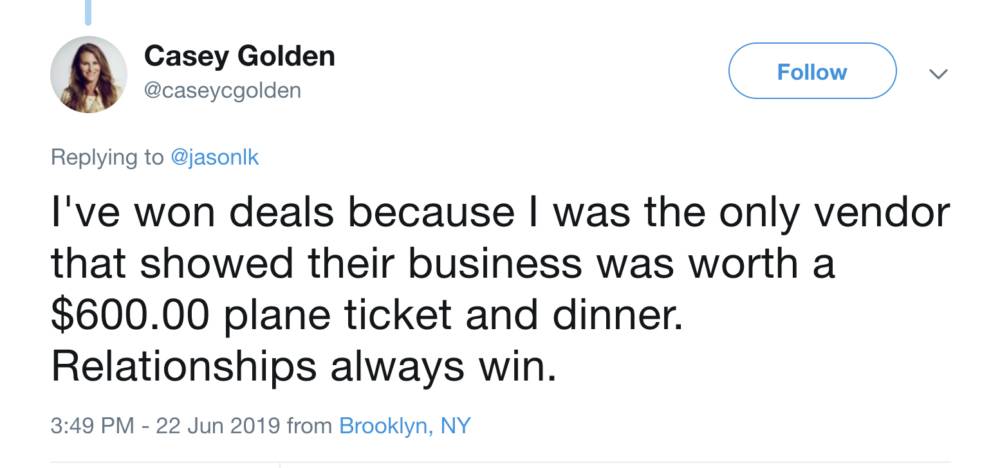
If the potential contract value is significant, an in-person visit may be one of the best investments you can make. A $500 sale rarely justifies a plane ticket. A six-figure annual contract might. The higher the stakes, the more buyers want confidence that your team understands their business and can deliver after the sale.
Visit when the solution is complex
Complex products and services often require education, customization, and trust. If your offer touches operations, compliance, technology, finance, staffing, customer experience, or physical space, the buyer may need more than a standard demo. In-person meetings allow you to map needs, answer layered questions, and involve multiple stakeholders in one productive session.
Visit when the prospect is local or regional
If you can visit a strong prospect within a reasonable drive, the bar should be lower. Local visits can create a major competitive advantage because they are practical, personal, and efficient. A nearby competitor may rely on email while you show up with a clear agenda and useful ideas. That is how you become the vendor who feels real instead of the vendor buried between newsletters and software trial reminders.
Visit when the deal is stuck
Some opportunities stall because the buyer is not interested. Others stall because the buyer is confused, overwhelmed, internally divided, or unsure how to move forward. A well-planned in-person visit can restart momentum. It gives you a chance to clarify priorities, address objections, and help the buyer build internal alignment.
Visit when trust is the missing ingredient
If a prospect likes your offer but hesitates because of risk, change management, implementation, or past disappointment with vendors, a face-to-face meeting can help. Trust is not built by saying, “Trust us.” That phrase has the same energy as a raccoon wearing a security badge. Trust is built through preparation, honesty, listening, and follow-through.
When You Should Not Visit Prospects In Person
In-person prospecting is powerful, but it is not automatically smart. There are times when visiting a prospect is unnecessary or even counterproductive.
Do not visit when the buyer has not shown meaningful interest. A cold drop-in may work in a few industries, especially local services or territory sales, but in many B2B contexts it feels intrusive. Do not visit just because your pipeline looks lonely. Visit because there is a business reason.
Do not visit when you have no agenda. “I thought I’d stop by” is not a sales strategy; it is something neighbors say before borrowing a ladder. A prospect visit should have a purpose: discovery, workflow review, stakeholder meeting, proposal discussion, executive alignment, pilot planning, or renewal expansion.
Do not visit when the economics make no sense. Sales activity should serve revenue, not vanity. If travel costs exceed the likely opportunity value, use video, phone, digital demos, or partner channels instead. The goal is not to collect boarding passes. The goal is to win better business.
How to Make an In-Person Prospect Visit Worth It
A bad in-person sales meeting is just a bad Zoom meeting with parking. The format does not save you. Preparation does.
Research before you arrive
Before visiting a prospect, review their website, industry, recent news, competitors, job postings, product lines, leadership changes, customer reviews, and any previous interactions with your company. Look for business triggers: expansion, hiring, regulation changes, operational growth, funding, new locations, customer complaints, or technology shifts. These details help you ask better questions and avoid wasting the buyer’s time.
Set a clear meeting objective
Every visit should answer one question: what should be different after this meeting? Maybe you need to confirm business pain, map the decision process, meet the operations team, review a facility, present a tailored proposal, or agree on next steps. If you cannot define the objective, reschedule until you can.
Bring insight, not just a pitch
Prospects do not need a live reading of your brochure. They need perspective. Share patterns you see in their industry. Explain common mistakes. Show benchmarks. Offer a practical idea they can use even if they do not buy today. This builds credibility and turns the visit into a valuable business conversation.
Ask better questions
Strong in-person selling depends on strong discovery. Ask questions that uncover impact, not just preferences. Instead of “What features are you looking for?” ask, “What happens if this problem is not fixed in the next six months?” Instead of “Who approves this?” ask, “Who will feel the most impact from this change?” Instead of “What is your budget?” ask, “How are you evaluating whether this is worth funding?”
Watch the room
In person, the room gives feedback. If the operations manager leans forward during one topic, explore it. If the finance leader goes quiet, invite their perspective. If end users exchange worried looks during implementation talk, slow down. The best salespeople are not just presenters. They are observers.
Follow up fast and specifically
The follow-up after an in-person meeting is where many sellers fumble the ball while celebrating on the five-yard line. Send a concise recap within 24 hours. Include what you heard, what you recommend, open questions, owners, deadlines, and the next meeting date. The buyer should think, “They understood us,” not “They sent the same template they send everyone.”
Specific Examples: Where In-Person Selling Wins
Imagine you sell warehouse automation software. A remote demo can show dashboards, workflows, and integrations. But an on-site visit reveals that supervisors use whiteboards, inventory labels are inconsistent, Wi-Fi is weak in one section, and the night shift has a completely different process from the day shift. That information changes the proposal. It also shows the buyer that your team understands implementation reality.
Or imagine you sell commercial HVAC services. A prospect may describe comfort complaints and rising energy bills, but a site visit uncovers aging equipment, poor zoning, blocked vents, and maintenance gaps. You can now provide a practical recommendation instead of a generic quote. The visit builds confidence because the buyer can see your expertise in action.
Or consider a marketing agency pitching a regional healthcare group. A video call can discuss goals and budgets. But an in-person workshop with leadership, intake staff, and patient experience managers may reveal that the real growth problem is not lead volume; it is appointment conversion. That changes the strategy from “more ads” to “better patient journey.” That is a better sale and a better outcome.
In-Person Visits Work Best Inside a Hybrid Sales Strategy
The future of sales is not a dramatic return to knocking on every door with a briefcase and a suspiciously shiny smile. Buyers expect digital convenience. They want fast answers, helpful content, transparent pricing, smooth scheduling, and the ability to research without being chased by a rep who uses “just bumping this” as a personality.
That means in-person prospect visits should be part of an omnichannel sales strategy. Use digital content to educate. Use email to share relevant resources. Use video for efficient conversations. Use phone calls to clarify urgency. Use in-person meetings when the relationship, complexity, or opportunity value justifies the effort.
The best sales teams do not force prospects into one channel. They match the channel to the moment. Early research may happen online. Initial qualification may happen by phone. A technical demo may happen by video. A final alignment session may happen in person. A renewal discussion may combine usage data, executive review, and an on-site visit. This is not complicated. It is simply respectful selling.
How to Measure Whether Prospect Visits Are Paying Off
If you want leadership to support more in-person sales activity, measure it. Feelings are nice, but finance teams prefer numbers because apparently “the vibe was excellent” is not a line item.
Track close rates for visited prospects versus non-visited prospects. Measure average deal size, sales cycle length, renewal rate, expansion revenue, and stage conversion. Compare travel cost against pipeline created and revenue won. Review whether visits improve discovery quality, stakeholder access, proposal accuracy, or implementation success.
Also measure qualitative outcomes. Did the visit uncover new decision-makers? Did it reveal a stronger business pain? Did it prevent a poor-fit deal? Did it help the prospect build consensus? Not every valuable visit closes immediately. Some improve forecasting, qualify out bad opportunities, or create future expansion. That matters too.
Common Mistakes to Avoid
The first mistake is showing up too early. If the prospect has no defined problem, no interest, and no reason to meet, an in-person visit may feel pushy. Earn the meeting first.
The second mistake is talking too much. Some sellers travel three hours and then spend the entire meeting performing a monologue with slides. Do not do that. The prospect’s office is not your theater debut. Ask, listen, observe, and adapt.
The third mistake is failing to involve the right people. If you visit only your champion but ignore the people who influence budget, implementation, security, operations, or adoption, you may leave with enthusiasm but not momentum. Before the visit, ask who should be included to make the conversation useful.
The fourth mistake is treating the visit like a one-time event. A prospect visit should connect to a broader sales process. Prepare before it. Run it with purpose. Follow up after it. Use what you learned to improve the business case.
So, Should You Visit More Prospects In Person?
Yes, almost certainly. But not randomly. Not desperately. Not because “sales used to be done this way.” Visit more prospects when the visit creates value for the buyer and improves the quality of the deal.
The strongest case for in-person selling is not nostalgia. It is differentiation. In a world overflowing with automated sequences, AI-generated emails, digital ads, webinar funnels, and calendar links, a thoughtful in-person visit can feel refreshingly human. It says, “Your business is worth understanding.” That message is hard to automate.
For high-value, complex, relationship-driven sales, face-to-face meetings can reveal problems faster, build trust deeper, and help prospects make better decisions. The key is to treat in-person visits as strategic moments, not routine errands. Show up prepared. Ask sharp questions. Bring useful insight. Respect the buyer’s time. Follow through with precision.
Field Experience: What Actually Happens When You Visit Prospects In Person
One of the clearest lessons from in-person prospecting is that the meeting you planned is rarely the meeting that matters most. You may arrive expecting to discuss pricing and leave understanding that the true issue is internal communication. You may prepare a product demo and discover the prospect needs help building a business case for leadership. You may think the decision belongs to the person who invited you, only to learn that the quiet department manager at the end of the table can make or break the entire deal.
In real sales environments, the small moments often create the biggest breakthroughs. The walk from the lobby to the conference room can reveal how the company operates. Are employees rushed? Are customers waiting? Are processes manual? Is the office organized or chaotic? None of these observations should become assumptions, but they can help you ask smarter questions. A seller who notices carefully can say, “I saw your team handling intake manually at the front desk. Is that part of the workflow you are trying to improve?” That is a much better opener than, “Let me tell you about our award-winning platform.”
Another experience many strong sellers share is that prospects relax when the conversation becomes practical. On a video call, buyers may stay formal and guarded. In person, especially during a facility tour or working session, they often become more candid. They point to problems. They introduce colleagues. They explain why the last vendor failed. They tell you what leadership is worried about. They may even admit, “Honestly, we do not know the best way to fix this.” That is not weakness. That is the beginning of a real sales conversation.
In-person visits also improve accountability on both sides. When you sit across from a buyer and agree on next steps, those steps tend to feel more concrete. Names, dates, and responsibilities become clearer. The buyer can see that you are serious, and you can see whether the opportunity is real. Sometimes the best outcome of a visit is not a closed deal; it is honest qualification. You may learn that the budget is not there, the timing is wrong, or the prospect is not a fit. That saves months of polite email tennis.
There is also a relationship effect that is difficult to measure but easy to recognize. People remember who helped them think clearly. If your visit gives the prospect language to explain the problem internally, a framework for comparing options, or confidence about the path forward, you become more than another vendor. You become a useful advisor. That does not mean pretending to be a consultant while secretly pushing a sale. It means selling with enough expertise and honesty that the buyer feels smarter after speaking with you.
Of course, in-person prospecting requires discipline. It can become a waste of time if sellers visit weak opportunities, skip preparation, or confuse activity with progress. The best field sellers are selective. They choose visits based on potential value, strategic fit, buying stage, stakeholder access, and the chance to learn something meaningful. They do not just show up; they show up with a reason.
The practical takeaway is simple: use in-person visits where they create an advantage that digital channels cannot. Visit when seeing the environment matters. Visit when trust is underdeveloped. Visit when the buyer group needs alignment. Visit when the deal is large enough to justify the effort. Visit when your presence helps the prospect make a better decision. Done this way, in-person selling is not old-fashioned. It is modern sales with shoes on.
Conclusion
In-person prospect visits are not dead. They are simply more strategic than they used to be. Buyers may prefer digital research, self-service tools, and efficient communication, but complex decisions still depend on trust, context, and confidence. A well-timed face-to-face meeting can help you understand the buyer’s world, create stronger relationships, and move serious opportunities forward.
Should you visit more of your prospects in person? Almost certainlyespecially if your deals are valuable, your solution is complex, or your competitors are hiding behind automated outreach. Just make every visit count. Bring insight. Listen closely. Respect the prospect’s time. Follow up with clarity. When you do that, showing up is not just a sales activity. It becomes a competitive advantage.