

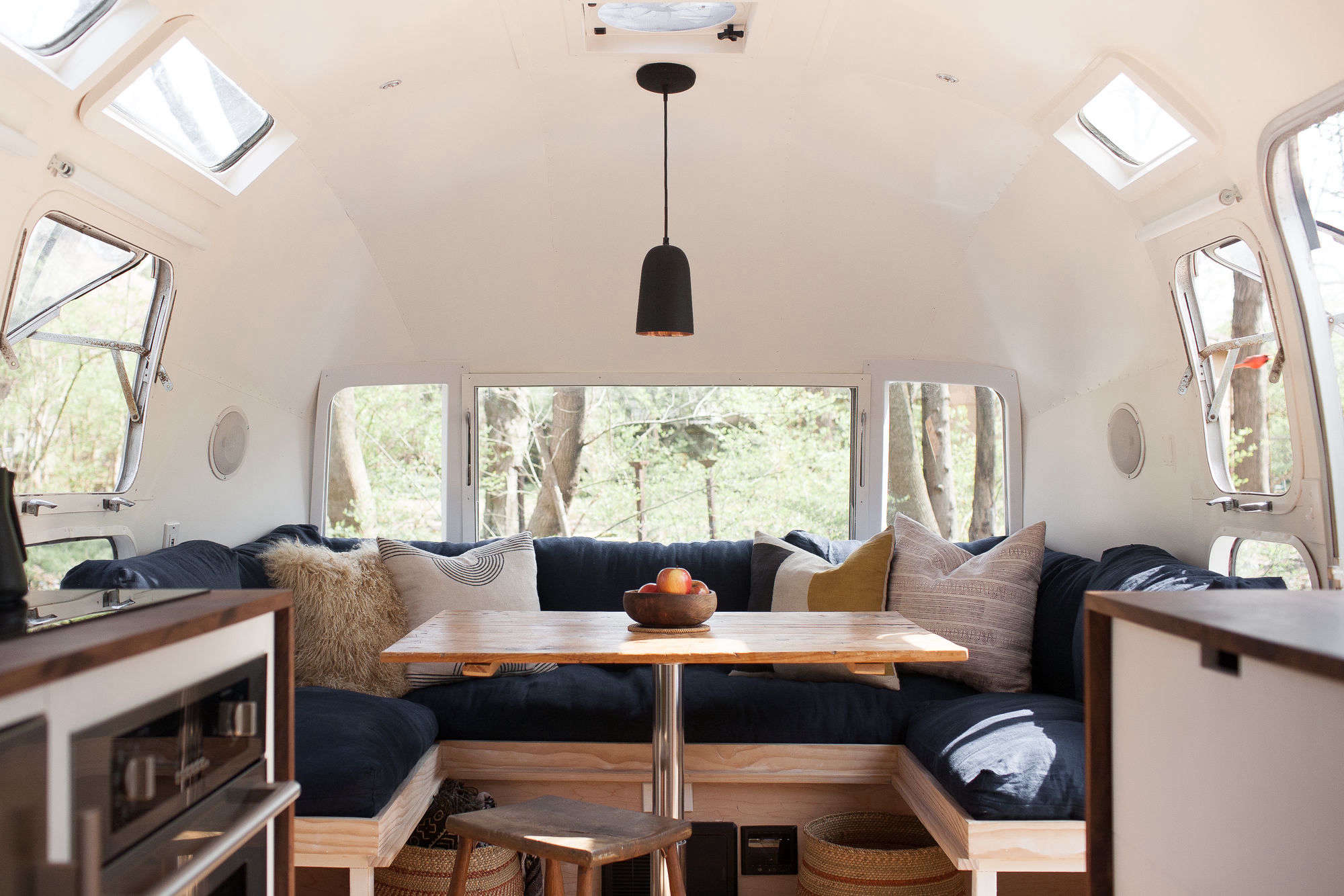
A vintage Airstream has a talent for stopping traffic without even moving. Its polished aluminum body looks part aircraft, part time capsule, and part very stylish toaster. Yet behind that unmistakable shell, a carefully restored trailer can function as a comfortable home, remote office, weekend retreat, or full-time base camp.
The best custom builds do not erase the trailer’s history. Instead, they preserve its curved silhouette and handcrafted character while adding efficient appliances, solar power, flexible furniture, dependable plumbing, smart storage, and enough electrical capacity to keep modern life running. The result is not merely an old camper with new cushions. It is a compact home engineered to travel.
Why a Vintage Airstream Remains an American Design Icon
Born From a Better Way to Camp
Airstream’s story began when founder Wally Byam experimented with a tent mounted on a Model T chassis in 1929. The setup was inconvenient, so he replaced it with a more protective teardrop-shaped trailer containing sleeping space, a stove, and an ice chest. By 1931, Byam was operating an Airstream business in Los Angeles and selling completed trailers, plans, and home-building kits.
That early idea still defines the brand: make travel comfortable without separating people from the adventure outside. Later models such as the Flying Cloud helped establish Airstream as a practical family travel solution, while the company’s international caravans turned the silver trailer into a symbol of optimistic, go-anywhere exploration.
The Aluminum Shell Has Character Modern Boxes Cannot Copy
A vintage Airstream’s riveted exterior is instantly recognizable. The rounded body reflects its surroundings, softens the visual size of the trailer, and creates a shape that seems equally appropriate beside a desert highway, a pine forest, or a midcentury home.
Inside, the curved ceiling creates both charm and complications. Standard cabinets, square furniture, and off-the-shelf wall panels rarely fit without modification. That is why a successful vintage Airstream renovation usually depends on custom fabrication. Every cabinet must respect the shell, every storage compartment must earn its weight, and every inch must perform at least one useful jobpreferably two, because square footage in a travel trailer is not known for its generosity.
A Proper Restoration Begins Beneath the Pretty Finishes
Renovation Is More Than Paint and Throw Pillows
It is tempting to buy an old trailer, paint the cabinets white, add a striped blanket, and announce that the renovation is complete. Unfortunately, water damage does not care about your color palette.
Experienced Airstream renovators consistently warn that a vintage restoration may require far more than cosmetic work. Aging trailers can hide floor rot, leaking seams, deteriorated insulation, damaged window seals, outdated wiring, corroded plumbing, frame problems, and appliances that belong in a museum rather than a campsite. Professional rebuilds often begin by removing much of the interior so the shell, subfloor, chassis, windows, and mechanical systems can be inspected properly.
Preserve What Matters, Replace What Does Not
A thoughtful custom build identifies which original features contribute genuine character. Rounded cabinet doors, aluminum end caps, vintage badges, original windows, folding tables, or period hardware may deserve restoration. Brittle wiring, leaking water lines, crumbling insulation, and questionable propane components do not deserve sentimental protection.
This balance separates preservation from imitation. The goal is not to freeze the trailer in 1967. The goal is to retain the visual language of 1967 while creating a home that can charge a laptop, keep food cold, provide hot water, and survive a rainstorm without turning the floor into an indoor pond.
Designing a Small Interior That Feels Surprisingly Large
Create Clear Zones Without Building Too Many Walls
A modern Airstream interior works best when it includes recognizable zones for cooking, dining, sleeping, working, storage, and bathing. However, dividing those zones with solid walls can make the trailer feel narrow and dark.
Custom builders often use changes in lighting, cabinetry, upholstery, or ceiling details to define spaces visually. A compact galley may transition into a dining banquette, which becomes a lounge after dinner and a guest bed at night. A bedroom platform can incorporate drawers, utility access, and a hidden water tank. A slim cabinet near the entrance might hold shoes, outdoor equipment, electrical controls, and the collection of mysterious cables every traveler somehow acquires.
Real-world renovations featured by design publications frequently use built-in seating, pedestal tables, hidden storage, and convertible work surfaces to give one area multiple purposes. These flexible elements allow a trailer to feel like a small home rather than a hallway decorated with appliances.
Choose Materials for Movement, Not Just Appearance
A trailer experiences vibration, temperature changes, humidity, road dust, and the occasional cabinet door that launches itself open during a dramatic turn. Materials must therefore be lightweight, stable, washable, and securely installed.
Good options include lightweight plywood cabinetry, durable laminate, sealed wood veneer, compact composite counters, marine-grade flooring, performance upholstery, and easy-to-clean wall surfaces. Natural wood adds warmth against the aluminum shell, but heavy stone, thick tile, and residential furniture can create unnecessary weight.
Rounded cabinet corners help circulation and visually echo the trailer’s exterior. Positive latches prevent doors and drawers from opening while the Airstream is moving. Soft-close hardware is pleasant at home; road-proof hardware is pleasant when your silverware does not explode across the floor at the first pothole.
Make Storage Accessible, Specific, and Secure
More cabinets do not automatically create better storage. Deep compartments can become caves where batteries, winter socks, and one long-lost avocado disappear together.
Effective storage is designed around actual belongings. Shallow pantry drawers reveal food at a glance. Vertical dividers secure pans and cutting boards. Charging drawers hide electronics. Overhead bins hold lightweight items, while tools, water, batteries, and other heavy equipment remain low and close to the axles whenever possible.
Every stored object also needs protection from movement. Bins, straps, drawer latches, shelf lips, and padded dividers keep daily life organized after a travel day. Otherwise, opening a cabinet at the campground becomes an extreme sport.
Modern Power for Work, Comfort, and Off-Grid Travel
Build the Electrical System Around Real Energy Use
A custom vintage Airstream may include rooftop solar panels, lithium batteries, an inverter, a solar charge controller, shore-power connections, USB outlets, and a monitoring display. Together, these components can support lighting, refrigeration, fans, water pumps, electronics, and selected household appliances.
Modern Airstream models illustrate how far mobile power has advanced. Recent factory systems have included substantial solar input, app-compatible monitoring, lithium storage, and inverters capable of operating demanding appliances. A vintage build can use similar technology, but its system should be sized according to realistic daily consumption rather than a fantasy in which the sun shines constantly and nobody ever uses the coffee maker.
Solar panels generate electricity, batteries store it, a controller manages charging, and an inverter converts battery power for AC devices. Solar-plus-storage systems improve resilience because stored electricity can be used when sunlight or grid power is unavailable. Still, available energy depends on weather, panel exposure, battery capacity, temperature, and appliance demand.
Efficiency Is Better Than Carrying a Power Plant
The smartest mobile homes reduce demand before adding more equipment. LED lighting, efficient refrigeration, insulated window coverings, roof ventilation, and low-power electronics extend battery life. Cooking with propane or an outdoor grill can reduce electrical loads, while a well-placed fan may provide comfort without running air conditioning all afternoon.
This approach also supports the RV industry’s broader movement toward lightweight trailers, solar technology, and energy-efficient components. Less energy consumption means less battery weight, fewer generator hours, and more time enjoying the campsite instead of holding an emergency meeting with the battery monitor.
Water, Climate Control, and Everyday Comfort
A Small Plumbing System Must Be Easy to Maintain
A practical renovation may include a freshwater tank, water pump, water heater, gray-water tank, black-water tank or composting toilet, exterior fill connections, filtration, and clearly labeled shutoff valves.
Access matters as much as capacity. Pumps, fittings, drains, and winterization valves should not be buried behind permanently installed furniture. A leak that requires dismantling half the bedroom is less a plumbing problem and more an architectural betrayal.
Low-flow fixtures and mindful water use extend the time between refills and tank dumps. Water-efficient products can reduce both water and energy consumption, a useful principle in any mobile home where every gallon must be carried, heated, stored, and eventually managed.
Ventilation Is Essential in a Curved Metal Home
Cooking, showering, breathing, and drying wet gear all add moisture to a small interior. Roof fans, operable windows, bathroom ventilation, and airflow behind mattresses and cushions help control condensation.
Insulation and window coverings improve comfort during hot afternoons and cold nights. Depending on the intended climate, a build may include air conditioning, a heat pump, a propane furnace, electric heat, heated tanks, or winterized plumbing. Equipment should match the trailer’s electrical capacity and expected destinations rather than every climate zone on Earth.
Technology That Supports the Journey Without Taking It Over
For remote workers, the modern Airstream can become a surprisingly capable mobile office. A built-in desk, supportive seat, cellular router, external antenna, multiple charging points, task lighting, and acoustic materials can transform a dining corner into a work zone.
Smart monitoring may track battery levels, solar production, tank status, temperature, and selected appliances. These tools are useful, but the interface should remain understandable. A traveler should not need an advanced engineering degree to discover why the water pump stopped working.
Technology is most successful when it disappears into the background. Hidden wiring channels, ventilated electronics cabinets, labeled breakers, replaceable components, and accessible service panels make the trailer feel polished while simplifying future repairs.
A Beautiful Airstream Still Has to Behave Like a Trailer
Weight Controls Nearly Every Design Decision
Custom cabinetry, batteries, water, appliances, solar equipment, mattresses, clothing, bicycles, and supplies all contribute to the loaded weight. Builders must consider the trailer’s gross vehicle weight rating, axle ratings, tire ratings, hitch capacity, tongue weight, and the towing vehicle’s payload and towing limits.
NHTSA advises owners to obtain loaded tongue-weight information and compare it with the tow vehicle’s ratings. It also emphasizes properly sized, load-rated, correctly inflated tires and confirms that road-legal trailers must comply with applicable federal safety standards.
Heavy materials should generally remain low and balanced. Water tanks and battery banks require especially careful placement because they can significantly affect handling. A trailer that photographs beautifully but tows like an angry shopping cart is not a successful design.
Safety Equipment Is Part of the Interior Design
A completed build should include functioning smoke, carbon-monoxide, and propane alarms; accessible fire extinguishers; properly vented combustion appliances; safe electrical protection; secure emergency exits; and professionally inspected gas connections.
Carbon monoxide deserves particular attention because it is colorless, odorless, and potentially deadly. Generators, engines, heaters, and other fuel-burning equipment must be operated and vented safely, especially around compact living spaces.
How to Keep the Vintage Personality
A modern renovation does not have to become a white box with a fiddle-leaf fig wedged beside the refrigerator. The most memorable builds preserve a sense of era while avoiding theme-park nostalgia.
Warm walnut, birch, cork, woven fabrics, brushed metal, globe lights, terrazzo-inspired surfaces, and muted colors complement an aluminum shell. A restored badge, original cabinet pull, vintage map, or period-style upholstery can carry more personality than dozens of novelty decorations.
Personal details matter, too. One renovation may prioritize music storage and a dedicated desk; another may include a large galley for enthusiastic cooks. Some owners build bunks for children, secure kennels for dogs, equipment lockers for outdoor sports, or convertible studios for photographers and filmmakers. Published projects demonstrate that the strongest Airstream interiors are shaped around their owners’ routines rather than copied from a standard showroom layout.
Is a Custom Vintage Airstream Right for You?
A custom build is appealing to travelers who value craftsmanship, compact living, design history, and the freedom to shape every detail. It can be especially rewarding for people who enjoy restoration work or are prepared to hire specialists for structural, electrical, plumbing, propane, and finish carpentry.
However, the project requires realistic expectations. Vintage trailers may reveal expensive problems after demolition begins. Custom parts take time. Curved surfaces complicate construction. Even a beautifully renovated trailer still needs maintenance, winterization, inspections, tire care, sealant checks, and a suitable towing vehicle.
Before buying, inspect the frame, subfloor, shell, windows, axles, brakes, tires, electrical system, plumbing, title, identification plate, and renovation history. A lower purchase price is not automatically a bargain when the trailer needs a frame-off restoration and appears to have hosted several generations of squirrels.
Life on the Road: The Experience Behind the Polished Aluminum
The First Arrival Changes the Way the Space Feels
Imagine towing a restored vintage Airstream to a forest campground late on a Friday afternoon. On the highway, the trailer felt substantial. Once parked between tall trees, it suddenly appears compact and wonderfully self-contained. Leveling, unhitching, connecting power, and checking the surroundings take a few minutes. Then the awning opens, two chairs come out, and the living room effectively expands into the entire campsite.
Inside, everything has a specific place. Shoes slide into a drawer beside the entrance. Keys land in a small tray that seemed unnecessary during construction but now prevents a daily household investigation. Groceries fit into shallow pantry drawers, and the refrigerator is reachable without climbing over luggage. The curved ceiling catches the evening light, making the interior feel warmer and wider than its floor plan suggests.
A Normal Workday Reveals Whether the Design Really Works
On Monday morning, the dining table becomes a desk. A cellular connection handles email and video meetings while the solar system replenishes energy used overnight. The roof fan runs quietly, and daylight from the windows reduces the need for electric lighting.
The compact layout encourages discipline. Work equipment must be put away before dinner, but the process takes less than a minute because chargers, headphones, and notebooks have dedicated storage. There is no spare room where clutter can retreat and begin a new civilization.
Cooking also becomes more deliberate. Counter space is limited, so ingredients are prepared in stages. A fitted cover turns the sink into extra workspace, and the dinette table provides a second surface. The cook learns that one excellent pan is more valuable than six mediocre pans performing a metal avalanche inside a cabinet.
Weather Introduces the Less Glamorous Side of Mobile Living
A rainy day tests the trailer differently. Wet jackets occupy hooks near the entrance, the roof fan removes moisture, and window coverings help stabilize the temperature. The sound of rain on aluminum is soothing until a suspicious drip appears near a window. Fortunately, the renovation included removable trim and accessible fasteners, so the seal can be inspected without demolishing the wall.
Later, the battery monitor shows that cloudy weather has reduced solar production. Rather than panicking, the occupants delay using a high-draw appliance and conserve power for refrigeration, lighting, communications, and the water pump. Off-grid living becomes less about heroic wilderness survival and more about understanding the relationship between resources and habits.
Dispersed Camping Requires Greater Independence
A move to a dispersed campsite changes the routine again. There may be no electricity, treated water, trash service, restroom, or convenient dump station. Forest Service guidance reminds campers that undeveloped sites often lack basic facilities and require visitors to pack out waste and follow Leave No Trace practices.
The Airstream’s water capacity, solar system, efficient refrigerator, and organized storage now become genuinely useful rather than merely impressive specifications. Daily water use is monitored. Trash is contained. Outdoor activity stays on durable surfaces, and the campsite is left as clean as it was found.
The Most Valuable Feature Is the Rhythm It Creates
After several weeks, the trailer’s greatest benefit may not be any single appliance or custom cabinet. It is the rhythm of mobile living. Mornings begin close to the landscape. Cleaning takes minutes rather than hours. Possessions become more intentional because unnecessary objects consume visible space and valuable carrying capacity.
There are frustrations. Beds may need to be made with acrobatic enthusiasm. Tank levels require attention. A loose latch can rattle for 200 miles before anyone identifies it. Campsites are not always level, weather is not always cooperative, and internet service occasionally responds to an important meeting by disappearing entirely.
Yet the custom-built vintage Airstream makes these compromises feel purposeful. It offers a stable, familiar interior while the view outside changes from desert rock to mountain forest to coastal fog. Home becomes less about a permanent address and more about a carefully designed place that travels with you.
Conclusion: Vintage Character With a Modern Purpose
A vintage Airstream custom-built for modern living combines preservation, engineering, and personal design. Its success depends on much more than attractive finishes. The shell and frame must be sound, mechanical systems must be safe, weight must be controlled, and every part of the interior must support life in motion.
When those priorities are handled thoughtfully, the result delivers something difficult to reproduce in a conventional RV: genuine history paired with contemporary independence. Solar power, flexible furniture, efficient appliances, clever storage, dependable connectivity, and customized workspaces make long journeys comfortable without hiding the trailer’s original personality.
The polished aluminum may attract attention first, but the real magic is insidea small home where every curve has a purpose, every cabinet has a latch, and every departure offers the possibility of waking up somewhere completely new.
SEO Metadata
Note: Any vintage trailer renovation involving structural repairs, brakes, tires, electrical wiring, propane, or plumbing should be inspected and completed by qualified professionals where appropriate.