

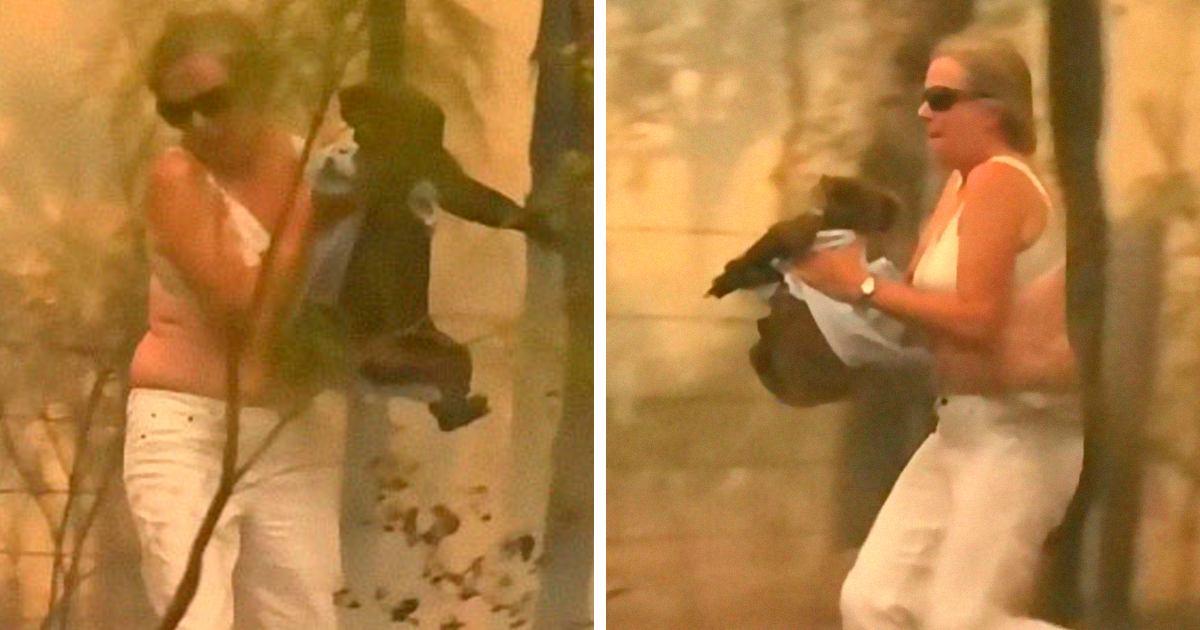
Some news stories flash across the internet, collect a few gasps, and vanish into the digital attic. This was not one of them. The story of a woman running into an Australian bushfire, pulling off her shirt, and using it to rescue a badly injured koala had the kind of emotional gravity that makes people stop mid-scroll and actually feel something. No celebrity stunt. No polished campaign. Just a human being, a terrified animal, and a split-second decision that turned into one of the most unforgettable wildlife rescue moments of the Black Summer fires.
The woman was Toni Doherty. The koala was later named Lewis. And the footage of that rescue hit people right in the rib cage because it captured something rare: compassion in motion. Not the inspirational-poster version with soft lighting and perfect timing, but the messy, urgent, real-world kind. The kind where someone acts first and processes later. The kind where heroism is less cape and soundtrack, more panic and instinct.
This article looks at why the moment mattered so much, what really happened, why koalas were especially vulnerable during Australia’s devastating bushfires, and what Lewis’s story still tells us about wildlife rescue, climate pressure, and the emotional power of one person doing the decent thing when it would have been easier to keep driving.
The Moment the World Couldn’t Ignore
In November 2019, as bushfires tore through parts of New South Wales, Toni Doherty spotted a koala in obvious distress near the flames. She jumped out of her car, rushed toward the animal, used the shirt off her own back to wrap him, and moved him to safety before getting him help. It was the sort of act that sounds almost too cinematic to be true, except it was recorded, reported, and seen around the world.
That video traveled fast because it compressed an enormous tragedy into one human-sized scene. The 2019-2020 Australian bushfire season was massive, chaotic, and heartbreaking. Statistics were everywhere. Acres burned. Habitats destroyed. Wildlife lost. But numbers, while important, do not always sink in. Lewis did. One injured koala, one visibly desperate rescuer, one emotional scene by the roadside suddenly gave millions of people a way to understand the wider disaster.
It is easier to comprehend a catastrophe when it has a face. In this case, it had two: a woman moving on pure adrenaline and a koala whose struggle made the scale of the crisis feel immediate rather than abstract. That is one reason the story became so widely shared. It made an ecological emergency feel heartbreakingly personal.
Who Were Toni Doherty and Lewis?
Toni Doherty was not trying to become famous. She was simply there, saw an animal in danger, and reacted. That detail matters. People are often moved most deeply not by professional rescuers doing their jobs, admirable as that is, but by ordinary people who show extraordinary courage without pausing to calculate whether the internet will applaud them later.
The koala she saved was later named Ellenborough Lewis, usually shortened to Lewis. Reports noted that the name came from one of Doherty’s grandchildren, which added another layer of tenderness to an already emotional story. Lewis was taken to the Port Macquarie Koala Hospital, a facility that became widely recognized during the bushfire crisis for treating injured koalas and drawing international support for rescue and rehabilitation.
For a brief moment, Lewis seemed to represent hope. The rescue was successful. He reached expert care. The world watched and waited. That sequence created a familiar emotional arc that people desperately wanted to end well. Unfortunately, real life does not always cooperate with our preferred script.
What Happened Next Was Sad, but Important
Lewis did not survive his injuries. After treatment and close attention from veterinary professionals, his condition worsened, and he was later put to sleep on animal welfare grounds. That outcome made the story more painful, but also more honest. This was never a fairy tale. It was a rescue during an environmental disaster, and those do not always come with tidy endings.
Still, Lewis’s death did not erase the meaning of the rescue. In some ways, it sharpened it. The point was never that compassion guarantees a perfect outcome. The point was that compassion still matters even when the ending is hard. Toni Doherty could not undo the fire. She could not restore the habitat. She could not promise survival. But she could refuse to leave a suffering animal alone in the flames. That choice still counts. Actually, it counts more than ever.
There is a lesson in that for wildlife rescue, for climate-era disasters, and for life in general: success is not always measured by a miracle. Sometimes it is measured by whether someone showed up at all.
Why Koalas Were So Vulnerable During the Bushfires
Koalas look like plush toys with opinions, but their biology gives them very few advantages in extreme fire conditions. They live in eucalyptus forests and depend on eucalyptus not only for food, but also for shelter. That means when eucalyptus woodlands burn, koalas are not just losing a place to hang out. They are losing the center of their entire existence.
Koalas also conserve energy because their diet is, to put it politely, not exactly premium rocket fuel. Eucalyptus leaves are low in nutrients, so koalas spend much of their time sleeping and moving slowly. That strategy works fine in a stable habitat. It works terribly in a fast-moving fire. When danger comes, koalas often climb higher into trees. Under ordinary threats, that can help. During severe bushfires, it can be a tragic mismatch between instinct and reality.
Fire does not only injure animals directly. It also strips away canopy cover, food sources, and the environmental stability animals need after the flames pass. Even survivors may face dehydration, starvation, predation, and disorientation in damaged landscapes. In other words, escaping the fire is only phase one. Living through the aftermath is phase two, and phase two can be brutal.
A Single Rescue Pointed to a Much Bigger Emergency
Lewis’s story stood out because it was visible, but countless animals were never filmed, never named, and never carried into international headlines. Researchers and wildlife groups later reported severe declines in koala populations across affected fire grounds, with some areas experiencing devastating losses. Government and conservation sources have also noted that koalas in Queensland, New South Wales, and the Australian Capital Territory were listed as endangered in 2022, reflecting the cumulative pressure of habitat loss, bushfires, drought, and other threats.
That broader context turns Toni Doherty’s rescue into more than a viral moment. It becomes a symbol of the gap between what individual courage can do and what large-scale policy failures leave undone. A shirt can save one koala from immediate danger. It cannot rebuild a forest. It cannot enforce habitat protection. It cannot solve climate pressure or land-clearing. Heroic moments are powerful, but they are not substitutes for systems that prevent disasters from becoming so devastating in the first place.
Why the Story Went So Viral
The internet is not always known for restraint, nuance, or emotional maturity. Sometimes it can barely handle a recipe comment section. But every now and then, a story breaks through the noise because it taps into something primal: protect the vulnerable. That is exactly what happened here.
The rescue had all the elements that make a story unforgettable. First, there was urgency. Doherty was not carefully planning a rescue operation with a clipboard and a branded vest. She saw danger and acted immediately. Second, there was sacrifice. The phrase “the shirt off her own back” is usually metaphorical. Here, it was literal. Third, there was innocence. Koalas are beloved animals, and Lewis was plainly helpless. Finally, there was contrast. Against the vast horror of bushfires, one act of tenderness felt like a flare of humanity in the smoke.
But the story did not go viral only because it was dramatic. It also went viral because people were desperate for one good, decent image in the middle of terrible news. During long disasters, audiences often develop a strange emotional hunger for proof that kindness still exists. Toni Doherty became that proof.
The Rescue Also Changed the Conversation
Stories like this can do more than generate tears and shares. They can redirect attention. Lewis’s rescue helped focus public interest on koala hospitals, wildlife rescue networks, habitat destruction, and the broader question of how animals survive climate-fueled emergencies. Donations to wildlife care organizations rose. More people learned the name of Port Macquarie Koala Hospital than probably ever expected to. Suddenly, wildlife rescue was not a niche concern for conservationists. It was dinner-table conversation.
That kind of awareness matters. Public empathy often opens the door to public support, and public support can help fund treatment, rehabilitation, habitat restoration, research, and political pressure. No single viral moment can fix a conservation crisis, but it can move the emotional needle. And when that needle moves enough, policy, philanthropy, and public behavior sometimes follow.
In that sense, Lewis became more than a rescued koala. He became a messenger. A painfully small, eucalyptus-scented messenger, yes, but a messenger all the same.
What This Story Reveals About Human Nature
There is something deeply revealing about the way people responded to this rescue. They did not merely admire courage. They identified with it. Many viewers imagined what they would do in the same situation. Some probably pictured themselves being equally brave. Others, more honestly, pictured themselves freezing in confusion and then needing five business days to emotionally recover. Either way, the story pushed people into moral reflection.
Toni Doherty’s action feels so moving because it bypassed cynicism. She did not ask whether the koala belonged to someone, whether the rescue was convenient, whether there were legal forms involved, or whether her outfit was suddenly less than ideal for public appearances. She saw suffering and responded. That kind of simplicity can feel almost radical in a world that loves delay, debate, and plausible excuses.
Her rescue reminds us that empathy is not just a feeling. It is behavior. Plenty of people say they care about animals. Fewer run toward danger when the moment demands action. That is why the story stuck. It did not merely show compassion. It showed compassion with legs.
Experiences Related to This Story: What the Black Summer Felt Like for Rescuers, Carers, and Witnesses
The emotional force of “Woman Saves A Scorched And Screaming Koala With The Shirt Off Her Own Back” becomes even clearer when you place it beside the real experiences reported by wildlife carers, volunteers, scientists, and local residents during and after the Black Summer fires. Many described landscapes so quiet they felt wrong, as if the normal soundtrack of birds, insects, and rustling movement had been erased. In burned areas, silence itself became part of the trauma.
Wildlife responders often faced a grim routine. They searched roadsides, forest edges, and half-burned gullies for survivors, knowing they would find only a fraction of the animals affected. Some found koalas that needed immediate treatment. Others found habitats that were still standing but barely functioning, with too little food, too little moisture, and too much heat. Rescue was not a single dramatic sprint every time. More often, it was hours of scanning, carrying, hydrating, cleaning, transporting, and waiting.
Veterinary and rehabilitation teams had their own version of the crisis. At wildlife hospitals, carers treated animals with burns, dehydration, smoke exposure, and exhaustion. They wrapped paws, monitored recovery, and made difficult welfare decisions when injuries were too severe. There is a particular emotional weight that comes with caring intensely for a wild animal that may never understand you are trying to help. The work is practical, clinical, and heartbreakingly tender all at once.
Scientists and field researchers described another kind of experience: returning to places they knew well and barely recognizing them. Forests that once held dense canopy cover looked stripped and raw. Some researchers reported going back into survey areas and finding far less life than before, not just fewer koalas but fewer signs of functioning ecosystems overall. For people who track wildlife over years, that kind of loss is not abstract. It feels personal, like returning to a neighborhood and discovering whole streets have vanished.
Volunteers supporting wildlife after the fires often did the less cinematic but absolutely essential work that keeps animals alive in recovery zones. They set out food and water, helped establish drinking stations, monitored movement, and supported habitat restoration projects. Some saw encouraging signs: regrowth from blackened trunks, animals cautiously returning, and koalas using recovering forest. Hope did exist, but it was the slow, stubborn kind, not the movie-ending kind.
Then there were the experiences of ordinary viewers around the world. For many people, the viral footage of Lewis was the first time they understood that bushfires do not only destroy trees and homes. They also trap living creatures inside an ecological disaster they cannot outrun. The rescue transformed distant headlines into something immediate and emotional. People donated, shared resources, followed updates from koala hospitals, and began paying closer attention to wildlife conservation in Australia. That response was not trivial. It showed how one visible act of compassion can turn spectators into participants.
Put all those experiences together, and Toni Doherty’s rescue stops looking like an isolated emotional moment. It becomes part of a larger human story about witnessing suffering, refusing indifference, and trying, however imperfectly, to help life continue after fire.
The Lasting Meaning of Lewis’s Story
Lewis did not survive, but his story endured because it captured multiple truths at once. It showed the vulnerability of koalas. It showed the scale of the bushfire crisis. It showed the importance of wildlife hospitals and carers. And it showed that ordinary individuals still have the power to matter in extraordinary situations.
There is also a hard but valuable truth here: emotional stories should not be dismissed just because they are emotional. Sometimes people roll their eyes at viral rescue stories as if caring deeply is somehow unserious. That is nonsense. Emotion is often the beginning of attention, and attention is often the beginning of action. The challenge is to turn the feeling into something lasting: better conservation policy, stronger habitat protection, more funding for rescue and rehabilitation, and a more serious public understanding of what climate-linked disasters do to wildlife.
That is the bigger legacy of this koala rescue story. It did not just make people cry. It made people care, and caring is where responsibility starts.
Conclusion
The headline “Woman Saves A Scorched And Screaming Koala With The Shirt Off Her Own Back” sounds dramatic because the event was dramatic. But what made it unforgettable was not just the danger. It was the humanity. Toni Doherty did not save the world that day. She did something both smaller and, in a way, more powerful: she saved a life from being abandoned in its worst moment. Even though Lewis’s story ended sadly, the rescue remains a reminder that compassion is never wasted.
In a time defined by environmental anxiety, habitat loss, and increasingly intense disasters, this koala rescue story still matters because it asks a simple question: when suffering is right in front of us, what do we do next? Toni Doherty answered without hesitation. The rest of us are still learning from it.